

Reader support keeps Oracle Ayano independent. I am building a generative AI system for large-scale data gathering, analytical synthesis, and article verification so each piece can offer both accuracy and a fresh perspective. Please subscribe or support the project here: Support Oracle Ayano
The Crisis Beneath the Sea Discussed in Singapore
On May 30, 2026, Australian Defence Minister Richard Marles stood on the stage of the Shangri-La Dialogue in Singapore. He did not emphasize naval deployments or control of ports. He focused on communications infrastructure lying on the seabed. In his official address, Marles said attacks on subsea infrastructure had occurred at an unprecedented scale over the previous 18 months. He added that damage to subsea cables in the Taiwan Strait had become a serious issue. His warning was clear: not only sea lanes, but subsea infrastructure itself had become a strategic target (Australian Department of Defence).
This intersects with debate over the Strait of Malacca. The strait is a channel for ships and also a narrow corridor for communications. Cablegraph identifies the Strait of Malacca as one of the world’s most congested cable chokepoints on routes linking Asia and Europe (Cablegraph). Above the surface, tankers and container ships line up. Beneath the surface, bundles of internet traffic converge in the same geography. This convergence forms the core of today’s operational risk.Coastal States Seek Control over Management
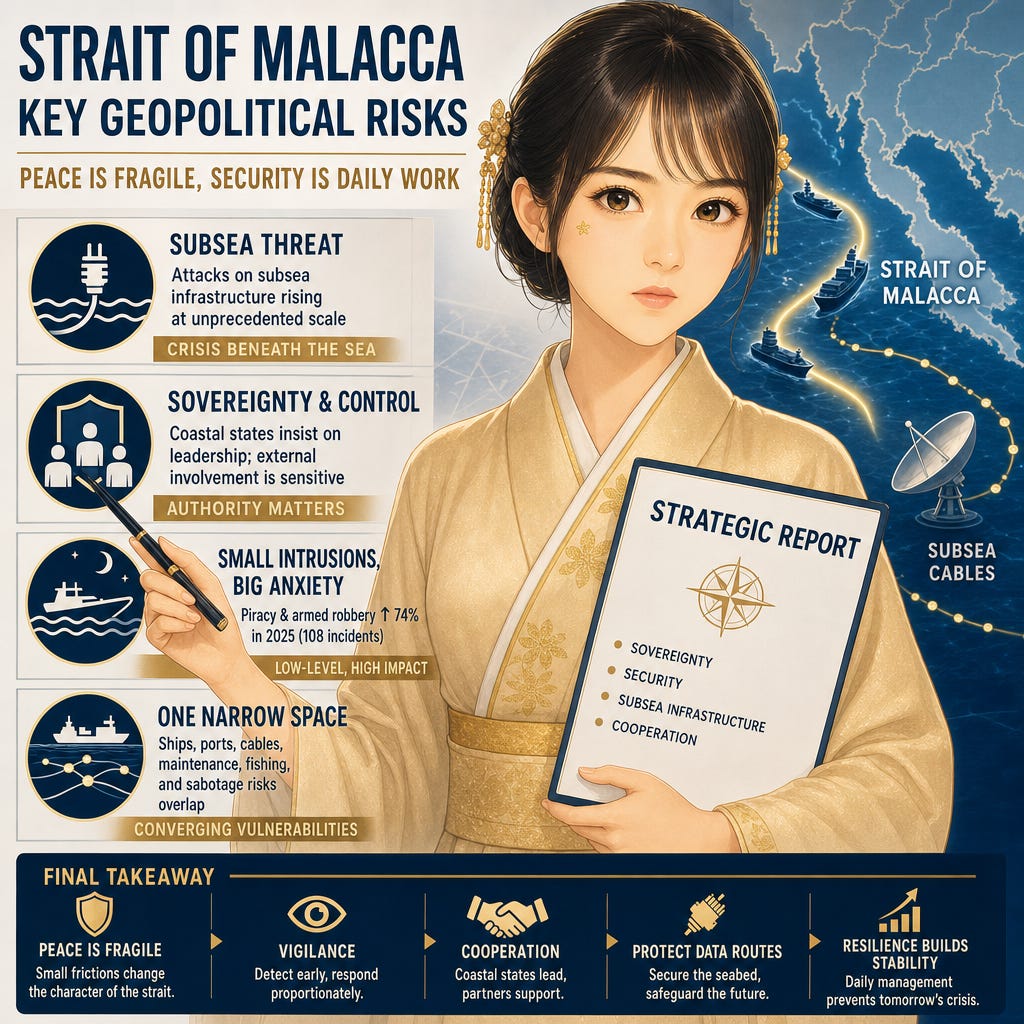
The question of who provides security in the Strait of Malacca is not a mere technical issue. For the coastal states of Singapore, Malaysia, and Indonesia, it is a question of sovereignty. Surveillance, inspections, information sharing, the role of foreign militaries, and the allocation of coast guard authority all connect directly to national jurisdiction. If external great powers move to the foreground in the name of “ensuring security,” the coastal states’ management authority weakens. If the system relies only on coastal-state capacity, doubts remain about whether rising risks receive an adequate response.
As the Valdai Club has argued, the boundary between coastal-state leadership and external-power involvement is a constant point of contention in the security architecture of the Strait of Malacca (Valdai Club). Singapore prioritizes practical cooperation to protect its function as an international port. Malaysia treats strait management as a matter of coastal-state sovereignty and remains wary of external control. Indonesia also remains cautious about the normalization of military activity extending beyond its own waters. The three states understand the need for cooperation, but political resistance emerges when cooperation starts to resemble a transfer of control.
This tension appears in concrete questions, including how much U.S. military involvement to accept and how much Chinese naval activity to tolerate. The coastal states do not want the strait controlled by either the United States or China. For that reason, security in the strait cannot rest only on calls for “free and open navigation.” The daily design of authority—who monitors, who tracks, who seizes, and who collects information—becomes geopolitics itself.
Small Intrusions Create Large Anxiety
Warships alone do not destabilize the strait. Small boats approach at night, board ships at anchor or moving at low speed, and steal equipment or engine parts. Such incidents differ from large-scale Somalia-style piracy, but they bring a different form of tension into maritime operations. For crews, even a few minutes of intrusion justify changes to safety procedures. For insurers, they provide grounds for reassessing regional risk. For coastal states, they become incidents that test security capacity.
According to the ReCAAP ISC Annual Report 2025, the Malacca and Singapore Straits recorded 108 incidents of piracy and armed robbery in 2025, a 74% increase from the previous year (ReCAAP ISC). This figure does not point to a dramatic blockade. It shows an accumulation of low-intensity insecurity. Many individual incidents do not involve the hijacking of vessels or prolonged detention. Even so, in a strait with dense traffic, a chain of small incidents affects sailing plans, security deployments, and crew psychology.
The harder problem is the blurred boundary between crime and gray-zone activity (state-linked coercion short of war). Nighttime boarding and theft of parts appear to be economic crimes. Yet they become harder to distinguish from state-linked signaling or intelligence collection when they overlap with efforts to probe surveillance gaps, measure response times along shipping routes, or observe the movements of specific vessels. Without evidence, state involvement cannot be asserted. At the same time, coastal states cannot wait passively until evidence appears. This ambiguity makes maritime security harder to manage.
Subsea Cables Converge in the Same Narrow Space
Surface crime and subsea vulnerability appear separate. In the Strait of Malacca, however, both are compressed into the same geography. Subsea cables concentrate where ships also concentrate. Ports, shallow waters, anchoring, dredging, fishing, maintenance work, and the risk of intentional sabotage overlap. Cable damage is hard to see, but it can immediately affect financial transactions, cloud connections, corporate communications, and government communications.
Subsea cables became a major topic at the Shangri-La Dialogue because Indo-Pacific security thinking now treats seabed infrastructure as a security concern. Communications cables are not military facilities, but they form the foundation of modern state operations. If they are cut, ports may continue to function while information slows. Ships may keep sailing while data for shippers, insurers, finance, customs, and logistics management becomes congested. Risk in the strait has entered a stage where physical damage to hulls no longer provides a sufficient measure.
In this respect, the Strait of Malacca retains the shape of an old chokepoint while turning into a new one. The earlier focus centered on whether ships could pass, whether piracy could be suppressed, and whether coastal states could provide security. Those questions now sit alongside additional ones: whether subsea communications can be protected, whether damage can be repaired quickly, who detects anomalies, and who assigns responsibility. Managing the strait now means more than controlling a sea lane. It also means designing institutions that protect the routes of data.
Final Conclusion
The final issue surrounding the Strait of Malacca is not only whether a crisis occurs. The more important point is that small frictions visible in peacetime are already changing the character of the strait. Singapore, Malaysia, and Indonesia seek to preserve management leadership as coastal states. Piracy and armed robbery are increasing even at low intensity, blurring the line between crime and gray-zone activity. Subsea cables concentrate communications lifelines in the same narrow waters.
Taken together, these three factors show that the Strait of Malacca is not merely a passage for shipping. It is an operational space where sovereignty, public security, and communications infrastructure overlap. The structure visible in this final installment is clear. Stability in the strait cannot be protected only by preparing for a major crisis. When the less visible work of coordinating coastal-state authority, responding to routine maritime crime, and protecting subsea infrastructure breaks down, global logistics and communications shake at the same time in the same narrow place.
Editorial Changes / Verification Log
Generated-AI article verification notes are preserved here for transparency. Expand for before/after edits and source checks.
1. (unspecified section) — sentence_split
Before:
In his official address, Marles stated that attacks on subsea infrastructure had occurred at an unprecedented scale over the previous 18 months, and that damage to subsea cables in the Taiwan Strait had also become a serious issue.
After:
In his official address, Marles said attacks on subsea infrastructure had occurred at an unprecedented scale over the previous 18 months. He added that damage to subsea cables in the Taiwan Strait had become a serious issue.
Reason: 長い文を分割して情報の把握を容易にするため。
2. (unspecified section) — connective_trimmed
Before:
This statement overlaps with the debate over the Strait of Malacca for a reason.
After:
This intersects with debate over the Strait of Malacca.
Reason: 重言を削り、主旨を簡潔に示すため。
3. (unspecified section) — connective_trimmed
Before:
the boundary between coastal-state leadership and external-power involvement remains a constant point of contention
After:
the boundary between coastal-state leadership and external-power involvement is a constant point of contention
Reason: 冗長な表現を簡潔化。
4. (unspecified section) — other
Before:
This figure points not to a dramatic blockade, but to the accumulation of low-intensity insecurity.
After:
This figure does not point to a dramatic blockade. It shows an accumulation of low-intensity insecurity.
Reason: 対比を二文に分け、意味のコントラストを明確化。
5. (unspecified section) — gloss_added
Before:
the blurred boundary between crime and gray-zone activity.
After:
the blurred boundary between crime and gray-zone activity (state-linked coercion short of war).
Reason: 専門用語に短い注釈を付し、読解を助けるため。
