

Reader support is what makes Oracle Ayano possible. I am pouring my heart into building a generative AI system for large-scale data gathering, analytical synthesis, and article verification, so each piece can offer both accuracy and a fresh perspective. Please consider supporting the project.
The 2003 Phrase Has ReturnedIn 2003, when Hu Jintao raised the term “Malacca Dilemma,” it referred to a policy problem: the vulnerability of maritime energy supply supporting China’s rapid growth. From Beijing’s perspective, the Strait of Malacca is not a distant waterway. It is a narrow passage that tankers from the Middle East must account for on the way to East Asia, and it functions as a maritime gate directly tied to the breathing rhythm of the Chinese economy.
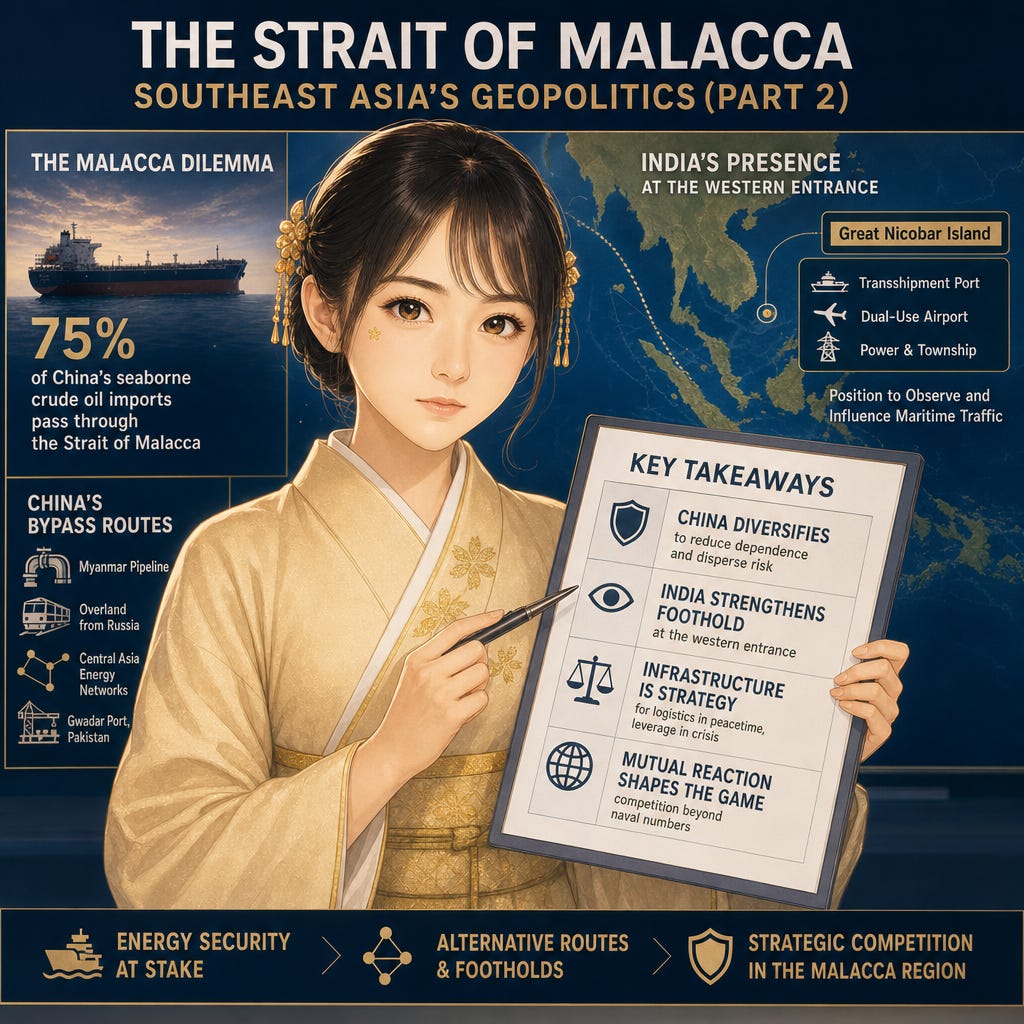
That phrase has regained weight. In 2025, Reuters reported, citing Vortexa data, that roughly 75% of China’s seaborne crude oil imports pass through the Strait of Malacca. The issue is not volume alone. If a Taiwan contingency, a South China Sea crisis, a U.S.-China confrontation, and the risk of an Indian naval blockade overlap, the structure itself exposes the Chinese economy to direct damage.
The “Malacca Dilemma” is not simply a story about a congested strait. It describes an asymmetry: the energy China requires travels long distances outside China’s military sphere of control. Beijing has expanded its influence on land, yet at sea it still depends on a narrow passage. This gap has shaped China’s strategic thinking.
China Has Increased Its Bypass Routes
China’s recent diversification measures answer this anxiety. Pipelines through Myanmar, overland transport from Russia, energy networks through Central Asia, Pakistan’s Gwadar Port, and the Belt and Road Initiative do not eliminate dependence on the Strait of Malacca. They disperse vulnerability. The concept known as the Malacca dilemma has expanded into a geoeconomic blueprint connecting ports, pipelines, railways, and overland corridors.
The Myanmar route draws energy from the Bay of Bengal side into China’s interior. Overland transport from Russia and energy networks through Central Asia provide northern and inland options that avoid the sea. Gwadar Port connects to the idea of a foothold on the Indian Ocean from Pakistan. None of these routes replaces the Strait of Malacca by itself, but each increases the routes China can choose in a crisis.
The key point is that China’s diversification has a defensive character while appearing to neighboring states as the expansion of a sphere of influence. For China, it is insurance for supply chains. For other countries, it is strategic penetration through ports and corridors. The same infrastructure produces economic rationality and security suspicion at the same time.
India Is Strengthening Its Presence at the Western Entrance
India reflects China’s anxiety from another angle. Viewed from the Indian Ocean side, the position of Great Nicobar Island becomes clear. The island lies near the western entrance of the Strait of Malacca and sits where east-west maritime traffic can be observed. From China’s perspective, a situation is emerging in which not only U.S. forces but also India has the latent capacity to interrupt maritime traffic.
The Great Nicobar Island development project has drawn attention. The Economic Times described the Rs 90,000-crore project as important for India in both military and economic terms. However, the officially confirmed components are an international container transshipment port, a greenfield international airport with dual-use characteristics, a 450 MVA power plant, and a township. A new naval base or surveillance facility cannot be asserted as an official element of the plan.
Even so, geography does not move. An international container transshipment port attracts cargo flows. A dual-use airport leaves room to straddle the boundary between civilian activity and security functions. Power supply and a township create the foundation for sustained activity. Even without being explicitly labeled as military facilities, thicker infrastructure on the island inevitably makes it easier for India to grasp east-west maritime traffic.
India’s strategic importance is rising sharply not because it controls the strait itself. It stands in the space before vessels enter the strait, observes shipping flows, and holds a position from which it can apply pressure if necessary. In great-power dynamics around the Strait of Malacca, the decisive question concerns not only the passage itself, but also who stands at its entrance.
China’s Diversification and India’s Approach Overlap
China extends corridors outward to reduce dependence on Malacca, while India consolidates a foothold on an island near Malacca’s western entrance. The two movements appear separate, but both respond to the same maritime geography. For China, the Strait of Malacca is an unavoidable vulnerability. For India, it is a point of contact where it can demonstrate influence as a major power.
In this configuration, infrastructure itself becomes strategy. Pipelines, ports, overland transport networks, international container transshipment ports, and dual-use airports serve logistics and growth in peacetime. In a crisis, they become options for bypassing, monitoring, pressuring, and interrupting flows. Competition over the Strait of Malacca is not decided only by the number of naval vessels. It is decided by which country holds alternative routes and footholds at which points.
The “Malacca Dilemma” that Hu Jintao identified in 2003 began as China’s own concern. Today, India’s rise has also expanded the other side’s options. The more China tries to dilute its dependence, the stronger surrounding states’ vigilance becomes. The more India strengthens its presence at the western entrance, the more China’s anxiety revives. Great-power politics around the Strait of Malacca consists of this mutual reaction.
Next time, the focus turns to the management authority of the coastal states Singapore, Malaysia, and Indonesia, piracy and gray-zone activity, and subsea cable vulnerabilities.
Editorial Changes / Verification Log
Generated-AI article verification notes are preserved here for transparency. Expand for before/after edits and source checks.
1. (unspecified section) — sentence_split
Before:
In 2003, when Hu Jintao raised the term “Malacca Dilemma,” it referred to a policy problem: the vulnerability of maritime energy supply supporting China’s rapid growth.
After:
In 2003, when Hu Jintao raised the term “Malacca Dilemma,” it referred to a policy problem. The issue was the vulnerability of maritime energy supply supporting China’s rapid growth.
Reason: Improve cadence and clarity at the outset without changing meaning.
2. (unspecified section) — connective_trimmed
Before:
The issue is not volume alone. If a Taiwan contingency, a South China Sea crisis, U.S.-China confrontation, and the risk of an Indian naval blockade overlap, the structure itself exposes the Chinese economy to direct damage.
After:
The issue is not volume alone. If a Taiwan contingency, a South China Sea crisis, a U.S.-China confrontation, and the risk of an Indian naval blockade overlap, the structure itself exposes the Chinese economy to direct damage.
Reason: Tighten phrasing and add the missing article for smoother readability.
3. (unspecified section) — fact_corrected
Before:
However, the officially confirmed components are an international container transshipment port, a greenfield international airport with dual-use characteristics, a 450 MVA power plant, and a township.
After:
However, the [officially confirmed components](https://www.pib.gov.in/PressNoteDetails.aspx?ModuleId=3&NoteId=158406&id=158406&lang=2®=3) are an international container transshipment port, a greenfield international airport with dual-use characteristics, a 450 MVA power plant, and a township.
Reason: Anchor the official source to align with the fact-check correction about what the plan formally includes.
4. (unspecified section) — other
Before:
Gwadar Port connects to the idea of securing a foothold on the Indian Ocean from the Pakistan side.
After:
Gwadar Port connects to the idea of a foothold on the Indian Ocean from Pakistan.
Reason: Minor wording simplification to improve flow.
