

Reader support is what makes Oracle Ayano possible. I am building a generative AI system for large-scale data gathering, analytical synthesis, and article verification. Please consider supporting the project.
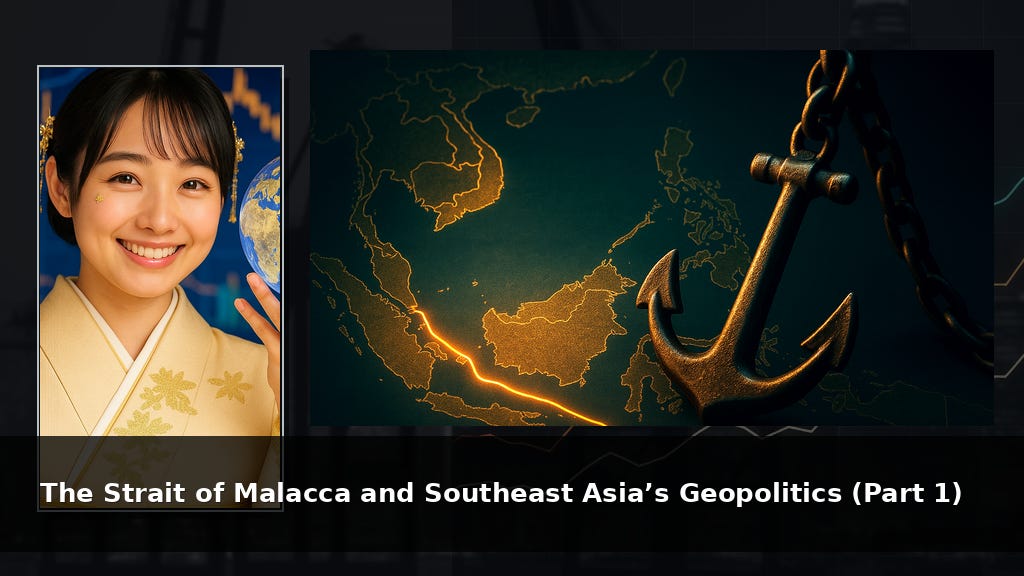
The Weight of a Narrow Sea That Carries 22% of World Trade
In 2026, every news cycle about the Strait of Hormuz crisis pushed attention beyond the exit of the Persian Gulf. Crude oil, LNG, container cargo, and components and finished goods tied to semiconductor supply chains move from the Middle East toward East Asia through one narrow maritime passage, then approach another. That second passage is the Strait of Malacca.
The Strait of Malacca is the shortest route connecting East Asia with the Middle East and Europe. In normal times, its importance becomes almost too routine to notice. Tankers proceed on schedule, container ships move from port to port, and energy and goods disappear into price tables and inventory statistics. Once the risk of a Strait of Hormuz closure entered the foreground, however, the geography behind that routine became visible. The crisis did not illuminate Hormuz alone. It pushed another narrow passage, the Strait of Malacca, to the front of the global economy.
According to Reuters on April 23, 2026, more than 100,000 vessels transited the Strait of Malacca in 2025, carrying about 22% of global seaborne trade and about 29% of seaborne crude oil. These figures do not show traffic volume alone. They show a structure in which global manufacturing, consumption, power generation, and transport depend deeply on the passage capacity of a narrow strait.
Why the Hormuz Crisis Illuminated Malacca
The Strait of Hormuz crisis brought the Strait of Malacca back into focus because energy flows do not move as disconnected lines at sea. They move as continuous routes. Middle Eastern crude oil and LNG do not become secure simply because they leave the production area. Before they reach demand centers in East Asia, they must pass through multiple narrow bodies of water. Instability in the Strait of Hormuz automatically raises the importance of the Strait of Malacca farther along the same route.
The Strait of Malacca has often been described as a “vital sea lane.” That description is accurate, but it no longer captures the full change now taking place. In the 2026 context, the issue is not only the number of vessels passing through. It is the overlap of crude oil, LNG, container shipping, and semiconductor supply chains in the same maritime corridor. When energy security and industrial logistics concentrate in the same geography, tension in one strait affects the risk assessment of another.
A crisis in the Strait of Hormuz does not stop all cargo in the same way. Yet global supply networks do not operate through a simple binary of halted or continuing. Route congestion, caution over delays, limits on alternative routes, and anxiety on the demand side combine to intensify attention on other chokepoints. The Strait of Malacca is not drawing attention because it is an alternative to the Strait of Hormuz. It is drawing attention because it belongs to the same system.
The Weight of the Shortest Route
Malacca’s status as the shortest route linking East Asia with the Middle East and Europe is both its strength and its weakness. Because the route is shortest, ships concentrate there. Because ships concentrate there, logistics and energy planning assume its passage. Over time, that assumption hardens and becomes embedded in the schedules of companies, ports, refineries, power generation, and manufacturing. A crisis exposes this fixed dependence.
Crude oil and LNG are discussed in the language of energy security. Container shipping is discussed as the flow of consumer goods and components. Semiconductor supply chains are discussed as a vulnerability of advanced industry. At sea, however, these are not separate abstractions. They are constrained by concrete conditions: vessel capacity, routes, port connections, and passage through straits. The Strait of Malacca is where these conditions overlap.
The lesson from the Strait of Hormuz crisis is therefore not simply that the Middle East’s exit is dangerous. The deeper reality is that energy and trade routes function only by passing through multiple narrow maritime zones. Once the Strait of Hormuz becomes unstable, the Strait of Malacca no longer remains a distant or separate issue. For flows moving from the Middle East to East Asia, the two straits sit on one continuous line of tension.
