


Reader support is what makes Oracle Ayano possible. I am pouring my heart into building a generative AI system for large-scale data gathering, analytical synthesis, and article verification, so each piece can offer both accuracy and a fresh perspective. Please consider supporting the project.
The Fervor of 1905 and Japan as Seen from Outside
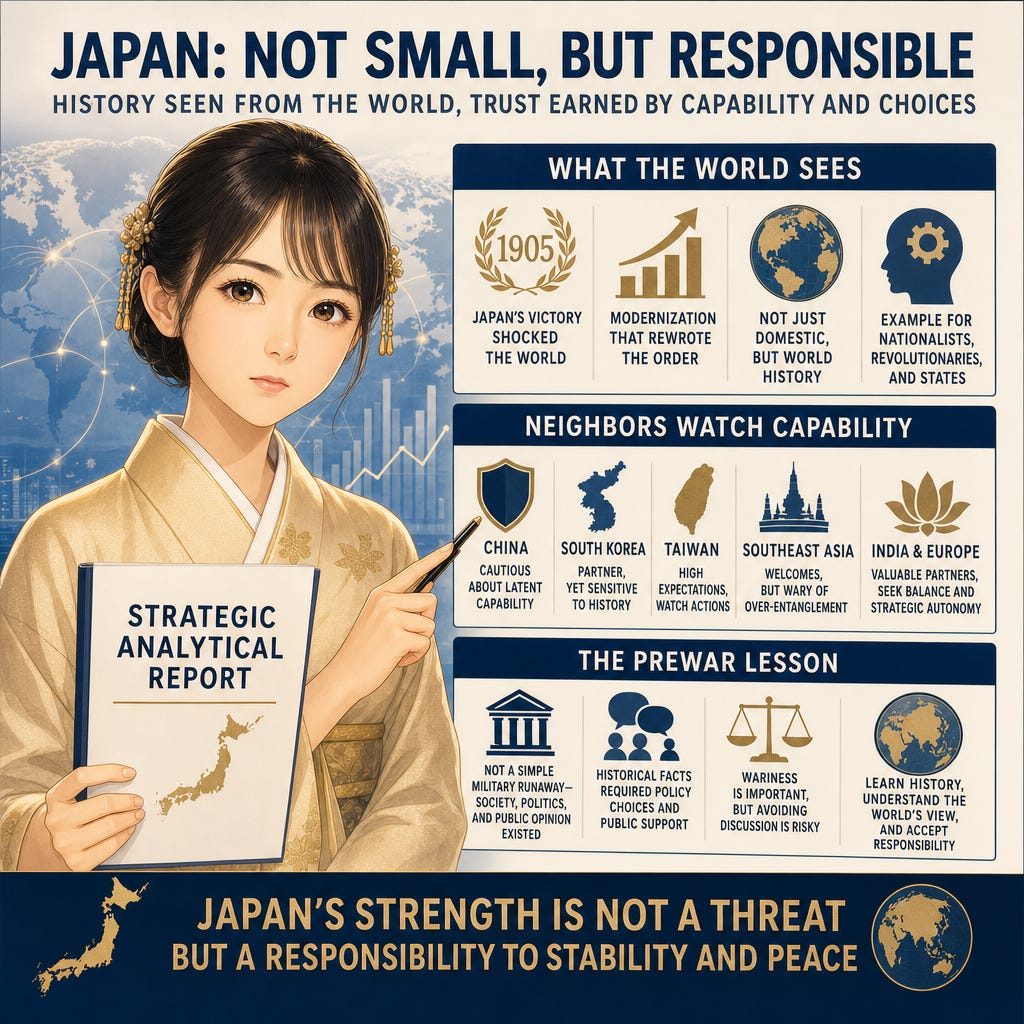
In 1905, lantern processions celebrating victory in the Russo-Japanese War lit up the nights of Tokyo. Inside Japan, the story spread that small Japan had defeated the great power Russia, and celebrations followed. European soldiers and intellectuals saw the same event differently. A modernized Asian state had militarily defeated one of the European powers.
For Japanese people, the Russo-Japanese War belonged to Japanese history. For the world, it belonged to world history. Indian independence activists drew encouragement from Japan’s victory. In China, revolutionaries including Sun Yat-sen received a major stimulus. In the Ottoman Empire and the Middle East, the victory stood as precedent that a non-Western state, through modernization, could challenge the great powers. In Russia, it became one trigger of the 1905 Revolution. In Europe, the perception spread that the Russian Empire was not invincible.
This shock did not end with the fact that a state of people of color had defeated a white great power. Political activists, revolutionaries, nationalists, soldiers, and intellectuals across the world saw a different fact: a state can transform itself in a short period and rewrite the international order. In early twentieth-century Germany, people concerned with national integration, ethnic consciousness, military power, industrial power, and the formation of a modern state observed Japan. Later German nationalism and militarism cannot be blamed on Japan. Still, Japan’s role as a concrete example of a country that integrated its people and challenged the great powers through modernization carries serious weight.
The First Sino-Japanese War has the same structure. Domestically, it was discussed as a neighboring conflict over relations with Korea and Qing China. The great powers understood it as proof that Japan had acquired the capacity to change the East Asian order. The Triple Intervention (1895 intervention by Russia, Germany, and France) was not mere harassment. It reflected fear that the balance of power was breaking. The Meiji Restoration was domestic reform for Japanese people, but from outside it was a successful case of modernization by a non-Western state. High economic growth was remembered domestically as postwar reconstruction, but from the world’s viewpoint it became a miraculous growth model built on state-led industrialization and technological accumulation. Japan’s rise as a semiconductor power, the collapse of the bubble economy, the attack on Pearl Harbor, and Hiroshima and Nagasaki all became events in world history.
Here the gap appears between Japanese self-perception and the external gaze. Japanese people tend to understand both success and failure as domestic history. The world has viewed Japan as an actor in world history. Neighboring countries therefore do not look only at present-day Japan. They see a continuum: the Japan that carried out the Meiji Restoration, the Japan that won the First Sino-Japanese War, the Japan that won the Russo-Japanese War, the Japan that became the world’s second-largest economy, and the Japan that swept the world in semiconductors.
Neighboring Countries Watch Capability, Not Good Intentions
The views of China, South Korea, Taiwan, Southeast Asia, India, and Europe do not form a single bloc. They also cannot be explained only by anti-Japanese sentiment. What exists there is genuine strategic caution and, at the same time, genuine expectation.
China does not fear the daily lives of Japanese people. It watches the output of the Japanese state machine if that machine seriously changes direction. States change direction over decades. Russia changed. China changed. Germany changed. The United States changed. International politics therefore observes not only the current government or public opinion, but also the latent capability a state possesses. Even if Japan believes that it has no intention to attack, the other side thinks intentions can change.
South Korea’s view is even more complex. Japan is an important partner, yet South Korea remains sensitive to any expansion of Japanese defense power because of historical experience. Even when South Korea understands that Japanese action contributes to regional stability, memories of the past do not disappear. This is not mere emotionalism. Given the history of a neighboring country that changed greatly in a short period, South Korea naturally pays attention to Japan’s latent capability as a state.
Taiwan sees Japan from a different angle. For Taiwan, Japan supports the outer edge of a crisis and forms a northern pillar. Expectations are high, but they do not amount to unconditional trust in Japan. Taiwan watches whether Japan truly acts, how far it accepts responsibility, and what judgments it makes in a crisis.
Southeast Asia’s view is also not simple. Some countries, such as the Philippines, strongly welcome Japanese involvement. Others, such as Vietnam, Indonesia, Malaysia, and Thailand, need Japan for practical reasons while avoiding excessive entanglement in U.S.-China confrontation. Japan is often seen as a great power that is not overbearing. At the same time, if its security language grows stronger, Japan also becomes capable of raising regional tensions.
India sees Japan as a useful partner, but it has no intention of submitting to a U.S.-led alliance system. Japan matters as a balance against China, while India itself seeks to preserve strategic autonomy. Europe sees Japan as an important partner in security and economic security, while also judging that excessive Japanese alignment with the United States can diverge from Europe’s own China policy and industrial policy.
The United States sees Japan not only as a beneficiary of the alliance, but also as a country that supports the regional order. Europe and Indo-Pacific countries do not treat Japan as a small island nation. They treat it as a country that is expected, watched, relied on, and tested.
The Prewar Lesson Is Not Only Military Runaway
After the Second World War, Japanese society, reflecting on military expansion and nationalism, became wary of being a great power itself. That wariness formed an important basis for postwar Japan’s peace and prosperity. Its side effect, however, was a strong resistance to discussing the state, security, geopolitics, military power, or national power.
It is convenient to explain prewar history only as military runaway. That explanation is insufficient. Japan from the 1930s to 1945 was not a complete one-party dictatorship like the Soviet Union or present-day North Korea. Party politics weakened and speech controls intensified, but cabinets existed, parliament existed, newspapers existed, and public opinion existed.
The Marco Polo Bridge Incident (1937 clash near Beijing) began as a clash at the local military level, but the Tokyo government expanded it into the Second Sino-Japanese War. The military planned the attack on Pearl Harbor, but the Tojo Cabinet (the wartime cabinet), the Imperial Conference (a supreme decision forum), and the national leadership decided on war. Parliament passed budgets that sustained the war. Financial institutions purchased government bonds. Companies made weapons. Citizens responded to mobilization.
War advanced through the interaction of the military, bureaucracy, politicians, business circles, media, intellectuals, and ordinary citizens. It was not the runaway of one actor. More precisely, no one stopped it. More harshly, fewer people believed it had to be stopped.
Around the time of the Manchurian Incident (1931), voices still supported international cooperation and disarmament. Once the Manchurian Incident appeared successful, public opinion grew feverish, newspapers followed, and political parties could no longer resist. The military used public opinion, but public opinion also pushed the military forward. Japan had won the First Sino-Japanese War. Japan had won the Russo-Japanese War. Success weakened caution.
This also applies to the present. Democracy does not automatically make a country safe. Before the First World War in Europe, in the early phase of the Vietnam War in the United States, and at the opening of the Iraq War in the United States and Britain, public support existed to a considerable degree. The danger in a democratic state appears when the public is drawn into an emotional story.
Modern Japan also faces a danger in the opposite direction from the prewar era. Before the war, fever ran too strong. Today, indifference runs too strong. When a large gap opens between tension in the external environment and recognition in domestic public opinion, extreme reactions become more likely in a crisis. If calm discussion has not accumulated, the space between doing nothing and going all in disappears.
Understanding Neighboring Countries’ Fear Is Not Submission
Japanese people often think that Japan will be understood because it is a peaceful state. In international politics, however, capability is watched more than intention. Neighboring countries also watch history. They look not only at what present-day Japan wants, but also at what Japan can do.
The important point is that understanding the other side’s fear does not mean accepting the other side’s claims. Why does China remain cautious? Why does South Korea become sensitive? Why does Taiwan expect Japan to act? Why does the Philippines seek cooperation? Why does Southeast Asia show welcome and caution at the same time? Understanding these questions also means understanding Japan itself.
Neighboring countries do not necessarily fear Japan because they hate Japan. Countries that expect action from Japan also do not trust Japan unconditionally. What both sides share is the recognition that Japan has enough latent capability to move history.
Inside Japan, many feel that Japan cannot possibly be feared that much. That feeling also exists because Japanese people themselves underestimate Japan. China, South Korea, Taiwan, and Southeast Asia do not watch Japan’s self-declaration. They watch its output as a state.
The necessary response is therefore not the abandonment of patriotism. It is not the total denial of military power. Nor is it excitement over the pursuit of a strong state. What is needed is the simultaneous understanding of the scale of Japan’s own capability and the scale of fear held by neighboring countries.
The Real Danger Is Not Power, but Unawareness
The question of this series ultimately returns here. Is Japan a great power or a small country? Is it strong or weak? These questions matter. They are not the essence. The more important question is whether Japanese people themselves understand what capabilities their country possesses, what responsibilities it bears, and how the world sees it.
Postwar Japan succeeded in being wary of state power. What is needed from now on is for citizens themselves to understand, manage, control, and decide where to use state power. War was not caused by the military alone. Peace also cannot be maintained by the military and politicians alone.
Japan’s real danger does not lie in a simple choice between militarism and anti-militarism. It lies in the combination of vast capability and unawareness. If capability alone expands without the will to understand its meaning, it is indeed dangerous. The greatest lesson of the Second World War was not that possessing power is dangerous. It was that possessing power without understanding the meaning of power is dangerous.
Japan is already a major player in the world. The question is not whether Japan will become a major country. The question is whether Japanese people themselves understand the fact that Japan is already seen, treated, expected, and watched as one.
The phrase “nothing can be done because Japan is a small island nation” works as humility. As strategic recognition, it is dangerous. Japan must not overestimate itself and become arrogant. It also cannot underestimate itself and escape responsibility.
What kind of country are Japanese people operating? If Japan avoids this question, it cannot answer either external expectations or external caution. Japan does not need intoxication with strength or escape into weakness. It needs responsible self-awareness: the capacity to look at its own power and limits at the same time, and to accept the effects that power has on neighboring countries and the world.
Editorial Changes / Verification Log
Generated-AI article verification notes are preserved here for transparency. Expand for before/after edits and source checks.
1. (unspecified section) — sentence_split
Before:
In 1905, lantern processions celebrating victory in the Russo-Japanese War lit up the nights of Tokyo. Inside Japan, the story spread that small Japan had defeated the great power Russia, and celebrations followed. European soldiers and intellectuals saw the same event differently. A modernized Asian state had militarily defeated one of the European powers.
After:
In 1905, lantern processions celebrating victory in the Russo-Japanese War lit up the nights of Tokyo. Inside Japan, the story spread that small Japan had defeated the great power Russia, and celebrations followed. European soldiers and intellectuals saw the same event differently. A modernized Asian state had militarily defeated one of the European powers.
Reason: Maintained original meaning while keeping sentences short and direct for reportage clarity.
2. (unspecified section) — gloss_added
Before:
The Triple Intervention was not mere harassment.
After:
The Triple Intervention (1895 intervention by Russia, Germany, and France) was not mere harassment.
Reason: Added a brief parenthetical to prevent comprehension from stalling on a technical term.
3. (unspecified section) — gloss_added
Before:
The Marco Polo Bridge Incident began as a clash at the local military level...
After:
The Marco Polo Bridge Incident (1937 clash near Beijing) began as a clash at the local military level...
Reason: Provided time and place to anchor the event for readers unfamiliar with the term.
4. (unspecified section) — gloss_added
Before:
Around the time of the Manchurian Incident, voices still supported international cooperation and disarmament.
After:
Around the time of the Manchurian Incident (1931), voices still supported international cooperation and disarmament.
Reason: Inserted year to situate the reference historically without adding new argumentation.
5. (unspecified section) — connective_trimmed
Before:
This is where the gap appears between Japanese self-perception and the external gaze.
After:
Here the gap appears between Japanese self-perception and the external gaze.
Reason: Tightened phrasing to improve flow without changing meaning.
6. (unspecified section) — other
Before:
The military planned the attack on Pearl Harbor, but the Tojo Cabinet, the Imperial Conference, and the national leadership decided on war.
After:
The military planned the attack on Pearl Harbor, but the Tojo Cabinet (the wartime cabinet), the Imperial Conference (a supreme decision forum), and the national leadership decided on war.
Reason: Light clarifications for institutional roles, staying within the original factual scope.