


Reader support is what makes Oracle Ayano possible. I am pouring my heart into building a generative AI system for large-scale data gathering, analytical synthesis, and article verification, so each piece can offer both accuracy and a fresh perspective. Please consider supporting the project.
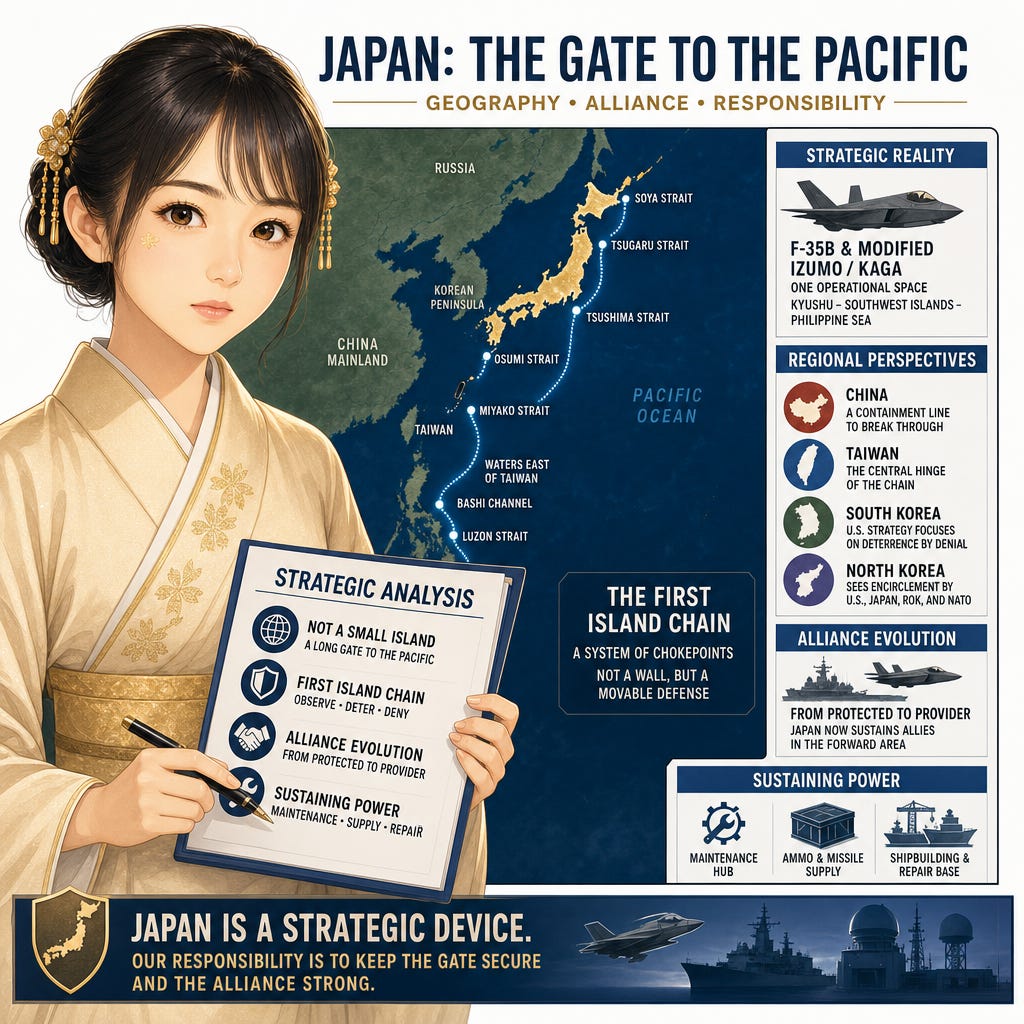
In 2025, the first three F-35Bs appeared at Nyutabaru Air Base. What stood beyond the runway was not merely the deployment of a new fighter. Short takeoff and vertical landing aircraft, linked to the modified Izumo and Kaga, began to present Kyushu, the Southwest Islands, and the Philippine Sea as one operational space. AP News framed the deployment as a reinforcement of southern defense, while Xinhua read it through the lens of de facto carrier operations. Their interpretations point in different directions, but they look at the same map. The Japanese archipelago is a long gate placed at the entrance to the Pacific.
The Japanese Archipelago as the Gate to the Pacific
The seas leading from the Chinese mainland, the Korean Peninsula, and the Russian Far East into the Western Pacific look broad on a map. In operational terms, however, that breadth contracts into straits: Soya, Tsugaru, Tsushima, Osumi, Miyako, the waters east of Taiwan, Bashi, and Luzon. Forces moving from the continental side into the Pacific must pass through these gates between Japan, Taiwan, and the Philippines.
This chain forms the First Island Chain. A National Institute for Defense Studies paper, published through Japan’s Ministry of Defense network information system, discusses China’s long-term naval development and defines the First Island Chain from Japan through Taiwan to the Philippines, as well as the Second Island Chain beyond it. The concept shown by the Ministry of Defense presents Japan not as a mere island country, but as a geographical device that channels naval activity from the eastern edge of the continent into the open ocean.
Chinese discussions describe the First Island Chain not as natural geography, but as a containment line formed by the United States, Japan, Taiwan, and the Philippines. Articles connected to People’s Daily Online treat U.S. island-chain tactics as pressure on China, while another People’s Daily Online account presents Chinese submarines crossing the First Island Chain in the 1970s as a symbol of the People’s Liberation Army Navy’s turn toward blue-water operations. The common premise is clear: the First Island Chain is a wall to break through.
Taiwan reads this line with greater urgency. Taiwan’s Ministry of Foreign Affairs criticized the mass deployment of Chinese military and coast guard vessels around the First Island Chain linking Japan, Taiwan, and the Philippines as an action damaging regional peace and stability, according to Taiwan Today. This reaction shows that Taiwan sees itself as the central hinge of the chain. If Taiwan holds, China’s naval exits into the Pacific face constraints. If Taiwan becomes a Chinese foothold, pressure increases on Japan’s Southwest Islands, the northern Philippines, and Guam.
South Korea’s view is more complex. Yonhap News described the “First Island Chain” as the connected line of islands from the Japanese archipelago through Okinawa, Taiwan, and the Philippines, and reported that U.S. Indo-Pacific strategy concentrates on deterrence by denial along that line. South Korea is not the central actor on the First Island Chain, but the U.S.-ROK alliance, Japan-U.S.-ROK cooperation, and responses to North Korea prevent it from standing outside this structure.
North Korea emphasizes encirclement through the United States, Japan, South Korea, and NATO rather than the technical term “First Island Chain.” Commentary carried by KCNA Watch denounced Japan and South Korea’s deepening ties with NATO as a crisis for the Asia-Pacific, and Reuters reported North Korea’s criticism of the United States and NATO as grave threats to world peace. The language contains propaganda, but the recognition is consistent: North Korea sees the Japanese archipelago as a forward base for U.S. forces, missile defense, and Japan-U.S.-ROK exercises.
The First Island Chain does not physically stop peacetime navigation. Chinese naval vessels pass through the Miyako and Bashi Straits, and Chinese aircraft carriers operate in the Western Pacific. Taiwan’s defense authorities criticized Chinese carrier activity in the Pacific in June 2025 as evidence of expansionist intent, according to Reuters. The issue is not whether Chinese forces can go out. The issue is whether each sortie is observed, tracked, and, in wartime, exposed to attack. The Japanese archipelago is not a wall. It is a movable set of chokepoints combining surveillance and denial.
From an Alliance That Protects Japan to an Alliance Japan Sustains
When the U.S.-Japan alliance sits on this geography, Japan’s meaning changes further. The alliance was once described as a system in which the United States protected Japan and Japan provided bases. Today Japan is becoming a forward maintenance hub for U.S. equipment, a supplementary node for ammunition and missile supply, and a shipbuilding and repair base that supports the operational availability of the Seventh Fleet.
The F-35 makes this visible. Japan plans to acquire 105 F-35As and 42 F-35Bs, for a total of 147 aircraft. When the U.S. State Department approved the additional sale in 2020, USNI News reported that Japan would become one of the largest F-35 operators outside the United States. The package was valued at about $23 billion. The location of maintenance matters as much as the number of aircraft.
Mitsubishi Heavy Industries’ Komaki South Plant hosts an F-35 Final Assembly and Check Out facility, or FACO. F-35 Lightning II and Lockheed Martin describe Nagoya as one of three FACO facilities in the F-35 program and as the site for final assembly and inspection of F-35As for Japan. Japan is not only a buyer. It is an industrial node inside the alliance that performs assembly and inspection.
In 2014, the U.S. Department of Defense selected the Nagoya FACO as the North Asia-Pacific hub for F-35 heavy maintenance, repair, overhaul, and upgrade work, or MROU. Reuters Japan reported that South Korea reacted negatively to the prospect of sending its own F-35s to Japan for heavy maintenance. That resistance reflected historical sentiment and the sensitivity of operational and maintenance data. Even with South Korean hesitation, U.S. weapons architecture embeds Japan as the maintenance node for North Asia.
The F-35 network continues to expand. Lockheed Martin announced that the aircraft had been adopted by the United States and 19 allied and partner countries and that 191 aircraft were delivered in 2025, a record. As Asia-Pacific operators increase, Japan’s MRO role gains weight. South Korea operates 40 F-35As, Australia has 72 F-35As, and Singapore is moving forward with F-35B and F-35A acquisitions. The South China Morning Post read this trend as an expansion of U.S.-allied sensor, communications, and strike networks across the region.
Missiles show the same transition from recipient to supplier. Japan has produced PAC-3 interceptors under license domestically. The 2023 revision of defense equipment transfer rules made it possible to export Japan-produced PAC-3 missiles to the United States. Reuters reported that Japan prepared to send Patriot interceptors to the United States, and the U.S. Department of Defense welcomed the decision as a contribution to U.S. inventories and Indo-Pacific stability.
Russia also noticed this shift. Reuters reported that Russia warned of “serious consequences” if Japan-made Patriot missiles reached Ukraine through the United States. Japan’s equipment transfers no longer sit only inside domestic institutional debate. They affect inventory management in a European war.
The 2024 Japan-U.S. Security Consultative Committee, or 2+2, stated that both sides would pursue opportunities for co-production of AMRAAM and PAC-3 MSE, expand production capacity, and strengthen supply-chain resilience. DICAS, the Japan-U.S. Defense Industrial Cooperation, Acquisition and Sustainment Forum, covers missile co-production, supply-chain resilience, and ship and aircraft repair. After the Ministry of Foreign Affairs document, Mitsubishi Electric announced in 2026 that it was examining participation in AMRAAM co-production. Japan’s electronics, guidance, and assembly industries are moving toward connection with the U.S. ammunition supply network.
This supply network is not all-powerful. Reuters reported that U.S. efforts to increase PAC-3 production at Japanese plants faced a bottleneck caused by shortages of Boeing-made seeker components. The report stated that Mitsubishi Heavy Industries produces around 30 PAC-3 missiles per year and may increase output to around 60, but seeker shortages constrain expansion. Japan’s industrial capacity matters, and that very importance binds it to U.S. components, ITAR, licensing, and export controls.
In naval repair, Japan’s geography and shipbuilding base connect directly to U.S. Navy readiness. The U.S. Navy maintains the Seventh Fleet through the U.S. Naval Ship Repair Facility and Japan Regional Maintenance Center, or SRF-JRMC, across Yokosuka, Sasebo, and Singapore. NAVSEA states that this system sustains Seventh Fleet readiness. Reuters reported in 2024 that the United States was pursuing regular maintenance and overhaul of U.S. Navy warships in Japanese shipyards to keep ships in Asian waters.
Sumitomo Heavy Industries Marine & Engineering holds a Master Ship Repair Agreement with the U.S. Navy and describes its work on Seventh Fleet vessels, including ships associated with nuclear-powered aircraft carriers. The Sumitomo Heavy Industries Marine & Engineering case shows that repairing U.S. vessels in Japan rather than sending them back to the continental United States increases U.S. staying power in a Taiwan contingency, the South China Sea, and a Korean Peninsula crisis. Japan is not only an ally under protection. It is an industrial state that sustains U.S. combat endurance on the Pacific side.
The Fine Net Built by OSA and Coast Guard Cooperation
Japan’s security influence cannot be measured only by F-35s and PAC-3s. Across Southeast Asia and the Pacific Islands, Japan is building a thinner, longer net made of patrol vessels, coastal surveillance radars, high-speed security boats, rescue equipment, training, and port facilities.
The Free and Open Indo-Pacific, or FOIP, initially centered on the rule of law, freedom of navigation, and connectivity. The Ministry of Foreign Affairs presents the 2026 Updated FOIP and records the Prime Minister’s speech in Hanoi, Vietnam. The Ministry of Defense describes it as a whole-of-government effort rather than a diplomatic slogan.
The turning point came in 2023 with Official Security Assistance, or OSA. The Ministry of Foreign Affairs defines OSA as a framework for providing equipment, materials, and infrastructure to the militaries and other security institutions of like-minded countries in order to strengthen their security capabilities and deterrence. It is separate from ODA. The definition matters because Japan stepped beyond the vocabulary of development cooperation and entered the language of deterrence.
The 2025 Diplomatic Bluebook states that Japan provides continuing support to the Philippines, Malaysia, Vietnam, Indonesia, and others to improve maritime law-enforcement capacity. According to the Ministry of Foreign Affairs, 2023 OSA decisions included coastal surveillance radars for the Philippines, patrol boats for Bangladesh, surveillance and rescue equipment for Malaysia, and patrol-boat-related equipment for Fiji. The OSA list as of May 2026 includes high-speed security boats for Indonesia worth 1.9 billion yen, disaster-response and maritime search-and-rescue equipment for Thailand, and RHIB boathouses and slipways for the Philippines. The Ministry of Foreign Affairs list shows that support has moved beyond training into coastal surveillance, boats, base facilities, and operational infrastructure.
Japan’s pattern places coast guard cooperation before military cooperation. The Japan Coast Guard established the Mobile Cooperation Team, or MCT, in 2017 and has provided capacity-building support to maritime law-enforcement agencies in Southeast Asia and beyond. As Nippon.com argues, this raises partner countries’ coast guard capacity against gray-zone activity by the China Coast Guard, maritime militia, survey ships, and fishing vessels. The Ministry of Foreign Affairs also states that Japan played a leading role in establishing ReCAAP, the Regional Cooperation Agreement on Combating Piracy and Armed Robbery against Ships in Asia, and contributes to capacity-building for coastal states.
The Philippines is the most advanced partner. An FULCRUM analysis notes that the Philippine Coast Guard acquired ten 44-meter multi-role response vessels, the Parola class, under the first phase of Japan’s maritime safety capability improvement project in 2013, with deployment from 2016 to 2018. Research materials summarized by JST-UD add that Japan has supported ten small patrol vessels, two large patrol vessels, and radar-based maritime surveillance systems for the Philippines. This accumulation supports the Philippine front line facing Chinese vessels in the South China Sea.
In 2024, Japan and the Philippines signed a Reciprocal Access Agreement, or RAA, making mutual visits and joint training by forces easier. The 2025 Diplomatic Bluebook records the transfer of air surveillance radars to the Philippines, OSA support, and progress in Japan-U.S.-Philippines cooperation, according to the Ministry of Foreign Affairs. At the Japan-Philippines summit in May 2026, both leaders confirmed continued OSA cooperation and the early convening of the next Japan-Philippines 2+2, as recorded by the Ministry of Foreign Affairs.
This cooperation connects to the Japan-U.S.-Philippines framework. In June 2026, Nippon.com reported that Japan, the United States, and the Philippines agreed to strengthen maritime security cooperation. China treats this with strong suspicion. Xinhua criticized Japan in May 2026 for accelerating coordination with the Philippines and for turning Japan-Philippines relations into a quasi-alliance. Its framing treats Japan’s OSA, defense equipment, and expanded Self-Defense Forces activity through the Philippines as one anti-China net.
Japan-Philippines cooperation does not stop in the South China Sea. In May 2026, Japan and the Philippines agreed to begin negotiations on delimiting maritime boundaries for their exclusive economic zones and continental shelves. China objected because the waters east of Taiwan were implicated, and the China Coast Guard conducted patrols east of Taiwan, according to Reuters and ABC中文. This movement shows that Japan-Philippines relations now connect to the waters east of Taiwan, the Bashi Strait, and the Luzon Strait. Reuters also reported a June 7, 2026 incident in which Taiwan expelled Chinese vessels.
Cooperation with Indonesia proceeds in a more cautious form. In May 2026, Japan and Indonesia signed a defense cooperation agreement covering defense industry, human-resource development, disaster response, and other strategic cooperation, as recorded by Reuters and the Ministry of Defense. Indonesia does not openly join an anti-China encirclement line. Japan therefore foregrounds disaster response, defense industry, personnel exchange, and maritime security, raising Indonesia’s capacity as a maritime state without naming China.
Japan’s approach extends across the region without creating formal military alliances. Naval News reported in 2020 that Japan planned to build six patrol vessels for the Vietnam Coast Guard, with the final delivery scheduled for 2025. Malaysia received OSA support for surveillance and rescue equipment in 2023, and Fiji received patrol-boat-related equipment, according to the Ministry of Foreign Affairs. This spread shows Japan’s method: distribute maritime security capacity without rapidly expanding military alliances.
Chinese commentary reads this support not as maritime law-enforcement capacity-building, but as encirclement and military normalization. A paper connected to the Chinese Academy of Social Sciences argued that Japan’s 2026 FOIP sought to build “small circles” centered on Southeast Asia in order to restrain China’s regional influence. China Internet Information Center also warned that Japan was weaving a network of arms sales and maritime law-enforcement capacity, especially toward the Philippines, centered on maritime domain awareness. The reading contains exaggeration, but it accurately sees Japan’s patrol vessels, radars, OSA, and Coast Guard training as one strategic disposition.
South Korea sees the same waters from another angle. In January 2026, the Japanese and South Korean defense ministers met in Yokosuka and agreed to upgrade cooperation in AI, unmanned weapons, joint maritime search-and-rescue exercises, and defense cooperation, according to Reuters. Japan’s expanded maritime security role carries historical caution for South Korea, but the growing coordination among North Korea, China, and Russia makes practical Japan-U.S.-ROK cooperation harder to avoid.
The Philippines receives Japanese support in practical terms. The Philippine News Agency reported in June 2025 that trilateral maritime exercises among the coast guard agencies of Japan, the United States, and the Philippines strengthened alliance and cooperation. AP News reported that the Philippines opened a coast guard base on Thitu Island in the South China Sea as a command site for maritime patrols, law enforcement, environmental protection, and search and rescue. In that field setting, Japanese patrol vessels, radars, and training are not abstract principles. They are the capacity to sail, watch, and respond every day.
An Unobtrusive Pivot Changes the Order
These three scenes show the same structure from different angles. Along the First Island Chain, the Japanese archipelago segments the gates through which continental power moves into the Pacific. In the U.S.-Japan alliance, Japan becomes an industrial, maintenance, and supply node that sustains U.S. forward deployment through F-35s, PAC-3, AMRAAM, and U.S. Navy ship repair. Through OSA and Coast Guard cooperation, Japan raises the coastal surveillance, law-enforcement, rescue, and patrol capacity of Southeast Asian and Pacific Island states.
This is not flamboyant hegemony. Japan does not dominate the sea alone with carrier strike groups, and it is not rapidly expanding formal alliances across Southeast Asia. Yet a state that monitors straits, maintains U.S. equipment, supplements missiles, repairs warships, transfers patrol vessels, installs radars, and trains coast guard officers changes the conditions under which other states act. China’s gray-zone activity becomes easier to observe. The Philippines, Vietnam, and Indonesia can remain at sea a little longer. The U.S. Navy can remain in the Western Pacific a little longer.
The image of Japan as only a small island country protected by the United States misses this security architecture. Japan is the entrance to the Pacific, the forward industrial base of the U.S. alliance, and a practical state that distributes maritime law-enforcement capacity across the Indo-Pacific. The question is not an abstract debate over how strong Japan is. The fact is that Japan’s location, and the fine net of maintenance, supply, and coast guard capacity that Japan sustains, already change the operational plans and daily behavior of surrounding states.
The next installment examines how neighboring countries view Japan through historical memory, expectation, and caution.
Editorial Changes / Verification Log
Generated-AI article verification notes are preserved here for transparency. Expand for before/after edits and source checks.
1. (unspecified section) — sentence_split
Before:
Short takeoff and vertical landing aircraft, linked to the modified Izumo and Kaga, began to present Kyushu, the Southwest Islands, and the Philippine Sea as one operational space.
After:
Short takeoff and vertical landing aircraft, linked to the modified Izumo and Kaga, began to present Kyushu, the Southwest Islands, and the Philippine Sea as one operational space.
Reason: Kept meaning but tightened preceding context and pacing by clarifying the scene; no content dropped.
2. (unspecified section) — connective_trimmed
Before:
Their interpretations point in different directions, but they look at the same map.
After:
Their interpretations point in different directions, but they look at the same map.
Reason: Left sentence intact; trimmed adjacent connective language elsewhere to keep flow concise.
3. (unspecified section) — sentence_split
Before:
The 2024 Japan-U.S. Security Consultative Committee, or 2+2, stated that both sides would pursue opportunities for co-production of AMRAAM and PAC-3 MSE, expand production capacity, and strengthen supply-chain resilience.
After:
The 2024 Japan-U.S. Security Consultative Committee, or 2+2, stated that both sides would pursue opportunities for co-production of AMRAAM and PAC-3 MSE. It also called for expanded production capacity and stronger supply-chain resilience.
Reason: Split a dense sentence into two for readability without changing facts.
4. (unspecified section) — gloss_added
Before:
In 2014, the U.S. Department of Defense selected the Nagoya FACO as the North Asia-Pacific hub for F-35 heavy maintenance, repair, overhaul, and upgrade work, or MROU.
After:
In 2014, the U.S. Department of Defense selected the Nagoya FACO as the North Asia-Pacific hub for F-35 heavy maintenance, repair, overhaul, and upgrade work, or MROU.
Reason: Acronym already expanded; ensured consistency of the parenthetical gloss and left content unchanged.
5. (unspecified section) — other
Before:
This cooperation connects to the Japan-U.S.-Philippines framework.
After:
This cooperation connects to the Japan-U.S.-Philippines framework.
Reason: Inserted as a brief transition to bridge paragraphs when reorganizing sentences for flow; no new claims added.