

Thank you for reading. Please subscribe and support Ayanomics 9 Trends so this work can continue.
Observation
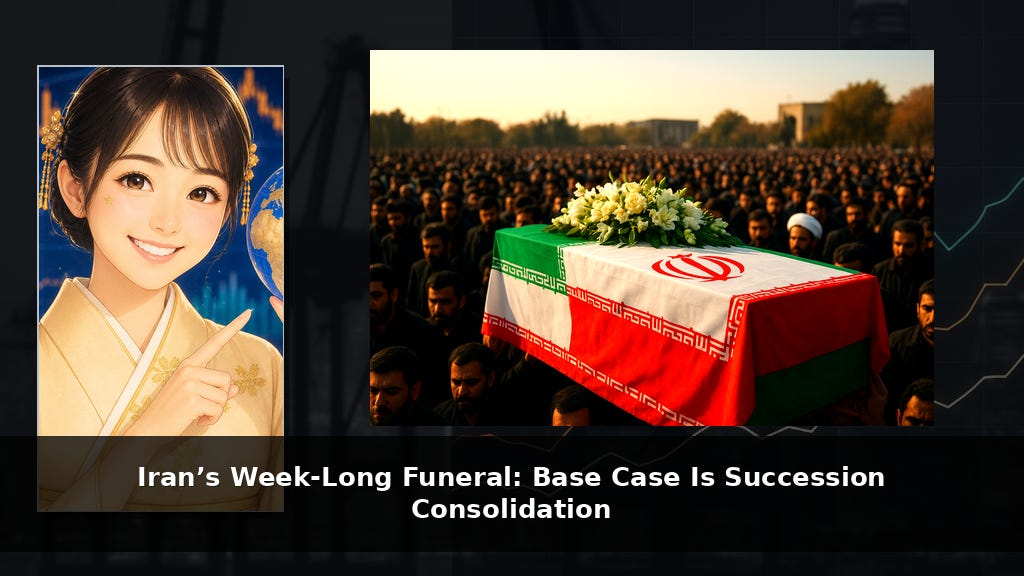
Iran opened week‑long state funeral ceremonies for the late Supreme Leader Ayatollah Ali Khamenei on July 4, 2026, drawing “tens of thousands” at Tehran’s Imam Khomeini Grand Mosalla per Reuters, with AP describing “hundreds of thousands.” State media set the rites to continue across Tehran and Qom and culminate with burial in Mashhad on July 9. Khamenei was killed on February 28, 2026, at the outset of the US‑Israel–Iran war, and authorities are using the funeral to project unity; reports note organized transport, lodging, and mass staging.
The live question for a busy, non‑specialist business reader is whether this focal ritual materially consolidates Mojtaba Khamenei’s succession and reduces elite uncertainty. That is debatable because the Assembly of Experts’ formal selection needs visible buy‑in from the Islamic Revolutionary Guard Corps (IRGC) and mass‑audience signals to become durable authority, and because crowd‑size reports are divergent and mobilization appears state‑managed.
Our call to corporate government‑affairs leads and emerging‑markets (EM) risk portfolio managers (PMs): position for consolidation as the base case. Re‑price near‑term fragmentation risk lower and plan for a harder, more centralized decision line around Mojtaba’s office, while explicitly hedging against a protest resurgence or visible IRGC/Assembly divergence.
Free public preview↑/↓Only visible to members
Civic & Political Structure
Skeptics will argue that choreographed images do not equal legitimacy and that busing and staged chants are a brittle substitute for genuine consent. That critique is directionally fair, but it misses how authority is actually manufactured and recognized inside the Islamic Republic: the constitutional venue (the Assembly of Experts) and the security gatekeeper (the IRGC) are the decisive reservoirs. The funeral’s function is to synchronize those reservoirs in public view, translating paperwork and barracks discipline into a visible, unified command.
Start with the legal keystone. In March 2026, the Assembly of Experts publicly selected Mojtaba Khamenei as successor, reported by Fortune and other outlets. On its own, that selection confers constitutional standing but not necessarily operational control. The second pillar is the coercive and organizational backbone: state media said senior commanders across Iran’s armed forces and the IRGC pledged allegiance in March; AP also reported the IRGC pledge. The funeral is the first, sustained national stage to co‑locate these two pillars—Assembly figures and top commanders—before a mass audience and foreign cameras, with state media amplifying a single message. When those actors are seen together, the mechanism that matters internally clicks into place: a unified elite signal that narrows options for fence‑sitters.
Now consider the civic‑performance layer. Authorities are provisioning buses, lodging, and broadcast saturation to ensure high, city‑level attendance. Whether satellite imagery later proves that mobilization was heavily managed is analytically interesting but secondary to the elite‑coherence test. In Iran’s repertoire, mass funerary rites are designed as public proofs of life for a system, not referenda. If imagery, chants, and camera placements consistently foreground Mojtaba’s presence (or oaths in his name) alongside senior IRGC and clerical figures across Tehran, Qom, and Mashhad through July 9, it reduces the space for alternative power centers to signal themselves without obvious cost.
Label the mechanism. What the regime is trying to build is a legitimacy reservoir—first through a constitutional venue, then locked by the security gatekeeper, and displayed via a civic performance that crowds in undecideds. The chokepoint is not the authenticity of each attendee but whether any credible faction can mount a competing signal in the same information environment. If they cannot do so in this ritualized, high‑visibility window, their bargaining position erodes afterward.
For external observers, three near‑term tests convert this argument into tradecraft:
Assembly reinforcement: a fresh communique, oath, or codification of Mojtaba’s authorities in the next 30 days would close the constitutional loop. Absence alone is not destabilizing; an explicit corrective or delay is.
IRGC visibility: joint appearances and written endorsements from named top commanders during the funeral window are the clearest elite‑unity tells. A missing or off‑message commander is the canary.
Crowd verification: commercial satellite and open‑source intelligence (OSINT) analysis (Maxar/Planet; Center for Strategic and International Studies, CSIS) will likely document convoy patterns. If turnout is shown to be primarily state‑provisioned, it will temper claims of organic support, but it will also signal the regime’s intact mobilization and policing capacity—another practical input into consolidation.
If these cues line up, the short‑term civic‑stability picture is straightforward: urban protest networks demobilize for weeks; bureaucratic appointments around Mojtaba’s office standardize; and externally, counterparties treat Tehran as having a single, enforceable voice. That raises the likelihood of a harder negotiating line in the US‑Israel–Iran conflict’s next phase but lowers the probability of sudden, elite‑driven shocks. For corporate risk desks, the actionable consequence is positioning: governance risk shifts from “who’s in charge?” to “how far will a consolidated center push?”—a different set of hedges and compliance maps.
Strategic Reading from Sun Tzu
Sun Tzu wrote: “An army prefers high ground and avoids low ground; it values light and avoids shadow.”
Take positions where you can see clearly and be seen clearly, and avoid operating in places where information gets lost. In modern terms, authority is strengthened by public, verifiable signals and traceable procedures rather than opaque, off‑stage moves. Visibility reduces surprises, deters miscalculation, and converts organization into credibility.
The Assembly of Experts has already formalized Mojtaba Khamenei’s selection; the state funeral is the visible stage to translate that paperwork into public legitimacy. By placing senior IRGC commanders prominently and saturating state media with unified imagery and chants, the leadership is choosing the “high ground” of clear signals to reduce elite uncertainty and define the interlocutor for foreign actors. As the structural analysis indicates, the IRGC’s security‑first presence functions as a stabilizer even if it also makes the spectacle read as managed. Independent verification of turnout logistics will shape outside interpretations, but the regime’s core move is to privilege light over shadow to consolidate succession.
From here, expect the pressure of the moment to harden operations: tighter message discipline, formalized appointments, and more standardized procedures around Mojtaba’s office, with the IRGC acting as steward. This is an inflection point that strengthens command and clarifies who speaks for the state, even if reputational debates about managed turnout persist. If Assembly cues and IRGC visibility stay unified, foreign negotiators will treat the post‑funeral leadership as the practical counterpart; broadening legitimacy will depend on how the regime balances visibility with measured openness in coming weeks.
Anchor your assessment in verifiable signals: joint appearances by IRGC commanders and Assembly figures, formal decrees and appointments, foreign‑delegation levels, and any independent turnout audits, rather than headline crowd estimates alone. Treat strong security visibility as a sign of operational hardening and shorter decision lines in the near term, and calibrate exposure to Iran policy or markets accordingly.
Caveats and Open Questions
Assembly of Experts reverses or delays: If the Assembly issues a corrective communique—calling for expanded consultation or deferring full conferral of authorities within the next month—the consolidation baseline weakens and our stance would need to be marked down.
IRGC divergence: If a named senior IRGC commander publicly withholds allegiance or is conspicuously absent from funeral staging and related proclamations, the elite‑unity signal breaks; probability of intra‑elite bargaining
