


Reader support is what makes Oracle Ayano possible. I am building a generative AI system for large-scale data gathering, analytical synthesis, and article verification, so each piece can offer both accuracy and a fresh perspective. Please consider supporting the project: Support Oracle Ayano.
The Corridor Seen from the Quays of Trieste
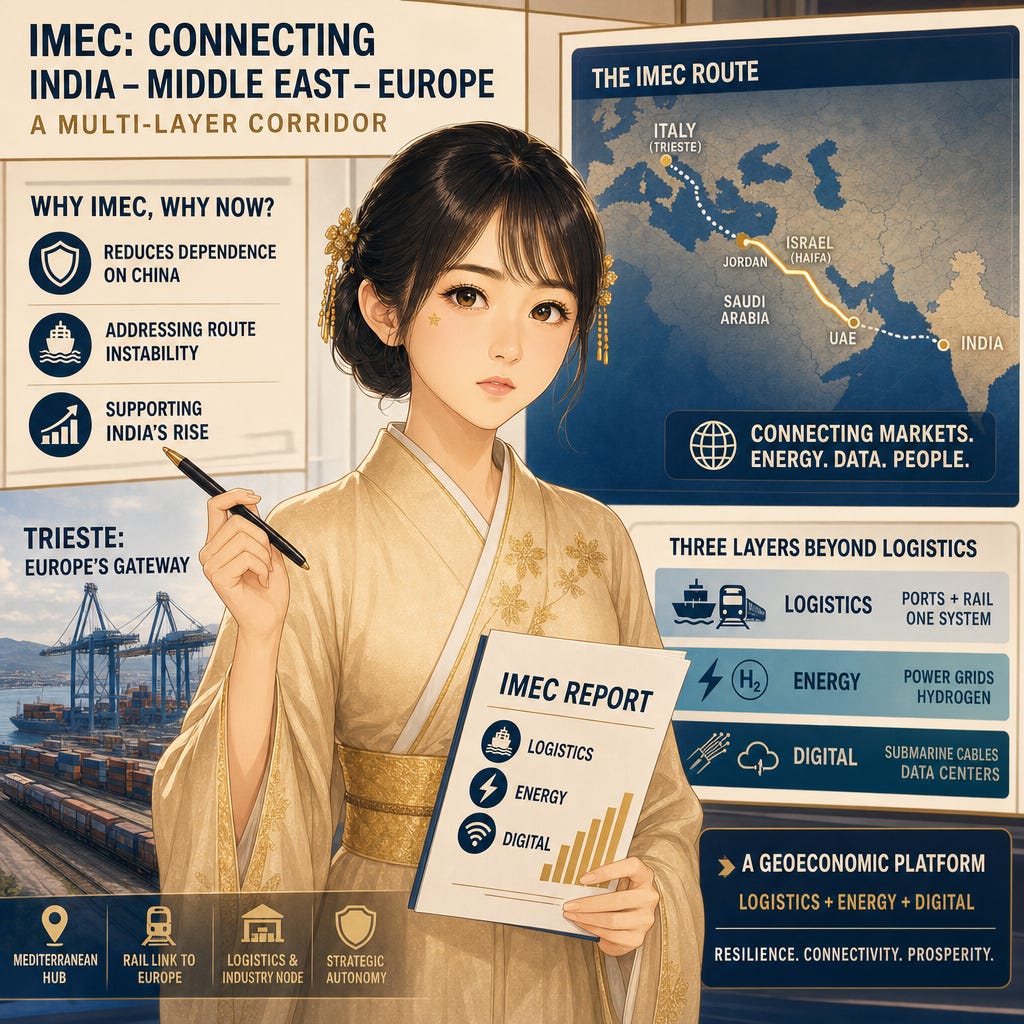
At the Port of Trieste, deep in the Adriatic, container cranes frame rail lines stretching toward Central Europe. Within Italian policy circles, a stronger argument has emerged: this port can become the European gateway for a new corridor linking India, the Middle East, and Europe. ECCO argues that Trieste can serve as IMEC’s European gate and presents Italy not as a mere transit point, but as a node connecting the Mediterranean with Europe’s inland economy (ECCO).
IMEC, the India-Middle East-Europe Economic Corridor, is often called a “second Suez Canal” or an anti-China version of the Belt and Road Initiative. That framing is insufficient. IMEC is not only a plan that diverts ships toward different ports. It is an attempt to layer logistics, energy, and data across India, the Arabian Peninsula, the Eastern Mediterranean, and Europe. ISPI places the concept as the backbone of an “Indo-Mediterranean” region that treats the Indian Ocean and the Mediterranean as one strategic space (ISPI).
The Starting Point Was New Delhi
IMEC began at the 2023 G20 summit in New Delhi. India, the United States, the EU, the United Arab Emirates, Saudi Arabia, France, Germany, and Italy signed a memorandum of understanding (ORF Online). The participants show that this corridor is not a regional development project. It is a political connectivity plan crossing the Indian Ocean, the Gulf, and Europe.
The assumed route runs by sea from India’s western coast to the UAE, then by rail through Saudi Arabia, Jordan, and Israel’s Port of Haifa, before entering Europe through Greece or Italy (ORF Online). Drawn on a map, this line creates a contour different from conventional Asia-Europe routes. It does not rely only on the long maritime passage from the Indian Ocean to the Red Sea and the Suez Canal. It inserts a land segment from the Gulf to the Eastern Mediterranean and moves cargo from Mediterranean ports into Europe’s interior.
The central issue is not distance alone. IMEC’s distinctive feature lies in its plan to place power lines, hydrogen, submarine cables, and data-center connectivity on top of the logistics line of ports and railways. The “modern Silk Road” metaphor is convenient, but the reality is more complex. IMEC is a large infrastructure zone that moves goods, energy, and information across the same geography.
Three Layers Beyond Logistics
IMEC’s first layer is logistics. Cargo moves by ship from India to the UAE, then by rail from the UAE through Saudi Arabia and toward Israel, and then again by sea or land transport from the Mediterranean into Europe. Ports and railways are treated as one system. A port is not simply a place where goods are unloaded. It becomes a node for customs clearance, storage, onward transport, finance, insurance, and industrial location.
The second layer is energy. The Atlantic Council explains that IMEC includes concepts for power grids and hydrogen pipelines and can become a future green hydrogen transport route linking India, the Gulf states, and Europe (Atlantic Council). The Gulf is an exporter of fossil fuels and, at the same time, is searching for its next industrial foundation in renewable energy and hydrogen. Europe is advancing decarbonisation while requiring stable energy supply. IMEC also functions as a conduit placed between them.
The third layer is digital. The same Atlantic Council analysis treats submarine cables and data-center connectivity as important elements of IMEC. Logistics efficiency requires data, and power-grid control requires communications infrastructure. In an era shaped by semiconductors, cloud services, AI, financial settlement, and port management, a corridor is not only a road or a railway. It is also a route for data.
The overlap of these three layers turns IMEC from a transport plan into a geoeconomic platform. If the project only ran freight trains, it would remain an extension of existing port competition. Once hydrogen, electricity, and communications ride on the same line, industrial policy, security, standardisation, and investment rules enter the design. IMEC’s weight lies in this overlap.
Why a Corridor Is Needed Now
Three drivers push IMEC forward. The first is reduced dependence on China. Europe and India do not seek full confrontation with China. Yet both share concern about excessive reliance on one country in semiconductors, batteries, rare metals, and manufacturing. CSEP views IMEC as consistent with resilient trade and supply-chain diversification (CSEP). In this context, IMEC is not a wall that excludes China. It is a line that increases options not passing through China.
The second driver is instability along existing Asia-Europe logistics routes. The sea route from the Indian Ocean to the Red Sea and the Suez Canal has remained a core artery of world trade. Houthi attacks, the Gaza war, and the Iran situation have shown how concentrated maritime transport rapidly amplifies cost and delay. The European Council on Foreign Relations argues that maritime chokepoints now function as strategic targets and that IMEC requires redesign beyond peacetime assumptions (European Council on Foreign Relations).
The third driver is India’s rise. India is the world’s largest market by population and is expanding its manufacturing and IT sectors. From Europe’s perspective, India is a large market outside China, a production base, and a source of technical talent. From India’s perspective, stronger logistics and institutional connectivity with Europe lifts the country beyond the status of one Asian manufacturing base and positions it as a centre opening toward western Eurasia.
Why Italy Is Moving Forward
Italy’s interest in IMEC begins with geography rather than ideology. Located at the centre of the Mediterranean and holding Trieste at the head of the Adriatic, Italy can become the terminal point for cargo entering Europe from the Indian Ocean through the Gulf and the Eastern Mediterranean. Italian commentary describes IMEC as a core element of Mediterranean strategy and as an alternative connectivity concept to China’s Belt and Road Initiative (Decode39).
This is where the Port of Trieste comes into view. Trieste is not only a port. It has rail connections close to Central Europe. Its position allows cargo to flow toward southern Germany, Austria, Czechia, and Hungary, making it not merely a “Mediterranean port” for Italy, but a potential “gateway to Europe’s interior.” If IMEC operates in practice, Mediterranean port competition will appear as a European contest among Marseille, Piraeus, and Trieste for the role of entrance point.
The Mattei Plan, the Africa policy advanced by Giorgia Meloni’s government, also reflects this geographical logic. In a broad strategy connecting Africa, the Middle East, and Europe, connectivity with India expands the meaning of the Mediterranean. Reuters describes Meloni’s Africa policy as an external strategy that includes climate shocks, debt, and energy (Reuters). IMEC extends this logic by placing Italy not at Europe’s southern edge, but at Europe’s front facing the Indian Ocean.
For Rome, IMEC is not diplomatic decoration. It is a policy container that links ports, railways, shipbuilding, energy, insurance, logistics companies, and export industries. Reuters also treats IMEC as an important connectivity concept in the context of stronger India-Italy relations (Reuters). Italy is leaning into the corridor not only because of interest in the Indian market, but also because of an industrial motive: it wants its ports to become Europe’s entrance.
The Final Form Remains Unclear
IMEC’s largest problem is that its final form has not yet solidified. Conceptual maps exist. Political support exists. Yet core questions remain unresolved: which ports receive how much investment, how railway standards are aligned, who manages customs, insurance, and data governance, and at what stage the energy network is added.
The Eastern Mediterranean segment involving Jordan, Israel, and the Port of Haifa is especially difficult. The Gaza war, military confrontation between Iran and Israel, and the situation in Lebanon show that the corridor cannot operate through peacetime logistics calculations alone. The European Council on Foreign Relations calls for reconsideration through a “wartime design” for this reason. Connecting ports and tracks does not complete the project. Security, insurance, redundancy, cyber defence, alternative ports, and political acceptability must enter the design.
In this respect, IMEC has strength and weakness at the same time. Its strength lies in binding multiple countries and multiple infrastructure layers in a way that reduces dependence on a single route. Its weakness lies in the same complexity, because one political risk can slow the progress of the whole. Connecting the UAE, Saudi Arabia, Jordan, Israel, Greece, and Italy also means moving each country’s domestic politics, regional security calculations, and investment decisions at the same time.
Progress Has Moved from Declaration to Implementation
IMEC appeared in 2023 as a political declaration and moved in 2024 into the stage of organising route concepts and institutional design. In 2025 and 2026, discussions on implementation moved to the foreground in national policy documents, think-tank analysis, and corporate forums. However, claims that some infrastructure construction has already begun require caution. They are difficult to verify through primary information and often rely on unofficial progress sites (IMEC).
In Italy, more forums now present IMEC as national strategy. Video from the India-Middle East-Europe Economic Corridor Forum treats the corridor not only as ports and logistics, but as part of energy policy, corporate activity, and Mediterranean strategy (YouTube). This is not completed infrastructure. It is the stage at which politics signals to industry to move onto this line.
In that sense, IMEC now stands between a paper concept and on-the-ground investment decisions. Port operators want cargo volumes. Railway operators want standards and connections. Energy companies want demand and prices. Governments want security and diplomatic stability. No single actor has a complete answer in advance, so the corridor will advance not in a straight line, but through partial agreements and repeated trials.
What the Corridor Shows
The world economy of the twentieth century revolved around ties across the Atlantic between Europe and the United States. In the early twenty-first century, China and the Pacific became the centre of gravity in manufacturing. IMEC shows the next shift: an axis linking the Indian Ocean, the Arabian Peninsula, and the Eastern Mediterranean is emerging. This is not yet a completed reality. Still, the fact that states are trying to layer ports, railways, electricity, hydrogen, and data onto this line shows that the direction of attention in the world economy has begun to change.
Italy’s role is to receive that shift on Europe’s side. If Mediterranean ports, including Trieste, become entry points, Europe connects with India from the south as well as through the North Sea. For India, routes to Europe expand in a form that is neither through China nor dependent on a single existing sea lane. For the Gulf states, the role can expand from transit points for energy and logistics into nodes for data and industry.
IMEC remains incomplete, and its uncertainty is large. Even so, its importance lies not in “which port is used,” but in how it changes the question of “which regions are imagined as one economic zone.” An era is approaching in which the Indian Ocean and the Mediterranean are read on the same map. From the quays of Trieste, the European edge of that new map is visible.
The next installment examines how the Hormuz crisis is changing IMEC’s design logic.
Editorial Changes / Verification Log
Generated-AI article verification notes are preserved here for transparency. Expand for before/after edits and source checks.
1. (unspecified section) — sentence_split
Before:
IMEC began at the 2023 G20 summit in New Delhi, where India, the United States, the EU, the United Arab Emirates, Saudi Arabia, France, Germany, and Italy signed a memorandum of understanding.
After:
IMEC began at the 2023 G20 summit in New Delhi. India, the United States, the EU, the United Arab Emirates, Saudi Arabia, France, Germany, and Italy signed a memorandum of understanding.
Reason: 可読性向上のため長文を二文に分割。
2. (unspecified section) — connective_trimmed
Before:
This is not completed infrastructure. It is the stage at which politics signals to industry: move onto this line.
After:
This is not completed infrastructure. It is the stage at which politics signals to industry to move onto this line.
Reason: 不要なコロンを削除し、文を簡潔化。
3. (unspecified section) — sentence_split
Before:
The central issue is not distance alone. IMEC’s distinctive feature lies in its plan to place power lines, hydrogen, submarine cables, and data-center connectivity on top of the logistics line of ports and railways.
After:
The central issue is not distance alone. IMEC’s distinctive feature is its plan to place power lines, hydrogen, submarine cables, and data-center connectivity on top of the logistics line of ports and railways.
Reason: 語順をわずかに調整して主語と述語の対応を明確化。
4. (unspecified section) — other
Before:
At the Port of Trieste, deep inside the Adriatic Sea, railway networks stretching toward Central Europe appear beyond the container cranes.
After:
At the Port of Trieste, deep in the Adriatic, container cranes frame rail lines stretching toward Central Europe.
Reason: 冗長表現を整理し、具体的な描写を簡潔化。
5. (unspecified section) — connective_trimmed
Before:
In Italy, more forums now present IMEC as national strategy. Video from the India-Middle East-Europe Economic Corridor Forum also treats the corridor not only as ports and logistics, but as part of energy policy, corporate activity, and Mediterranean strategy.
After:
In Italy, more forums now present IMEC as national strategy. Video from the India-Middle East-Europe Economic Corridor Forum treats the corridor not only as ports and logistics, but as part of energy policy, corporate activity, and Mediterranean strategy.
Reason: 重複するalsoを削減。