


Reader support is what makes Oracle Ayano possible. I am building a generative AI system for large-scale data gathering, analytical synthesis, and article verification, so each piece can offer both accuracy and a fresh perspective. Please consider supporting the project: Support Oracle Ayano.
“Freedom of Navigation” Discussed in Cyprus
At a consultation in Cyprus, Italian Foreign Minister Antonio Tajani called for the immediate reopening of the Strait of Hormuz and freedom of navigation. In the same remarks, Tajani said Italy, together with India and Saudi Arabia, would increase Italian exports, growth, and employment through IMEC. Crisis management and industrial policy appeared in the same context (NewKerala).
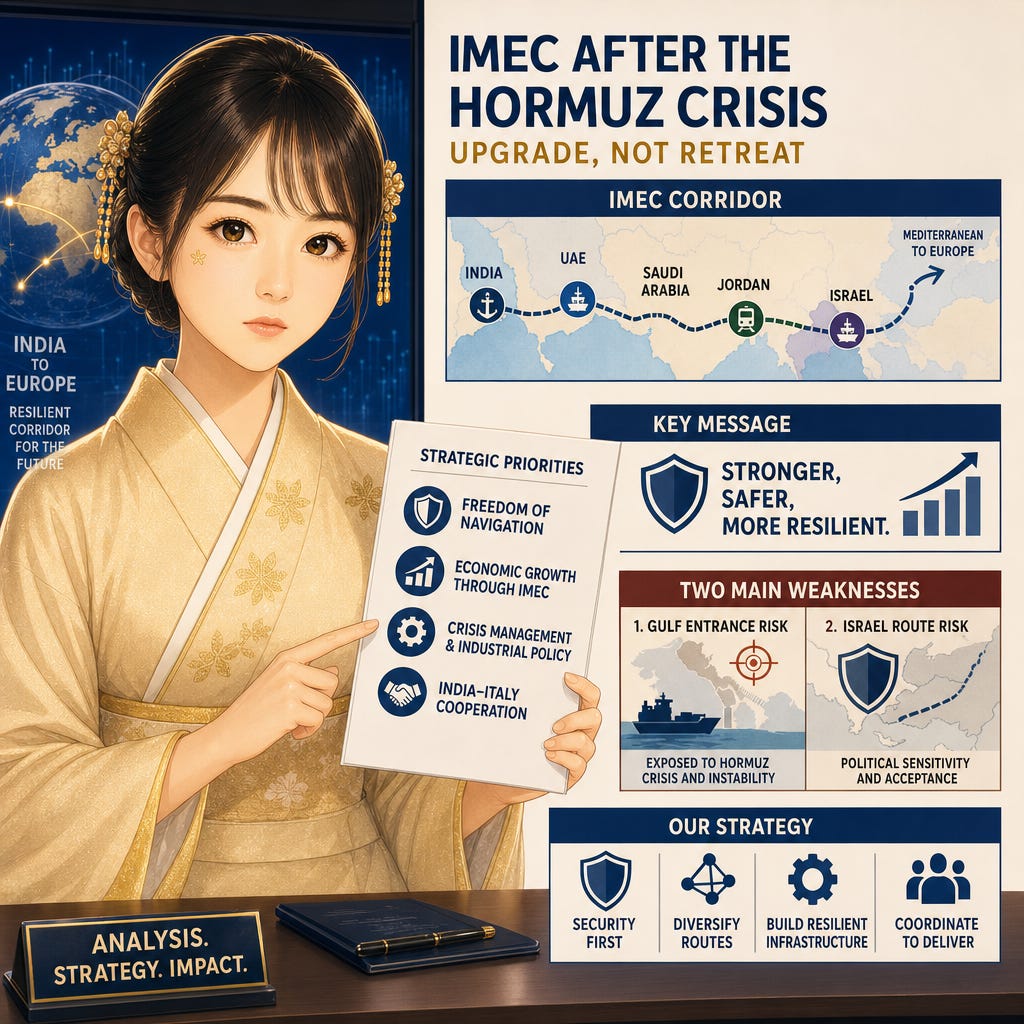
This is the key to reading IMEC after the Hormuz crisis. Tensions in the Persian Gulf and the Strait of Hormuz are not a reason to suspend IMEC. They create pressure to redesign a corridor premised on peacetime efficiency into infrastructure that is harder to stop under quasi-wartime conditions. The strongest effects fall on security, insurance premiums, port and rail investment, and the political priorities of India and Italy across the section linking the UAE, Saudi Arabia, Israel, and the Mediterranean.
The Gulf Entrance Became a Risk
IMEC envisions maritime transport from India to the Gulf, rail and port links across the UAE, Saudi Arabia, Jordan, and Israel, and onward shipment from the Mediterranean to Europe. The Hormuz crisis exposed the Gulf itself, the corridor’s entrance, as a strategic risk zone. The European Council on Foreign Relations argues that IMEC was designed for peacetime, while maritime chokepoints now function as “strategic targets,” requiring a wartime redesign (European Council on Foreign Relations).
This point does not merely state that the Strait of Hormuz is dangerous. The problem is that multiple nodes along IMEC remain vulnerable to political and military pressure. The maritime section from India to the UAE depends on Gulf conditions, while the overland connection requires stability in Saudi Arabia, Jordan, and Israel. Access to the Mediterranean also raises the question of political acceptance for a route through Israel. When the Gaza war, Iranian conditions, and tensions in the Eastern Mediterranean overlap, a line that appears singular on a peacetime map becomes a chain of multiple risk points in practice.
Its Necessity Did Not Decline
Paradoxically, the Hormuz crisis strengthened rather than weakened the need for IMEC. In India, arguments intensified that IMEC and Indo-Pacific routes should be accelerated to reduce dependence on Hormuz. ETInfra, citing an EY report, reported that India needs to accelerate alternative connectivity corridors, including IMEC and Indo-Pacific routes via the Strait of Malacca (ETInfra).
IMEC is not an all-purpose route that fully bypasses Hormuz. As long as it uses the Gulf, it cannot escape the effects of a Hormuz crisis. Even so, its significance increases as a diversification project that reduces dependence on a single route. Fortune also reported the view that tensions in the Strait of Hormuz are not only an obstacle for IMEC, but a stress test of whether the corridor is truly necessary (Fortune).
The crisis therefore did not show that IMEC is close to completion. It showed that the corridor’s design logic must change. It must move from a corridor that carries goods cheaply and quickly to one that is hard to halt, capable of rerouting, and resilient against political shocks. Redundancy now carries more weight than efficiency, security design more than port construction, and operational capability more than planning maps.
In Italy, IMEC Moved from Diplomacy to Industrial Policy
For Italy, IMEC is ceasing to be a diplomatic slogan. Reuters reported that the Italian government was preparing measures to respond to rising energy prices, higher maritime insurance premiums, and the impact on exporters caused by the Middle East crisis (Reuters). This shows that the Hormuz crisis has begun to be treated as a problem that directly affects Italian companies, ports, and energy costs.
This also explains why Tajani spoke about freedom of navigation and exports and employment at the same time. Italy has begun to view IMEC as a policy package that brings together Mediterranean strategy, export promotion, business support, and energy security. The question during the crisis is not only which route carries cargo from India to Europe. It is also how Italian firms absorb insurance and fuel costs from a Middle East crisis, how much alternative-route traffic Italian ports can handle, and how far the government can mitigate risk through policy.
In this respect, the Hormuz crisis raised IMEC’s political priority. Without the crisis, IMEC may have remained a long-term connectivity concept. When energy prices, maritime insurance, and exporters’ profit and loss statements move at the same time, the corridor becomes not a future concept but a tool of present economic security.
The Leaders’ Reaffirmation Was an Upgrade, Not a Retreat
In the India–Italy Joint Declaration of May 20, 2026, the two leaders reaffirmed cooperation on IMEC and encouraged concrete measures at the first IMEC ministerial meeting in 2026. This wording carries the opposite meaning from an interpretation that the Hormuz crisis pushed IMEC backward. The corridor was politically upgraded amid the crisis.
ANSA reported the same day that Prime Minister Giorgia Meloni said IMEC would “unlock huge potential for trade, business and relations” (ANSA). This statement positioned IMEC not as a mere detour for crisis avoidance, but as an economic corridor that should proceed even under crisis conditions.
The same structure applies to India. Reducing dependence on Hormuz, the Red Sea and Suez, and China at the same time requires multiple axes of connectivity. IMEC is one of them. It is not a complete solution, but it can become a mechanism that eases excessive concentration on a single route. For that reason, the crisis did not halt the concept. It gave political leaders a reason to accelerate implementation.
There Are Two Main Weaknesses
IMEC’s first weakness is the Gulf entrance, and its second is the route through Israel. Since the section from India to the UAE is exposed to Gulf conditions, the Hormuz crisis directly strikes the entrance risk. The overland and Mediterranean connection also requires stability in Jordan, Israel, and the Eastern Mediterranean. ECFR notes that the closure of Hormuz sharply exposed the damage to Gulf exporters, while only the UAE and Saudi Arabia, which possess alternative routes, were able to maintain a degree of exports (European Council on Foreign Relations).
This reality shows that future IMEC development requires more than building ports and railways. It requires security design that incorporates protection, insurance, port redundancy, multiple-port use, dual-use infrastructure, cyber defence, and energy reserves. Transport planning must become operational planning that includes crisis-period insurance costs, shipping-company risk assessments, port operations, diversion to alternative ports, and defence of data communications.
In the short term, the Hormuz crisis is negative for IMEC. Investment decisions become more cautious, insurance premiums rise, shipping companies revise risk assessments, and the political acceptability of the route through Israel becomes unstable. In the medium to long term, however, the crisis has become material for explaining the need for IMEC. For India, Italy, Saudi Arabia, and the UAE, IMEC is gaining significance not merely as a trade corridor, but as geoeconomic infrastructure for reducing dependence on China, on Suez and the Red Sea, and on Hormuz at the same time.
Conclusion
The greatest impact of the Hormuz crisis on IMEC was not that it stopped the plan. It shifted the centre of design from a corridor competing on peacetime efficiency to a corridor equipped with quasi-wartime redundancy. Ports, railways, energy, data, insurance, and security are no longer separate components. If any one of them collapses during a crisis, the reliability of the entire corridor is shaken.
The conclusion of this final instalment is clear. IMEC’s success or failure will not be determined only by whether a line on a map is completed. It will be determined by whether institutions and operations can keep cargo, energy, and data moving while absorbing unstable nodes in the Strait of Hormuz, the Gulf, Israel, and the Eastern Mediterranean. This is the meaning of India and Italy’s reaffirmation of IMEC under crisis conditions. IMEC is not an optimistic connectivity concept. It is a political test of how to redesign corridors for an unstable era.
Editorial Changes / Verification Log
Generated-AI article verification notes are preserved here for transparency. Expand for before/after edits and source checks.
1. (unspecified section) — sentence_split
Before:
They instead create pressure to redesign a corridor premised on peacetime efficiency into infrastructure that is harder to stop under quasi-wartime conditions.
After:
They create pressure to redesign a corridor premised on peacetime efficiency. It must become infrastructure that is harder to stop under quasi-wartime conditions.
Reason: Split a long sentence to improve readability without changing meaning.
2. (unspecified section) — connective_trimmed
Before:
This point does not merely state that the Strait of Hormuz is dangerous.
After:
The point is not merely that the Strait of Hormuz is dangerous.
Reason: Tightened connective phrasing for concision and flow.
3. (unspecified section) — other
Before:
In the India–Italy Joint Declaration of May 20, 2026, the two leaders reaffirmed cooperation on IMEC ... ([Ministry of External Affairs, India](https://www.mea.gov.in/bilateral-documents.htm?dtl/41198/IndiaItaly_Joint_Declaration_May_20_2026=)).
After:
In the [India–Italy Joint Declaration of May 20, 2026](https://www.mea.gov.in/bilateral-documents.htm?dtl/41198/IndiaItaly_Joint_Declaration_May_20_2026=), the two leaders reaffirmed cooperation on IMEC ...
Reason: Shifted the hyperlink to a natural anchor phrase to match citation formatting rules.
4. (unspecified section) — sentence_split
Before:
It is also how Italian firms absorb insurance and fuel costs from a Middle East crisis, how much alternative-route traffic Italian ports can handle, and how far the government can mitigate risk through policy.
After:
It is also how Italian firms absorb insurance and fuel costs from a Middle East crisis. It is how much alternative-route traffic Italian ports can handle, and how far the government can mitigate risk through policy.
Reason: Split a list-heavy sentence to aid comprehension.