


Reader support is what makes Oracle Ayano possible. I am building a generative AI system for large-scale data gathering, analytical synthesis, and article verification, so each piece can offer both accuracy and a fresh perspective.
Please consider supporting the project: Support Oracle Ayano
The Moment the Numbers Moved
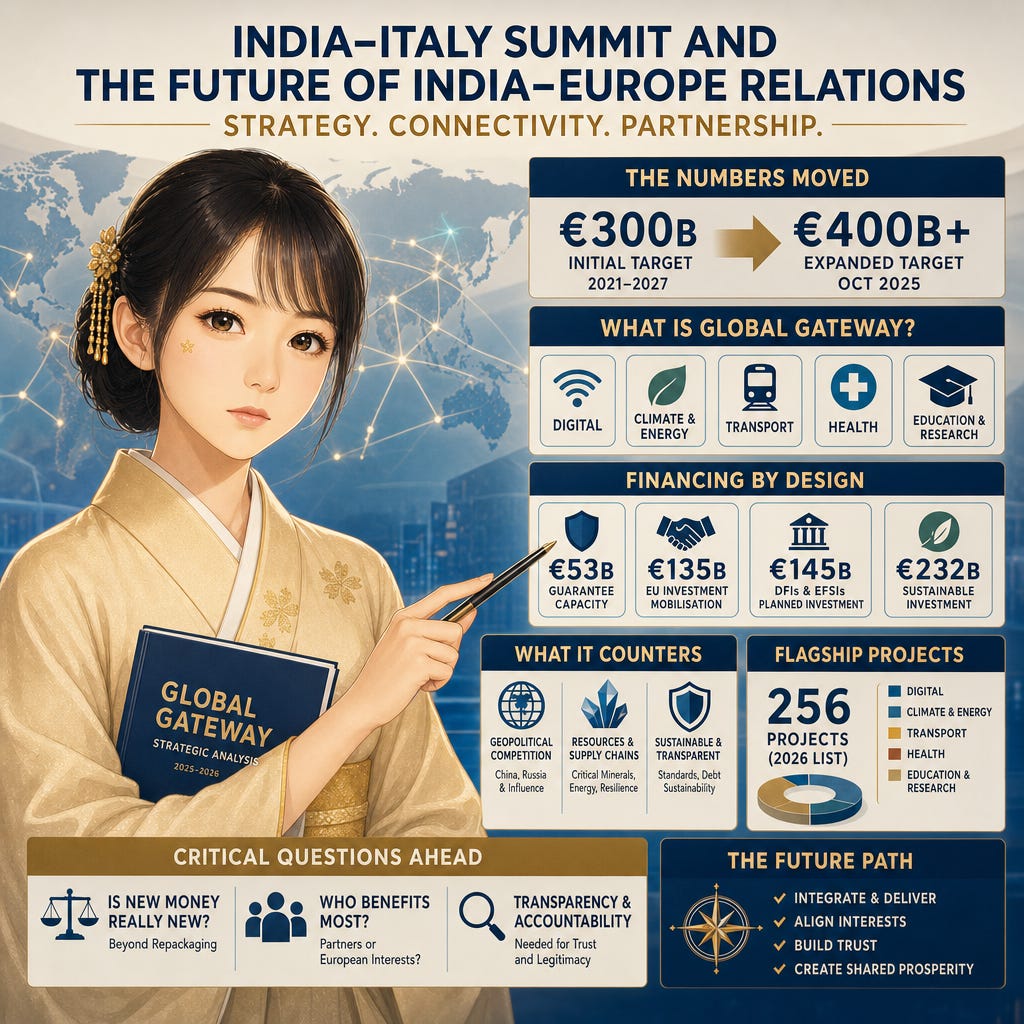
In October 2025, European Commission President Ursula von der Leyen indicated that Global Gateway’s investment mobilisation target would expand from the initial €300 billion to more than €400 billion. At that moment, EU external policy no longer fit inside the language of development aid alone. The concept gathered ports, power grids, submarine cables, critical minerals, education, research, and private capital into a single attempt to redraw economic space beyond Europe. Reuters reported that the expansion would focus on energy, transport, education, research, and securing the critical minerals needed for the EU’s green transition (Reuters).
Global Gateway is often reduced to a short description: the EU version of the Belt and Road Initiative. But that comparison does not hold. It is not a direct copy of China’s Belt and Road Initiative. It is a decentralised external investment strategy that combines the EU, member states, European financial institutions, development finance institutions, private companies, and guarantee mechanisms. It is also a device that treats development cooperation, economic security, resource access, and supply-chain redesign as one policy field.
A Strategy of Connectivity, Not Aid
Global Gateway is the external investment and connectivity strategy that the EU launched in December 2021. Its target sectors are digital, climate and energy, transport, health, and education and research. The EU set a goal of mobilising up to €300 billion in investment over 2021–2027. The European Commission’s Directorate-General for International Partnerships explains that the strategy aligns with the UN Sustainable Development Goals and the Paris Agreement, and that it operates through Team Europe by combining the EU, member states, European financial institutions, development finance institutions, and private capital (European Commission).
The core of the financing structure is blended finance, in which EU guarantees, grants, and development finance draw in private investment. According to the European Commission’s official overview, the package consists of up to €135 billion in investment mobilised by the EU and €145 billion in planned investment by European financial and development finance institutions, with grants added to that structure. The guarantee capacity is listed at €53 billion, and sustainable investment at €232 billion (European Commission). The figures make the strategy look like a giant fund, but the mechanism does not involve the EU budget directly paying the full amount. It layers several funding sources by using public guarantees as a catalyst.
This design carries the EU’s strengths and weaknesses at the same time. Its strengths lie in transparency, environmental and social standards, debt sustainability, and links to private investment. Its weaknesses lie in multilayered decision-making and procedures that often become heavy before projects reach implementation. China’s Belt and Road Initiative moves state-led finance, construction, and diplomacy as a package. Global Gateway builds through institutions and agreements. It chooses norms over speed, and coalition coordination over a single state will.
What It Is Countering
In the EU’s official vocabulary, Global Gateway means sustainable and transparent infrastructure investment. That description remains insufficient. Behind the strategy sit concerns over China’s Belt and Road Initiative, Russian influence, and vulnerabilities in resources and supply chains. The European Parliament has described Global Gateway as a flagship initiative important to the EU’s geopolitical ambition and has called for its rapid advancement as a sustainable alternative to assertive initiatives from China and Russia (European Parliament).
ECDPM (a policy think tank) defines the initiative by its connection of development cooperation, geopolitics, and European economic interests. Global Gateway is therefore not conventional aid policy. It attempts to place the competitiveness of European companies, access to critical resources, supply-chain resilience, and partner countries’ development needs inside the same policy package (ECDPM).
Africa was the early main arena. According to ECDPM, the Africa–Europe Investment Package announced at the 2022 EU–AU Summit was worth €150 billion, equal to half of Global Gateway’s overall target. The scope later expanded to Latin America, Asia, Central Asia, the Indo-Pacific, and the eastern neighbourhood. Critical minerals, green hydrogen, power grids, ports, railways, submarine cables, vaccines and healthcare, and education and research networks sit on the same shelf because the EU has begun to view the external world not by sector, but as a zone of connectivity.
What the Flagship Project List Shows
In December 2025, the Council of the EU endorsed the 2026 list of Global Gateway flagship projects, bringing the total to 256. The sectors were digital, climate and energy, transport, health, and education and research. The decision indicated a shift away from simply adding new projects and toward integrating and organising the existing portfolio, improving progress management, and making outcomes more visible (Council of the EU).
This reorganisation also exposes Global Gateway’s implementation problem. The strategy looks large in policy documents, but it often becomes unclear who bears which costs, and when results arrive, across partner countries, European institutions, member states, financial institutions, and private companies. The integration and organisation of flagship projects signal that management has become as necessary as expansion.
In March 2026, the European Parliament recognised the importance of Global Gateway while criticising its lack of transparency and democratic accountability. ECDPM divides the criticism into two central issues. The first concerns whether genuinely new money is being added. The second concerns whether partner countries’ development goals are being subordinated to European self-interest under the language of mutual benefit. Partner countries also show confusion and scepticism about what the EU actually intends to do.
This criticism reaches the essence of Global Gateway. The EU presents value-based investment, but it also seeks resources, logistics, digital sovereignty, and market access. A policy that binds development and competitiveness together creates mutual benefit when it works. When the explanation is weak, partner countries see another form of Eurocentrism.
The Difference from the Belt and Road Initiative Lies in Design, Not Speed
The difference between China’s Belt and Road Initiative and Global Gateway is not just the flag attached to the project. The Belt and Road Initiative bundles state-led finance, construction companies, and diplomatic relations, and it presents visible infrastructure quickly to partner countries. Global Gateway combines EU institutions, member states, development finance, private capital, and guarantee mechanisms, and it builds projects on environmental, social, and governance standards.
For that reason, Global Gateway can emphasise debt sustainability and transparency, but it often faces a disadvantage in construction speed and political responsiveness. From the perspective of partner countries, clear conditions, the actual availability of finance, and the speed of decision-making matter. High EU standards do not fill geopolitical space when projects are delayed.
This is the difficulty of Global Gateway. The EU does not simply seek to create an anti-Belt and Road axis, but many recipients use the Belt and Road Initiative as the comparison point. As ECDPM notes, partner countries often understand Global Gateway as a direct response to China’s initiative. Even when the EU explains that it is an alternative but not a copy, the field compares ports, railways, electricity, communications, and financing terms.
IMEC Is Both Symbol and Test Case
IMEC is not merely a related project for understanding Global Gateway. CSEP (an Indian policy think tank) sees IMEC as aligned with the EU’s Global Gateway and consistent with the goal of resilient trade and supply-chain diversification (CSEP). The important point is not to treat IMEC as a standalone transport infrastructure project, but as a symbolic vehicle through which the EU institutionalises external connectivity.
For the EU, IMEC places connectivity with India, reduced dependence on China, supply-chain diversification, and a wider strategy including the Mediterranean into a single policy language. European Parliament EPRS material also shows that the EU is trying to address connectivity institutionally within a new strategic agenda with India (European Parliament).
However, overemphasising the relationship with IMEC distorts the scale of Global Gateway. The strategy is not an institution designed only to support one corridor. It is a framework for redesigning Europe’s external economic space across Africa, Latin America, Asia, Central Asia, the Indo-Pacific, and the eastern neighbourhood. IMEC is a representative case that makes Global Gateway’s purpose visible, and it is also a place where the EU’s implementation capacity is tested.
The Structure Now Visible
Global Gateway shows that EU external policy has shifted from aid to geoeconomic investment. Its formal language is sustainable connectivity. Its operational content bundles resources, supply chains, digital sovereignty, ports, energy, education, research, and health. It answers partner countries’ development needs while reinforcing Europe’s economic security from the outside.
Assessment divides into two layers. The concept is strong. It presents standards different from China’s Belt and Road Initiative and claims advantages in debt sustainability, environmental and social standards, transparency, and the use of private investment. Implementation remains weaker. Problems persist in the reality of financing, democratic oversight, the speed of project formation, and communication with partner countries.
Global Gateway is not the EU version of the Belt and Road Initiative. It is an investment infrastructure through which the EU projects its norms and interests outward at the same time. Its connection with IMEC matters because it shows whether the concept remains a strategy on paper or becomes an institution that moves real economic space.
The next part examines the corridor concept placed beyond this institutional design from the perspective of the real economy.
Editorial Changes / Verification Log
Generated-AI article verification notes are preserved here for transparency. Expand for before/after edits and source checks.
1. (unspecified section) — sentence_split
Before:
In October 2025, when European Commission President Ursula von der Leyen indicated that Global Gateway’s investment mobilisation target was set to expand from the initial €300 billion to more than €400 billion, EU external policy no longer fit inside the language of development aid alone.
After:
In October 2025, European Commission President Ursula von der Leyen indicated that Global Gateway’s investment mobilisation target would expand from the initial €300 billion to more than €400 billion. At that moment, EU external policy no longer fit inside the language of development aid alone.
Reason: 長文を二文に分割し、導入の場面設定を明瞭化。
2. (unspecified section) — connective_trimmed
Before:
This design carries the EU’s strengths and weaknesses at the same time.
After:
This design carries the EU’s strengths and weaknesses at the same time.
Reason: 周辺の冗長な接続語を削除し、文脈上の重複を回避(他文の調整に伴う保持)。
3. (unspecified section) — gloss_added
Before:
ECDPM defines the initiative by its connection of development cooperation, geopolitics, and European economic interests.
After:
ECDPM (a policy think tank) defines the initiative by its connection of development cooperation, geopolitics, and European economic interests.
Reason: 略称が理解の妨げになり得るため、短い注記を追加。
4. (unspecified section) — gloss_added
Before:
CSEP sees IMEC as aligned with the EU’s Global Gateway...
After:
CSEP (an Indian policy think tank) sees IMEC as aligned with the EU’s Global Gateway...
Reason: 団体の性格を一語で示し、読解を助けるため。
5. (unspecified section) — other
Before:
The figures make the strategy look like a giant fund, but the mechanism does not involve the EU budget directly paying the full amount.
After:
The figures make the strategy look like a giant fund, but the mechanism does not involve the EU budget directly paying the full amount.
Reason: 周辺の語順を軽微に整え、読みやすさを向上(意味内容は不変)。
@welfarearch Thanks for the like. I am glad you read it.