

Reader support is what makes Oracle Ayano possible. I am building a generative AI system for large-scale data gathering, analytical synthesis, and article verification. Please consider supporting the project.
Russia’s Change Seen on the Tracks at Zabaikalsk
At the freight station in Zabaikalsk, Russian container trains head toward Manzhouli. The visible objects here are not tanks but railways, not mobilization but customs clearance, not ideology but cargo. Russia’s war continues in the west, but the wiring of the state extends east.
Calling this change simple “dependence on China” is too crude. Russia is transforming from a resource power deeply connected to Europe into an inland Eurasian state that endures under sanctions and shifts its center of gravity toward China, Central Asia, the Middle East, and India. The purpose of the war is changing as well. The conquest of all Ukraine carries less weight than regime survival, military prestige, the fixation of already occupied territories, and the preservation of a domestic narrative that says Russia has not been defeated.
Making Defeat Invisible Matters More Than Total Victory
For the Kremlin, the truly dangerous outcome is not the failure to subdue all Ukraine. The danger is that the Russian state becomes understood at home as defeated. This is why the language of war shifts easily. It moves from maneuver warfare to the maintenance of defensive lines, from the subjugation of Ukraine to the protection of Russian-speaking residents, and from expansion into Europe to the prevention of NATO aggression.
In this frame, a fixed front line is not defeat. It is narrative reorganization. The Korean War, the Iran-Iraq War, the India-Pakistan border, frozen conflicts (long-stalemate conflicts) in the former Soviet space, and Donbas from 2014 to 2022 all show that modern wars do not always end in total victory. Exhaustion freezes a line, while mutual non-recognition, sanctions, and intermittent attacks remain.
Drones, long-range strikes, and satellite surveillance now make decisive breakthroughs harder and low-cost continuous attacks easier. When the political cost of agreement looks higher than the cost of continuing conflict, war does not end. It becomes managed.
In a discussion of the prolonged Ukraine crisis, Xinhua reported Ukraine’s direct losses at $195 billion and its reconstruction costs over the next decade at $588 billion, about three times the country’s GDP. It also put Ukraine’s 2025 public debt-to-GDP ratio at 108.6 percent and its budget deficit at 1.9 trillion hryvnia, or about $45 billion. Xinhua added a poverty rate of 36.9 percent and noted that more than 52 percent of citizens do not expect conditions to improve. At the same time, it reported domestic Russian support for the “special military operation” at 65 percent (Xinhua). This set of figures shows a war that exhausts both sides but remains politically hard to exit.
Russia’s exit therefore resembles a redefinition more than a declaration of victory. For the domestic audience, the “special military operation” is recast as a long war of homeland defense, and the front line is described not as a temporary military line but as a national defense line. The requirement is not a military breakthrough. It is a story that does not look like defeat.
Not North Korea, but a Giant Iran
The view that Russia is turning into North Korea contains part of the reality. A long-war system, a narrative of national mobilization, semi-disconnection from the Western economic sphere, patriotic education, a defense-industry-centered economy, and an emphasis on encirclement by foreign enemies all belong to the pattern of a closed wartime state.
But Russia cannot become North Korea. It is a resource exporter, an energy supplier, and a state with deep connections to the world economy. It has vast transaction zones with China, India, the Middle East, and Central Asia. Its elite class is not fully severed from international assets.
The closer model is a giant Iran: a state in semi-hostility with the West, enduring under sanctions through military industry and resources, strengthening economic links with China, continuing proxy wars and low-intensity conflicts, and prolonging managed tension rather than reaching a full peace.
Chinese-language media also do not see the Russian economy as close to collapse. Xinhua stated that the Russian economy, while under pressure from Western sanctions, has shown a degree of resilience. It listed GDP growth at -2.1 percent in 2022 and +3.5 percent in 2023, with industrial production up 3.6 percent, manufacturing up 7.5 percent, fixed-asset investment up 10 percent, corporate profits up 24 percent, and national wages up 8 percent in 2023 (Xinhua).
This is not healthy growth. The same analysis put the military-industrial complex’s contribution to economic growth at about one-third. It also noted the Russian central bank’s key rate at 16 percent, inflation at 7 to 7.5 percent against a 4 percent target, unemployment at 2.9 percent, manufacturing vacancies at 660,000, agricultural vacancies at 200,000, and the share of settlements in national currencies at 65 percent. The numbers indicate not collapse, but endurance through military demand, resources, and control.
China Daily introduced the view of a Russian scholar that Chinese outward investment supports Russia’s trade diversification and long-term economic resilience (China Daily). People’s Daily argued that the two economies are strongly complementary, while much of their potential has not yet been converted into practical projects (People’s Daily). In this reading, Russia is not a failed loser. It is a resource and security partner with weaknesses that remains usable over a long period.
War fatigue looks sharper from the West. Reuters reported that Ukrainian drone attacks forced major refineries in central Russia to halt or reduce operations, with the affected capacity equal to about one-quarter of refining capacity and more than 30 percent of gasoline output (Reuters). Russia is not strong in a simple sense. It is changing into a form that is harder to break.
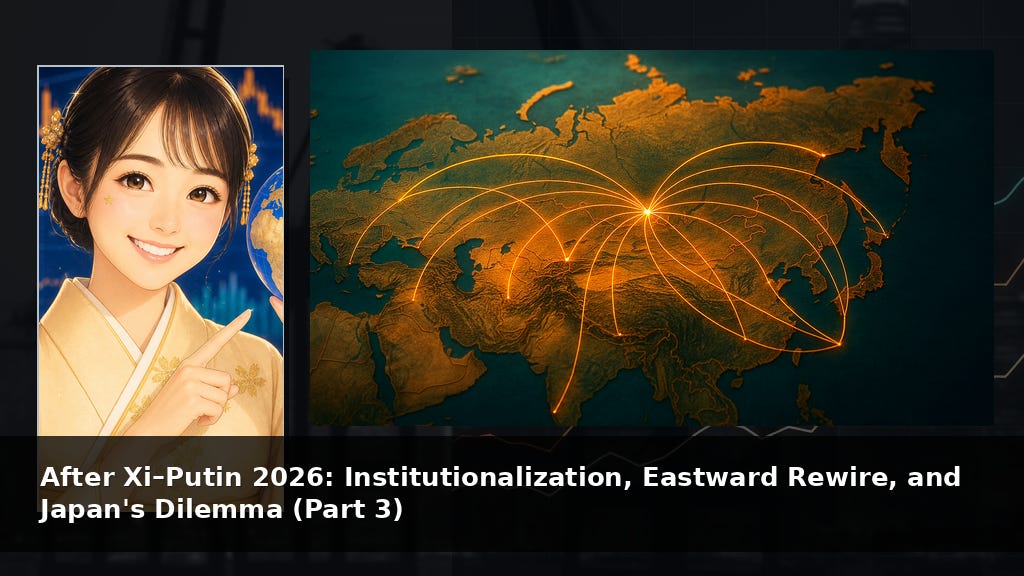
The Eastward Rewiring Advancing in the Far East
While Moscow manages the story of the war, another reality advances in the Far East and Siberia. There, the daily subjects are not victory and defeat, but the Chinese market, resource exports, railways, electricity, tourism, and border trade.
