


Reader support is what makes Oracle Ayano possible. I am building a generative AI system for large-scale data gathering, analytical synthesis, and article verification, so each piece can offer both accuracy and a fresh perspective. Please consider supporting the project: Support Oracle Ayano.
Paid content below this line
What Is Being Tested Now Is Not the Resource Itself
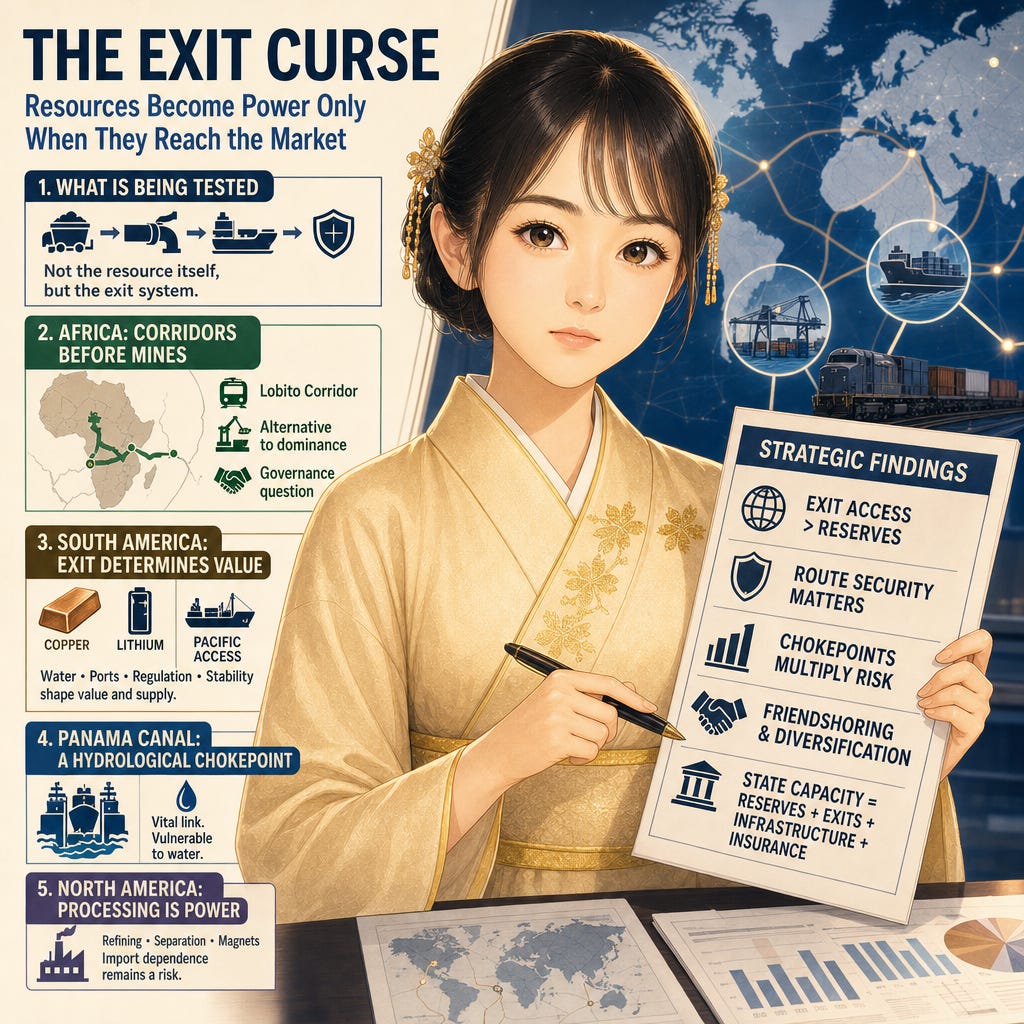
What global resource markets now reveal is that national power cannot be measured by the volume of mines and oilfields alone. In 2026, attention has converged on the Lobito Corridor in Africa, copper and lithium logistics in South America, water shortages at the Panama Canal, refining gaps in North America, the Middle Corridor in Central Asia, Russia’s Northern Sea Route, and China’s export controls on critical minerals. Their common point is simple. A resource becomes power only when it reaches the market through an exit.
The conventional “resource curse” argued that resource revenues generate corruption and industrial stagnation. The present problem has moved one stage further. The question is not only who possesses the resource, but who controls the ports, railways, canals, pipelines, refining facilities, insurance, and transit states that move it to market. I read this as an “exit curse.” The strength of a resource state is determined less by reserves than by how far it can secure exits, refining, insurance, ports, and corridors on its own or within friendly networks.
UNCTAD argues that disruption at chokepoints does not remain a regional logistics problem; it spreads through maritime transport, ports, seafarers, commodity markets, and entire supply chains (UNCTAD). E3G likewise notes that energy security cannot stand on adequate supply alone if transport chokepoints remain exposed, because price surges, insurance withdrawal, physical supply constraints, and contract failures can cascade (E3G). State capacity must now be read as the product of reserves, production capacity, the number of exits, the political safety of routes, and the continuity of insurance and shipping.
In Africa, Corridors Matter More Than Mines
The most symbolic case in Africa is the Lobito Corridor, designed to move copper and cobalt from the Democratic Republic of the Congo and Zambia to the Atlantic. Linking Angola, the Democratic Republic of the Congo, and Zambia, the corridor uses Angola’s Lobito port as an export route for minerals and is positioned by the United States and Europe as an alternative to China-led infrastructure. Africanews reports that the Lobito Corridor is drawing attention as a “strategic alternative” to Chinese dominance over mining infrastructure (Africanews).
This is not a simple infrastructure success story. According to Reuters, the U.S. International Development Finance Corporation has advanced a $553 million loan to renovate Angola’s railway, with the aim of reducing the transport costs of copper and cobalt from the Democratic Republic of the Congo and Zambia. At the same time, a Global Witness report points to displacement risks around Kolwezi (in the DRC) (Reuters). The Lobito Corridor is an exit-diversification project, but it also carries a governance question: a corridor for whom?
Southern Africa also involves the Tanzania-Zambia Railway, South African ports, and Mozambique corridors. The coming checkpoint is not the mine itself, but which sea the minerals of the Congolese interior reach. An Atlantic exit deepens linkage with the U.S.-European sphere. An Indian Ocean exit strengthens linkage with China and the Indian Ocean sphere. The geography of ore is fixed, but the direction of the exit can change political alignment.
In South America, the Exit Determines the Value of Copper and Lithium
South America is the geopolitics of copper and lithium. In an April 2026 regional note, the OECD stated that Latin America and the Caribbean hold about 60% of the world’s lithium reserves and about 40% of its copper reserves. Chile, Peru, and Mexico are important copper producers; Chile alone accounts for about 23.7% of global mine production, while Peru accounts for about 10.2% (OECD).
The investor’s focus, however, cannot stop at ore grade. Transport from the Andes to Pacific ports, port labor relations, water resources, and refining capacity are the real bottlenecks. Chile and Peru have the advantage of direct Pacific access, but drought, Indigenous and environmental regulation, port strikes, and changes of government can still interrupt supply. In the “lithium triangle” of Argentina, Chile, and Bolivia, Bolivia is landlocked and depends on neighboring ports. Here again, the weakness lies less in resource volume than in the politics of the exit.
The Panama Canal Is a Hydrological Chokepoint
In Central America and the Caribbean, the central issue is not the resource itself but the Panama Canal as a transport checkpoint. The Financial Times reported that demand for diversions in maritime transport increased Panama Canal revenue by 10% to 15% (Financial Times). The canal is not merely a shortcut on a map. It is a price-forming mechanism connecting the U.S. Gulf Coast, Asia, oil, coal, and commodity shipping.
The Panama Canal’s weakness, however, is not military. It is water. Drought in 2023 produced transit restrictions, and El Niño forecasts in 2026 are again being watched as a risk to shipping capacity (Riviera Maritime Media). This is a variant of the exit curse. A state with a canal holds a geopolitical tollgate, but if that tollgate is bound to water levels, global logistics are taxed by climate.
North America’s Weakness Is Processing and Northern Infrastructure, Not Extraction
North America has resources and capital, but processing, permitting, and northern infrastructure remain likely points of congestion. The 2026 edition of the USGS mineral summary is a core reference for 2025 global mineral production, reserves, and trade, and it shows that U.S. import dependence for critical minerals continues (USGS). The U.S. problem is not only whether ore can be mined. Where refining, separation, magnets, and chemical processing take place has become central to national security.
After China’s rare earth export restrictions, U.S. listings by companies tied to tungsten, antimony, rare earths, and uranium surged on the back of defense demand. This is less a normal resource boom than a market driven by national security demand (Reuters). It looks like a mining equity story, but the substance is the reshoring of refining capacity and defense supply chains.
Canada presents the inverse pattern: strong resource volume, weak northern infrastructure. In May 2026, the Government of Canada announced investment in Arctic mining, ports, roads, and low-carbon infrastructure, including moves linked to Nunavut and the Grays Bay deepwater port concept to bring zinc, copper, and other minerals to market (Government of Canada). North American resource geopolitics has shifted from what lies underground to whether routes can be built from the north to the market.
In Central Asia, the Absence of the Sea Constrains State Strategy
Central Asia is the classic region of “resources without a sea.” Kazakhstan has oil and uranium, Uzbekistan has gold and copper, and Turkmenistan has gas, but their exits depend on Russia, China, the Caspian Sea, Iran, and the South Caucasus. These states possess resources, yet the absence of ports reduces their bargaining power.
The current focus is the Middle Corridor, or Trans-Caspian Transport Corridor. The World Bank presents this route linking Kazakhstan, Azerbaijan, Georgia, and other actors as a way to reduce dependence on routes through Russia and strengthen supply-chain resilience (World Bank). The OECD also treats the corridor as a key to Central Asian economic diversification and regional integration (OECD).
Alternative exits, however, are not free from politics. Carnegie argues that the Middle Corridor faces the Anaklia port issue (in Georgia), South Caucasus geopolitics, environmental deterioration in the Caspian Sea, and insufficient processing capacity, making it difficult to serve as a full substitute for the northern route through Russia (Carnegie Endowment). Central Asia’s weakness is not only that it lacks an exit. It is that its alternative exits also depend on the politics of multiple states.
Russia Is Having Its Exits Reconfigured by Sanctions
Russia’s resource checkpoint lies in the forced restructuring of exports away from land and sea routes to Europe and toward Asian and Arctic routes under sanctions. Reuters reported in May 2026 that Russia had sent its first LNG tanker of the year eastward along the Northern Sea Route. Arctic LNG 2 is under U.S. sanctions, and the Northern Sea Route has become a strategic means of bypassing Suez and European routes (Reuters).
Russia’s strength is resource volume. Its weaknesses are sanctions, insurance, icebreakers, LNG technology, and buyer concentration. In pipelines, the share directed toward China is rising, but that is also a shift from dependence on Europe to dependence on China. The Northern Sea Route shortens distance, but ice conditions, insurance, sanctions, port capacity, and military tension overlap. Changing the exit is possible, but it does not necessarily erase the structure of dependence.
China Controls Midstream Processing More Than Mines
China is less a resource-holder than a midstream-processing checkpoint state. In rare earths, gallium, germanium, antimony, graphite, battery materials, and magnets, China controls processing, refining, and export licensing more than mining itself. In October 2025, the IEA noted that China’s new export controls had made supply concentration risks in critical minerals a reality (IEA).
Reuters also reported in May 2026 that the United States asked China to address shortages of yttrium, scandium, indium, and neodymium. Indium is especially important for next-generation semiconductor materials, making this a chokepoint in high-value intermediate goods, not in mines (Reuters). China’s power lies not in where resources are dug up, but in the process that turns them into forms other countries’ industries can use.
At the same time, China’s own weakness is maritime dependence for imported energy. If the Strait of Malacca, the South China Sea, the Taiwan Strait, or Indian Ocean routes are blocked, both resource imports and export industries come under pressure. This is why China is interested in overland pipelines, Belt and Road ports, Central Asian railways, corridors through Myanmar and Pakistan, and the Arctic Polar Silk Road (an Arctic route). China controls the midstream processing of others while trying to increase the number of its own entrances.
What to Watch Next
Seen from this angle, global resource geopolitics becomes much clearer. Africa and South America are resource warehouses, but corridors and ports determine value. Central America is a canal chokepoint, with water as the constraint. North America has resources and capital, but refining and permitting create congestion. Central Asia has resources but no sea, and even alternative corridors are politically constrained. Russia is being pushed by sanctions to reconfigure its exits and move toward China and the Arctic. China controls midstream processing more than mines and can interrupt other countries’ industries.
The indicators to watch next are not reserves and production volumes alone. You should ask which port the resource exits through, whose railway it crosses, who refines it, whether insurance is available, and how many alternative exits exist. A resource becomes national power when it has multiple exits. With only one exit, it becomes a hostage. This is the most important perspective for reading the current resource market.
Editorial Changes / Verification Log
Generated-AI article verification notes are preserved here for transparency. Expand for before/after edits and source checks.
1. (unspecified section) — sentence_split
Before:
UNCTAD argues that disruption at chokepoints does not remain a regional logistics problem; it spreads through maritime transport, ports, seafarers, commodity markets, and entire supply chains (UNCTAD). E3G likewise notes that energy security cannot stand on adequate supply alone if transport chokepoints remain exposed, because price surges, insurance withdrawal, physical supply constraints, and contract failures can cascade (E3G).
After:
UNCTAD argues that disruption at chokepoints does not remain a regional logistics problem; it spreads through maritime transport, ports, seafarers, commodity markets, and entire supply chains ([UNCTAD](https://unctad.org/publication/strait-hormuz-disruptions-implications-global-trade-and-development?utm_source=chatgpt.com)). E3G likewise notes that energy security cannot stand on adequate supply alone if transport chokepoints remain exposed. Price surges, insurance withdrawal, physical supply constraints, and contract failures can cascade ([E3G](https://www.e3g.org/publications/chokepoints-systemic-threat-energy-security-oil-gas-importers/?utm_source=chatgpt.com)).
Reason: Long sentence broken to improve readability and emphasis while preserving content and citations.
2. (unspecified section) — connective_trimmed
Before:
The present problem has moved one stage further. The question is not only who possesses the resource, but who controls the ports, railways, canals, pipelines, refining facilities, insurance, and transit states that move it to market.
After:
The present problem has moved one stage further. The question is not only who possesses the resource but who controls the ports, railways, canals, pipelines, refining facilities, insurance, and transit states that move it to market.
Reason: Removed an extra comma after ‘resource’ for flow and clarity.
3. (unspecified section) — gloss_added
Before:
At the same time, a Global Witness report points to displacement risks around Kolwezi (Reuters).
After:
At the same time, a Global Witness report points to displacement risks around Kolwezi (in the DRC) ([Reuters](https://www.reuters.com/world/africa/us-agency-consortium-sign-553-million-loan-angola-railway-revamp-2025-12-17/?utm_source=chatgpt.com)).
Reason: Added a brief parenthetical to aid readers unfamiliar with the location.
4. (unspecified section) — other
Before:
Financial Times reported that diversion demand in maritime transport increased Panama Canal revenue by 10% to 15%.
After:
The Financial Times reported that demand for diversions in maritime transport increased Panama Canal revenue by 10% to 15%
Reason: Minor phrasing adjustment for natural English without altering the claim.
5. (unspecified section) — gloss_added
Before:
Carnegie argues that the Middle Corridor faces the Anaklia port issue, South Caucasus geopolitics, environmental deterioration in the Caspian Sea, and insufficient processing capacity...
After:
Carnegie argues that the Middle Corridor faces the Anaklia port issue (in Georgia), South Caucasus geopolitics, environmental deterioration in the Caspian Sea, and insufficient processing capacity...
Reason: Added a brief geographic gloss for Anaklia to avoid a comprehension pause.
6. (unspecified section) — gloss_added
Before:
...and the Arctic Polar Silk Road.
After:
...and the Arctic Polar Silk Road (an Arctic route).
Reason: Added a short parenthetical to clarify the term for general readers.