Oracle Ayano support notice
Reader support is what makes Oracle Ayano possible. I am pouring my heart into building a generative AI system for large-scale data gathering, analytical synthesis, and article verification, so each piece can offer both accuracy and a fresh perspective. Please consider supporting the project.

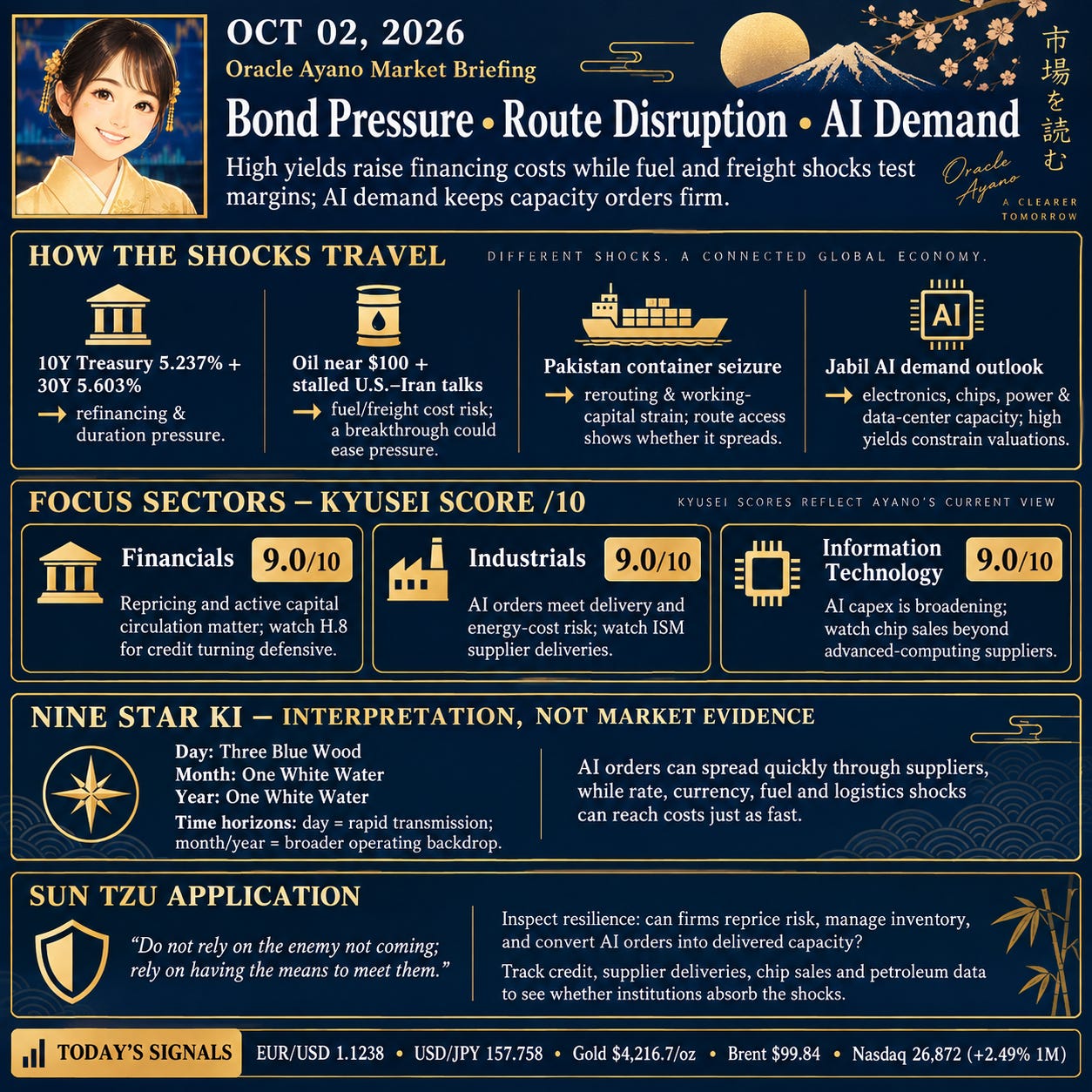
Good morning. Renewed bond selling, disrupted freight routes, and firm AI infrastructure demand define today’s setup. High long-term yields are raising financing costs, while oil near $100 and cargo accumulation in Pakistan are testing margins and inventory plans.
Stocks and FX
Reuters reported another global bond-market sell-off, with the 10-year U.S. Treasury yield at 5.237% and the 30-year yield at 5.603%. EUR/USD fell 0.78% to 1.1238, while USD/JPY rose 0.13% to 157.758. These moves increase refinancing pressure and duration risk—the sensitivity of asset values to long-term rates—while changing import costs and overseas earnings.
Commodities
Reuters reported gold at $4,216.7 per ounce, up 0.34% on the day but down 2.42% for the week ahead of U.S. payrolls; silver rose 1.11% to $61.40. The weekly gold decline leaves Materials sensitive to the next move in rates and the dollar, despite stable defensive demand.
World Affairs
Reuters reported that oil rose about $1 a barrel as U.S.-Iran talks stalled and fuel markets remained tight, although the supplied snapshot showed Brent down 2.41% at $99.84 and WTI down 3.94% at $89.21. Stalled diplomacy can preserve a geopolitical premium, while any breakthrough could quickly reduce fuel, freight, and inflation pressure.
Supply Chain
Reuters reported cargo accumulation after Pakistan seized containers to block routes to the capital. The obstruction can extend delivery times, force rerouting, and increase trucking, fuel, and working-capital costs for Industrials and consumer-goods companies. Inventory availability and route access will show whether the disruption remains local or spreads through supplier schedules.
AI
Reuters reported that Jabil forecast full-year results above estimates because of AI data-center demand. The Nasdaq stood at 26,872, up 2.49% over one month, showing continued exposure to AI capital-spending sentiment. The signal supports electronics manufacturing, chips, power equipment, and data-center supply chains, but higher yields remain a valuation constraint.
Industry News
Reuters reported that South Korea was ordered to pay Elliott $48.49 million over the Samsung merger case. The award highlights governance and cross-border shareholder risk around large corporate combinations, with implications for technology groups, deal financing, and investor confidence in South Korean conglomerates.
Industry Forecast
Today’s Setup
On 2026-10-02, Three Blue Wood (Sanpeki Mokusei, 三碧木星) operates within a One White Water (Ippaku Suisei, 一白水星) month and year; Kanro (Cold Dew) begins on October 8. The reading favors rapid commercial transmission, meaning AI orders can spread through suppliers quickly, but rate, currency, fuel, and logistics shocks can reach financing costs and margins just as fast.
Focus Sectors
Financials (9.0/10): The 5.237% 10-year Treasury yield keeps loan pricing, bond portfolios, deposits, and currency exposure central to performance. Banks and insurers able to reprice risk may benefit from active capital circulation, but another bond sell-off could deepen duration losses and refinancing stress. The Federal Reserve H.8 release, measuring weekly changes in commercial-bank loans, securities, and deposits, will show whether credit continues expanding or balance sheets turn more defensive.
Industrials (9.0/10): Jabil’s stronger AI data-center outlook supports equipment and electronics orders, while Pakistan’s container seizures threaten the conversion of orderbooks into delivered goods. Brent at $99.84 also raises energy and transport costs before contracts can be repriced. The Institute for Supply Management Manufacturing PMI, covering U.S. production, new orders, and supplier deliveries, will clarify whether demand is overcoming slower logistics and higher inputs.
Information Technology (9.0/10): Jabil’s outlook shows AI capital spending spreading through the electronics GVC (global value chain), while the Nasdaq at 26,872 and its 2.49% monthly gain indicate sustained AI sentiment. High real yields and the Samsung merger ruling add valuation and governance risks. The Semiconductor Industry Association monthly sales report, measuring global chip sales by region, will show whether demand is broadening beyond a small set of advanced-computing suppliers.
Consumer Discretionary (7.2/10): Consumer demand remains supported by commercial activity, but Brent at $99.84, blocked routes in Pakistan, and elevated bond yields raise delivery and financing costs for autos, travel, and other large purchases. Delayed inventory could also reduce product availability. The U.S. Census Bureau advance retail sales report, measuring monthly spending by major retail category, will show whether households are absorbing these pressures or postponing discretionary purchases.
Consumer Staples (7.2/10): Cargo accumulation in Pakistan directly tests essential-goods inventories, trucking capacity, and working capital. Rerouting can raise costs for imported food, packaging, and household products, while Brent near $100 adds distribution pressure where pricing power is limited. The U.S. Bureau of Labor Statistics Producer Price Index for processed foods and feeds, measuring monthly wholesale food-input inflation, will clarify whether producers face renewed margin pressure.
Materials (7.2/10): Gold at $4,216.7 per ounce was up 0.34% on the day but down 2.42% for the week, leaving metals exposed to payrolls, real yields, and the dollar. Energy-intensive processing and freight disruption add cost risk beyond precious-metal pricing. The World Bank Pink Sheet, which tracks monthly prices for gold, copper, aluminum, and other commodities, will show whether weakness is confined to gold or spreading across industrial materials.
Watchlist
Energy (4.8/10): Brent at $99.84 and WTI at $89.21 reflect a volatile mix of stalled U.S.-Iran talks, tight fuel markets, and reversal risk; the EIA Weekly Petroleum Status Report, measuring U.S. crude inventories, refinery utilization, and product stocks, will clarify whether physical tightness supports prices.
Communication Services (3.0/10): High yields raise the cost of spectrum, fiber, and data-center investment while regulation and concentrated advertising demand limit monetization; the Federal Communications Commission Internet Access Services report, measuring broadband subscribers and adoption, will show whether network demand is expanding fast enough to cover infrastructure costs.
Health Care (3.0/10): Innovation must still pass through reimbursement, procurement, regulatory review, and hospital capacity, leaving revenue conversion constrained; Centers for Medicare & Medicaid Services National Health Expenditure Data, measuring U.S. spending growth and payer composition, will clarify whether public and private budgets are supporting demand.
Real Estate (3.0/10): The 5.237% 10-year Treasury yield raises property debt costs and capitalization rates, the yields used to value income-producing property; the Federal Reserve Senior Loan Officer Opinion Survey, measuring bank lending standards for commercial real estate, will show whether refinancing access is tightening further.
Utilities (3.0/10): AI data-center demand increases electricity needs but also expands the financing burden for generation, grids, and connections as Treasury yields remain high; the U.S. Energy Information Administration Electric Power Monthly, measuring generation, demand, fuel mix, and capacity, will show whether supply is keeping pace with load growth.
Caveats
A sustained fall in Treasury yields would ease pressure on technology valuations, property refinancing, utilities, and consumer credit. Restored Pakistani route access or progress in U.S.-Iran talks would weaken the freight, fuel, and inventory-cost interpretation.
Sun Tzu Strategy View
Sun Tzu wrote: —— Do not rely on the enemy not coming; rely on having the means to meet them.
Today’s strongest sectors are not insulated from high yields, fuel costs, or route disruption; their advantage lies in repricing risk, managing inventory, and converting AI orders into delivered capacity. Resilience therefore matters more than assuming bond or logistics stress will fade quickly.
Action: Track credit, supplier-delivery, chip-sales, and petroleum data for evidence that institutions can absorb the current shocks.
Today’s Points
The 5.237% 10-year Treasury yield and EUR/USD at 1.1238 raise refinancing, valuation, and cross-border earnings risks.
Brent at $99.84 and cargo accumulation in Pakistan put fuel, freight, and inventory costs in focus.
AI data-center demand supports electronics manufacturing, with the Nasdaq at 26,872 and up 2.49% over one month.
This is structural analysis through geoeconomics and Nine Star Ki, not investment advice. Verify any actionable read with primary sources and a licensed advisor.