Reader support is what makes Oracle Ayano Project possible. I am pouring my heart into building a generative AI system for large-scale data gathering, analytical synthesis, and article verification, so each piece can offer both accuracy and a fresh perspective. Please consider supporting the project.

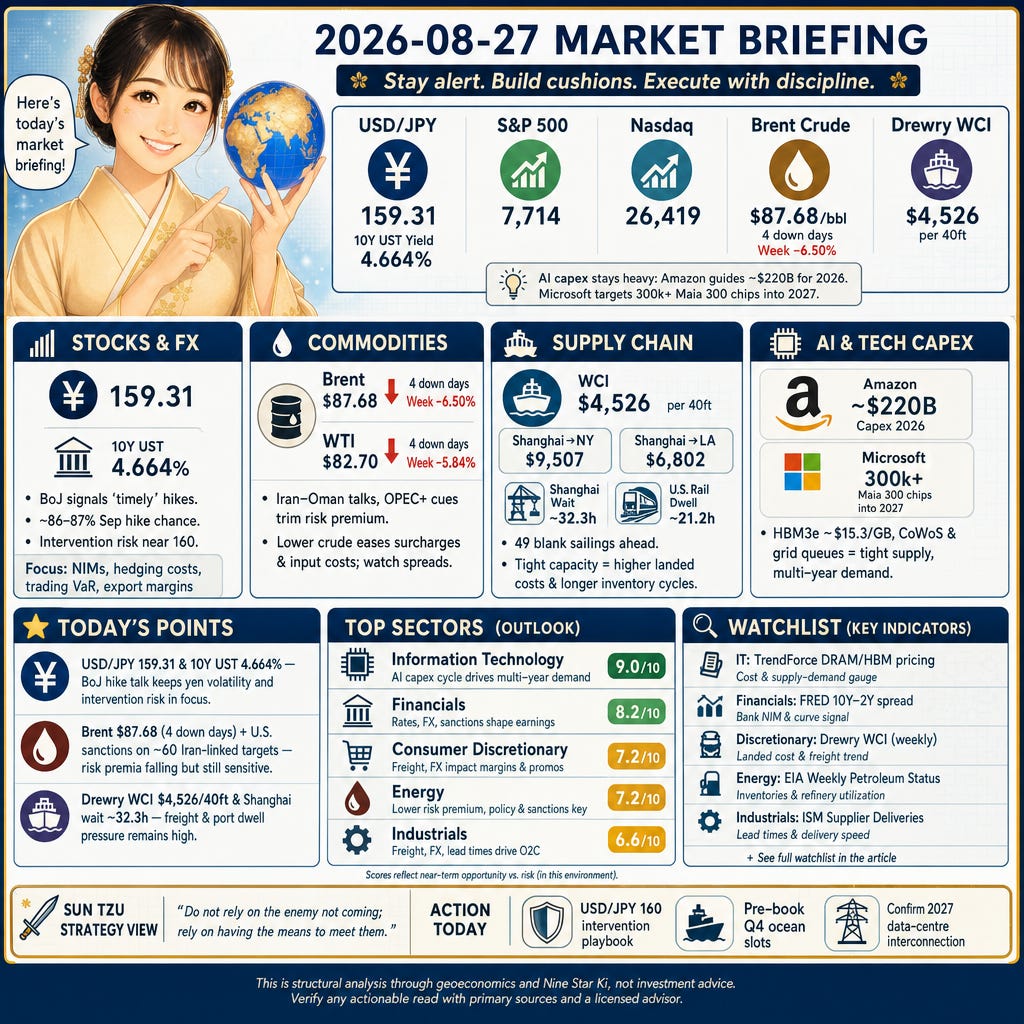
Good morning. USD/JPY sits at 159.31 with the 10Y U.S. Treasury at 4.664%, keeping funding and FX hedging front and center. Brent at $87.68 after four straight down days trims headline energy pressure. Freight remains tight with Drewry’s WCI at $4,526/40ft, while AI capex stays heavy — Amazon guiding ~$220B for 2026 and Microsoft lining up Maia 300 volumes — anchoring tech supply chains.
Stocks and FX
USD/JPY is 159.31 while the 10Y U.S. Treasury yield is 4.664% and equities print S&P 500 7,714 and Nasdaq 26,419, per Reuters. BoJ’s Himino backed “timely” hikes, with markets pricing roughly an 86–87% chance of September action; intervention risk lingers near 160. For Financials, the yield‑curve level and slope shape net interest margins and trading VaR, while FX‑sensitive Consumer Discretionary and Industrials face tighter hedging bands and faster margin math on imports/exports.
Commodities
Brent is $87.68/bbl and WTI $82.70/bbl after four down days, with Reuters noting weekly drops of about 6.50% and 5.84% respectively. Iran‑Oman talks and OPEC+ cues have clipped the Gulf risk premium. Lower crude softens fuel surcharges and petrochemical inputs for Industrials and Materials while easing headline inflation pressure; the flip side is narrower producer spreads if products lag the move.
World Affairs
Roughly 60 Iran‑linked individuals and entities were named in expanded U.S. secondary sanctions, Reuters reports, even as Gulf diplomacy continues. With the Strait of Hormuz historically carrying about one‑fifth of seaborne oil, the channel runs through insured shipping costs, tanker availability, and counterparty risk. Energy price premia, bank compliance workload, and trade‑finance due diligence rise with any broadening of enforcement.
Supply Chain
Drewry’s WCI is $4,526 per 40ft, with Shanghai→New York at $9,507 and Shanghai→Los Angeles at $6,802; 49 blank sailings are flagged ahead, and port/rail dwell remains elevated (Shanghai ~32.3h, Rotterdam ~25.0h, U.S. rail ~21.2h). These levels elongate inventory cycles and raise landed costs for import‑heavy retailers and manufacturers. Planning needs earlier bookings, larger safety stock, and tighter cash conversion monitoring.
AI
Amazon plans about $220B of 2026 capex and Microsoft is targeting 300k+ Maia 300 AI chips for delivery into 2027, per Reuters/Fortune. SiliconAnalysts pegs HBM3e near ~$15.3/GB, keeping per‑accelerator BOMs elevated while advanced packaging (e.g., CoWoS) and grid interconnection queues act as chokepoints. The setup sustains multi‑year demand for accelerators, HBM, substrates, and data‑centre electrical/mechanical kit, supporting Information Technology and upstream Materials suppliers.
Industry News
Bitcoin is $80,380 and Ethereum $2,522 as CoinDesk tallies an eight‑day spot‑ETF inflow run totaling roughly $2.8B. Persistent ETF demand tightens the link between institutional risk appetite and cyclicals, lifting flows into Information Technology and Financials and raising volatility for payments and digital‑asset‑adjacent firms. Correlation risk rises on reversal days when inflows fade.
Industry Forecast
Today’s Setup
For 2026-08-27, a Three Blue Wood (Sanpeki Mokusei, 三碧木星) day in Risshuu (Beginning of Autumn) favors initiation and follow‑through where pipelines already exist. With the month in Two Black Earth (Jikoku Dosei, 二黒土星) and the year in One White Water (Ippaku Suisei, 一白水星), cost discipline and network effects reward projects that have financing and routes secured. Translate this as: use today to scale deployments that are pre‑approved and supplied; watch FX/financing costs, container rates, and power interconnection queues as the binding constraints.
Focus Sectors
Information Technology (9.0/10): $220B Amazon 2026 capex and Microsoft’s 300k+ Maia 300 target lock in multi‑year demand across accelerators, HBM, substrates, and data‑centre kit. HBM3e near ~$15.3/GB and tight CoWoS capacity keep upstream pricing power firm, while grid interconnection queues pace delivery. Why it matters: device and materials vendors can ship at firm margins where capacity is reserved. Watch: TrendForce DRAM/HBM pricing for cost inflection and any export‑control shifts.
Financials (8.2/10): USD/JPY 159.31 and the 10Y UST at 4.664% underpin NIM math, hedging costs, and trading revenues, with markets pricing an 86–87% chance of a September BoJ hike. Expanded U.S. secondary sanctions on ~60 Iran‑linked targets raise compliance and correspondent‑banking workload. Why it matters: curve shape and FX volatility drive earnings dispersion. Watch: FRED 10Y–2Y slope and MoF intervention risk near 160 that can spike VaR.
Consumer Discretionary (7.2/10): Drewry’s WCI at $4,526/40ft (Shanghai→NY $9,507; Shanghai→LA $6,802) extends inventory cycles and raises landed costs, even as Brent at $87.68 relieves fuel surcharges at the margin. USD/JPY near 159 shifts import/export margin math for Japan‑exposed names. Why it matters: promotions and pricing cadence must absorb freight and FX swings. Watch: Drewry WCI and port dwell; renewed blank sailings can re‑inflate costs quickly.
Energy (7.2/10): Brent at $87.68 after four down days (≈6.5% lower week‑on‑week) signals a softer risk premium on Iran‑Oman talks, while U.S. sanctions widened to ~60 Iran‑linked targets. Why it matters: refined‑product spreads, insurance premia through Hormuz, and OPEC+ policy steer near‑term cash flows. Watch: EIA inventories/utilization for balance; disruption or stricter enforcement can re‑inflate premia swiftly.
Industrials (6.6/10): WCI $4,526/40ft and dwell times (Shanghai ~32.3h; U.S. rail ~21.2h) keep supplier deliveries as the gating mechanism, while Brent’s pullback trims fuel/adders. USD/JPY ~159 alters exporter pricing and hedge costs; sanctions add friction to trade finance and project milestones. Why it matters: order‑to‑cash depends on freight bookings and lead‑time control. Watch: ISM Supplier Deliveries for relief or further slippage.
Watchlist
Information Technology: TrendForce DRAM weekly price index (contract/spot DRAM and HBM pricing levels as a near-term cost and supply-demand gauge).
Financials: FRED 10Y minus 2Y Treasury spread (daily yield-curve slope as a proxy for bank NIM potential).
Consumer Discretionary: Drewry World Container Index weekly update (global 40ft container rates on key lanes, a direct landed-cost input).
Energy: EIA Weekly Petroleum Status Report (U.S. crude and product inventories plus refinery utilization, the near-term balance signal).
Industrials: ISM Manufacturing Supplier Deliveries Index (monthly lead-time gauge indicating whether deliveries are speeding up or slowing).
Consumer Staples: BLS CPI Food-at-Home (monthly U.S. grocery price changes as a pass-through and volume elasticity signal).
Materials: LME Copper Official Cash Price (daily benchmark for copper, a broad activity proxy for industrial and construction demand).
Real Estate: Green Street Commercial Property Price Index (monthly U.S. CRE pricing levels as a read on cap rates and transaction momentum).
Utilities: EIA Electric Power Monthly (U.S. generation mix, retail sales, and capacity factors that track demand growth and utility throughput).
Communication Services: S&P Global U.S. Services PMI — New Business (monthly gauge of demand for services, a proxy for marketing and advertising spend momentum).
Health Care: BLS CPI Medical Care (monthly U.S. price changes for medical services and drugs, a proxy for payer pressure and reimbursement trends).
Caveats
Solar‑term boundaries can shift sentiment a day or two around Risshuu, so today’s read is sensitive to timing within the fortnight. Policy levers (MoF FX action, sanctions scope) can flip signals faster than scheduled data; freight and grid indicators also arrive with lags versus on‑the‑ground conditions.
Sun Tzu Strategy View
Sun Tzu wrote: —— Do not rely on the enemy not coming; rely on having the means to meet them.
JPY intervention around 160, Gulf sanction enforcement, and sudden freight re‑tightening are all plausible shocks. Build cushions where chokepoints bite: FX hedges, alternative sailings, and reserved power/interconnection for data‑centre builds.
Action: Pre‑commit critical capacity: keep a USD/JPY 160 intervention playbook, pre‑book Q4 ocean slots, and confirm 2027 data‑centre interconnection queues.
Today’s Points
USD/JPY at 159.31 and 10Y UST yield 4.664% — BoJ ‘timely’‑hike comments keep yen volatility and JPY‑intervention risk in focus for Financials and exporters.
Brent $87.68 (four consecutive down days) + U.S. sanctions on ~60 Iran‑linked targets — energy risk premia are falling but remain sensitive to Gulf shipping and sanction scope.
Drewry WCI $4,526/40ft and Shanghai wait ~32.3 hours — elevated freight and port dwell (plus Amazon ~$220B AI capex) mean persistent input‑cost and logistics pressure for Industrials and Consumer Discretionary.
This is structural analysis through geoeconomics and Nine Star Ki, not investment advice. Verify any actionable read with primary sources and a licensed advisor.