Reader support is what makes Oracle Ayano Project possible. I am pouring my heart into building a generative AI system for large-scale data gathering, analytical synthesis, and article verification, so each piece can offer both accuracy and a fresh perspective. Please consider supporting the project.

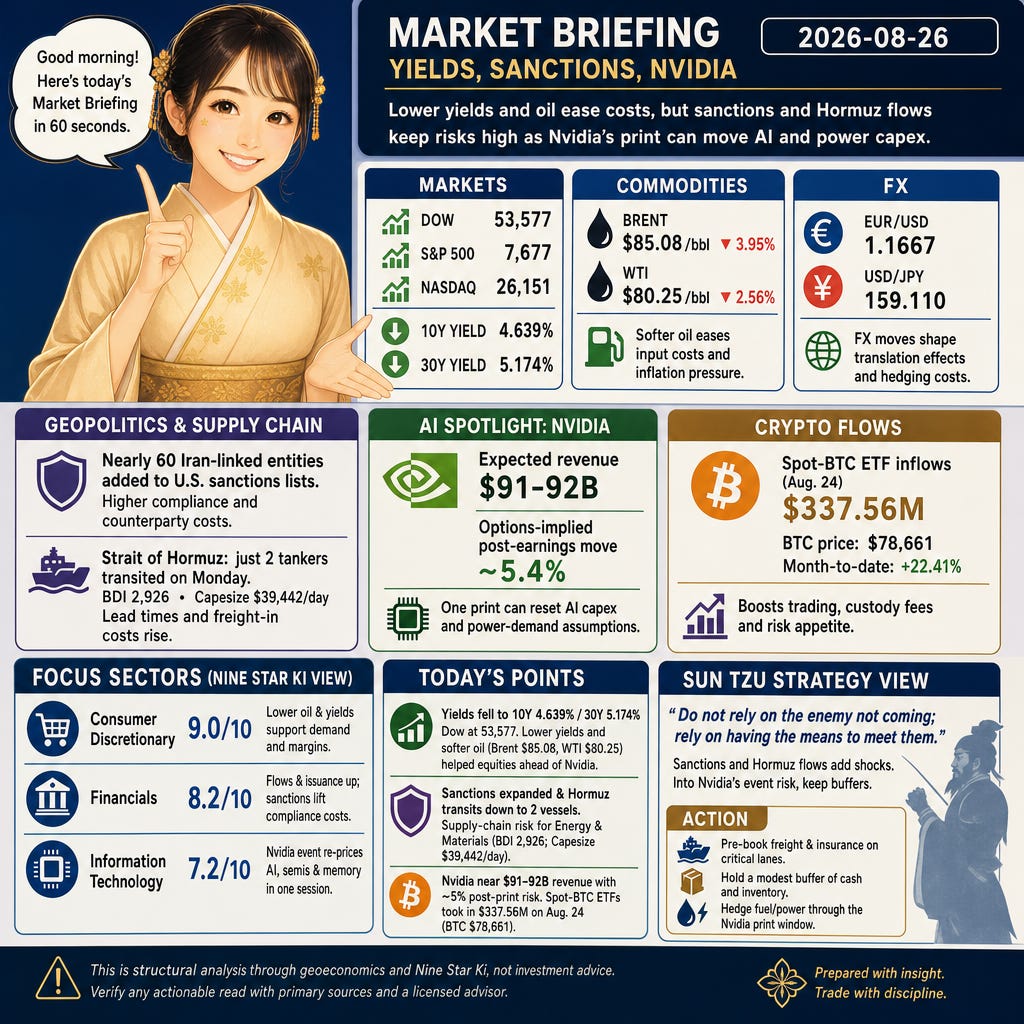
Good morning. Lower long-end yields (10Y 4.639%, 30Y 5.174%) and softer oil (Brent $85.08, WTI $80.25) ease discount rates and input costs. Expanded Iran sanctions and just two Hormuz transits keep freight and compliance risks elevated. Nvidia’s $91–92B event after the close can reset AI-capex and power-demand assumptions.
Stocks and FX
The Dow closed 53,577, the S&P 500 7,677, and the Nasdaq 26,151 as the U.S. 10-year yield fell to 4.639% and the 30-year to 5.174% (Kitco/Reuters). EUR/USD printed 1.1667 while USD/JPY hovered at 159.110, shaping translation effects for multinationals and hedging costs for Financials and Industrials. Softer long-end yields reduce discount-rate pressure on growth stocks and cyclicals ahead of Nvidia’s results, while a firm dollar-yen near 159 keeps Japan-sourced revenues favorable in USD terms.
Commodities
Brent fell 3.95% to $85.08/bbl and WTI 2.56% to $80.25/bbl, with Brent down 7.14% and WTI 6.50% over the week (Investing.com reporting Reuters). Lower crude trims fuel, packaging, and freight surcharges for Consumer Discretionary and Industrials and cools the inflation impulse feeding bond yields. For Energy, weaker flat prices compress upstream cash margins and shift focus to refined-product spreads and trading rather than volume growth.
World Affairs
Nearly 60 Iran-linked targets were added to U.S. sanctions lists in an expanded secondary-sanctions push (Associated Press). The broader remit raises counterparty-screening and routing costs for banks, shippers, and traders, lifting shipping insurance and selective trade frictions. Net effect: higher compliance opex for Financials and episodic risk premia for Energy and Materials, even as headline oil eased.
Supply Chain
Just 2 tankers transited the Strait of Hormuz on Monday while the Baltic Dry Index printed about 2,926 and Capesize earnings roughly $39,442/day (gCaptain reporting Reuters/Baird Maritime). The near-halt at Hormuz tightens physical flows and can extend lead times, while firmer dry-bulk rates lift freight-in costs. Inventory planners should expect wider landed-cost dispersion and longer reorder cycles on Middle East–linked lanes.
AI
$91–92B in expected Nvidia revenue with an options-implied ~5.4% post-earnings swing sets elevated event risk (RecessionAlert/CappNotes). A beat/miss can re-rate semiconductors, HBM memory and advanced packaging capacity, and cloud-capex plans within hours. Utilities feel this via data-center power demand, while lower yields help cushion long-duration tech valuations into the print.
Industry News
$337.56m in net spot-Bitcoin ETF inflows on Aug. 24 accompanied a snapshot BTC price of $78,661 and about +22.41% month-to-date (CoinDesk). Rising ETF AUM and prices lift trading volumes, custody/admin fees, and risk appetite across Financials, with spillovers to Information Technology via correlations and infrastructure demand. Liquidity swings can amplify equity and derivatives moves around major tech events.
Industry Forecast
Today’s Setup
2026-08-26 sits in Four Green Wood (Shiroku Mokusei, 四緑木星), with the month in Two Black Earth (Jikoku Dosei, 二黒土星) and the year in One White Water (Ippaku Suisei, 一白水星), during Risshuu (Beginning of Autumn). Diffusion favors networks and commerce hubs: cheaper fuel and lower yields support throughput and financing, but Hormuz routing frictions and sanctions keep lead times and compliance costs high; Nvidia’s print can redirect AI and power-capex flows quickly.
Focus Sectors
Consumer Discretionary (9.0/10): Brent near $85 and WTI near $80 (Investing.com/Reuters) plus softer long-end yields (10Y 4.639%) ease fuel surcharges and financing, improving operating leverage for retailers, autos, travel, and leisure. Better checkout conversion and leaner last‑mile costs support margins as volumes hold. Watch for a sanctions or Hormuz flare-up to re-inflate freight and insurance, and for any rapid yield backup that would cool big-ticket demand. Keep an eye on the U.S. Census retail sales print for demand confirmation.
Financials (8.2/10): Long yields slipping (10Y 4.639%, 30Y 5.174% per Reuters) can compress NIM but lift issuance, trading, and risk appetite. Crypto flows help activity: spot‑BTC ETFs drew $337.56m (CoinDesk), supporting custody and brokerage fees. Expanded secondary sanctions (AP) raise onboarding and payments-routing costs, concentrating compliance risk. A sudden curve re‑steepening or credit‑loss uptick would hit capital ratios. Track the Fed’s SLOOS for lending standards and demand into Q3.
Information Technology (7.2/10): Nvidia’s $91–92B revenue setup with ~5% options‑implied move (RecessionAlert) can re-price semis, HBM memory, advanced packaging, and AI-adjacent software in one session. Lower long-end yields ease the discount-rate drag on long-duration names, but bottlenecks in HBM/packaging and power availability at data-center hubs can cap shipment growth. A guidance reset by hyperscalers would ripple into tools and components. Watch SEMI North America equipment billings for fab-tool momentum.
Watchlist
Consumer Discretionary: U.S. Census Bureau Advance Monthly Retail Trade Report (monthly headline retail sales and control-group sales used in GDP tracking).
Financials: Federal Reserve Senior Loan Officer Opinion Survey (SLOOS) on Bank Lending Practices (quarterly survey of lending standards and loan demand).
Information Technology: SEMI North America Semiconductor Equipment Billings (monthly fab tool spending by chipmakers).
Consumer Staples: FAO Food Price Index (monthly global food commodity prices across cereals, oils, dairy, meat, and sugar).
Materials: London Metal Exchange (LME) daily warehouse copper stocks and cancellations (available inventories and scheduled withdrawals signaling near-term tightness).
Real Estate: Freddie Mac Primary Mortgage Market Survey (PMMS) — 30-year fixed mortgage rate (weekly U.S. mortgage-rate benchmark).
Utilities: EIA Electric Power Monthly (U.S. generation mix, retail sales, and average retail electricity prices by state and sector).
Industrials: ISM Manufacturing PMI — Supplier Deliveries and Backlog of Orders (monthly U.S. manufacturing lead-time and backlog gauges).
Energy: EIA Weekly Petroleum Status Report (weekly U.S. crude and product inventories and refinery utilization).
Health Care: FDA CDER Drug and Biologic Approvals (monthly counts of approvals and review timelines).
Communication Services: Nielsen The Gauge (monthly U.S. TV and streaming viewing share by platform).
Caveats
A fast re-steepening in long-end yields or a sharp oil rebound from a shipping incident would flip the discount‑rate and input‑cost relief embedded today. Nvidia’s print is a single-node shock that can override the day’s diffusion bias; shipping tallies are volatile day to day, so Hormuz flow could normalize faster—or tighten further—than weekly averages imply.
Sun Tzu Strategy View
Sun Tzu wrote: —— Do not rely on the enemy not coming; rely on having the means to meet them.
With sanctions widening and Hormuz down to two transits, assume routing shocks can recur and price insurance, inventory buffers, and alternative lanes accordingly. Into Nvidia’s event risk, keep liquidity and hedges sized so a surprise does not force reactive de‑risking.
Action: Pre-book freight and insurance on critical lanes, hold a modest buffer of cash and inventory, and hedge fuel/power through the Nvidia print window.
Today’s Points
U.S. yields fell to 10Y 4.639% / 30Y 5.174% while the Dow sits at 53,577 — lower yields plus oil easing (Brent $85.08, WTI $80.25) helped equities recover ahead of Nvidia’s results.
Geopolitics: Treasury added nearly 60 Iran-linked entities to sanctions lists and Strait of Hormuz transits dropped to 2 vessels, a direct supply-chain risk for Energy and Materials (BDI 2,926; Capesize $39,442/day).
AI and flows: Nvidia guidance/consensus sits near $91–92B in revenue with options pricing ~5% post-print risk — at the same time spot-BTC ETFs took in $337.56M on Aug. 24 as Bitcoin tested $80k (BTC $78,661).
This is structural analysis through geoeconomics and Nine Star Ki, not investment advice. Verify any actionable read with primary sources and a licensed advisor.