Reader support is what makes Oracle Ayano Project possible. I am pouring my heart into building a generative AI system for large-scale data gathering, analytical synthesis, and article verification, so each piece can offer both accuracy and a fresh perspective. Please consider supporting the project.

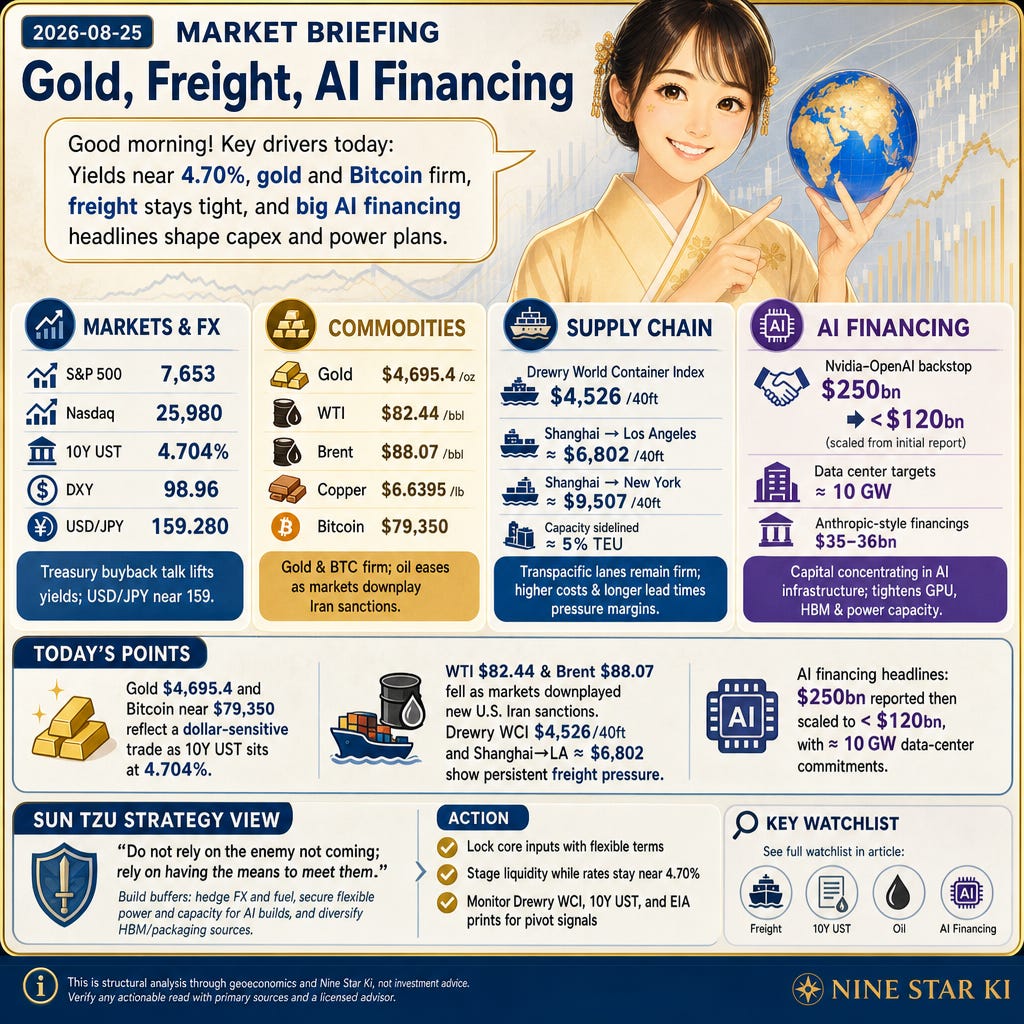
Good morning. The 10-year U.S. Treasury sits at 4.704% and USD/JPY has drifted back toward 159, while gold at $4,695/oz and Bitcoin near $79,350 reflect dollar‑sensitive flows. WTI $82.44 and Brent $88.07 eased as markets downplayed new Iran sanctions. Transpacific freight remains firm — Drewry’s WCI is $4,526/40ft — and AI infrastructure financing headlines, scaled from $250bn to under $120bn, continue to shape capex and power planning.
Stocks and FX
159.280 USD/JPY, 7,653 on the S&P 500, 25,980 on the Nasdaq, a 4.704% 10‑year, and a dollar index near 98.96 set the tape, per Reuters (published on Investing.com). Treasury buyback talk and expanded Iran sanctions framed the dollar’s path as yen‑intervention effects faded back toward the 159 line. A 4.70% long end keeps equity discount rates elevated and lifts FX hedging costs in USD‑funded supply chains. Yen weakness supports Japan‑exposed exporters on translation but complicates input hedges for Industrials and Consumer names.
Commodities
$4,695.4/oz gold, $82.44/bbl WTI, $88.07/bbl Brent, and $6.6395/lb copper — Investing.com (with Reuters data) shows bullion firm on buyback/dollar signals while oil and copper eased. Lower crude compresses near‑term refining cracks and lightens gasoline/jet input pressure for travel, logistics, and retailers. Copper near $6.64/lb still underpins upstream costs for machinery and AI‑hardware builds. For Materials, gold’s strength nudges capital toward bullion‑linked projects; for Energy, softer crude narrows margin cushions into the shoulder season.
World Affairs
$88.07 Brent and $82.44 WTI fell even as the U.S. widened Iran sanctions on Aug 24–25, Reuters reports, with markets pricing a limited supply shock rather than forced reroutes. The policy stance lifts compliance and shipping‑insurance costs but hasn’t repriced physical flows. Energy must watch for any escalation that reshapes the curve; Financials face added screening and trade‑finance overhead.
Supply Chain
$4,526/40ft on Drewry’s World Container Index and ~$6,802/40ft Shanghai→Los Angeles — Drewry/MTS flag firm transpacific lanes, with Shanghai→New York near $9,507 and roughly 5% TEU capacity sidelined by congestion (Laminar361). Higher landed costs elongate reorder cycles and raise weeks‑of‑supply, pressuring Consumer Discretionary margins and Industrial procurement. Tight capacity also slows IT‑hardware restocking and forces Materials suppliers to manage pass‑through carefully.
AI
<$120bn scaled from a reported $250bn Nvidia‑OpenAI backstop, 10 GW data‑center targets, and Anthropic‑style $35–36bn financings — WSJ/Reuters coverage shows AI infrastructure capital concentrating. That pulls demand forward for GPUs and HBM (high‑bandwidth memory), tightens advanced packaging (CoWoS) supply, and heightens credit and power‑contract exposure. Real‑estate campuses with available power and Utilities navigating interconnection queues sit at the fulcrum of delivery risk and upside.
Industry News
$79,350 Bitcoin with intraday prints above $80k and $337.6m net inflows into U.S. spot ETFs on Aug 24 (Farside/SoSoValue via Reuters/Investing) extend a multi‑day streak; weekly inflows ran ~$1.92bn to Aug 21. Deeper institutional flows lift liquidity and raise beta correlation with tech equities. Financials see incremental custody/trading revenue potential, while Consumer Discretionary can catch ancillary spend and engagement effects.
Industry Forecast
Today’s Setup
On 2026-08-25, Five Yellow Earth (Goou Dosei, 五黄土星) sits at the center under a Two Black Earth (Jikoku Dosei, 二黒土星) month and a One White Water (Ippaku Suisei, 一白水星) year during Risshuu (Beginning of Autumn). Expect policy-led pivots to dominate: freight at $4,526/40ft sets costs and inventory timing, a 4.704% 10-year anchors financing math, and AI-build funding decisions steer capex pipelines and power procurement.
Focus Sectors
Information Technology (8.4/10): Multi‑$10–100bn AI financing — an initially reported $250bn backstop later scaled to under $120bn and 10 GW build plans (WSJ/Reuters) — pulls GPU/HBM demand forward and concentrates underwriting and supplier exposure. Copper around $6.64/lb and elevated ocean freight slow hardware restocking at the margin, while a 4.704% 10‑year keeps the sector’s discount rate in play. Crypto ETF flows (~$338m/day) add a liquidity beta. Watch HBM and CoWoS capacity; a rate spike or financing pullback would pressure multiples and pipelines.
Consumer Discretionary (8.4/10): Transpacific freight is the chokepoint: Drewry’s WCI at $4,526/40ft and Shanghai→LA near $6,802/40ft keep landed costs and weeks‑of‑supply elevated, forcing tighter pricing and promotion calendars. Oil’s pullback (WTI $82.44, Brent $88.07) eases jet/gasoline pressure for travel/leisure, partially offsetting logistics strain. USD/JPY near 159 shapes translation for Asia‑exposed sellers, while a 4.704% 10‑year raises BNPL and auto‑loan costs. If carriers hold GRIs and blank sailings into peak, gross margins compress.
Consumer Staples (7.6/10): Retail logistics is the fulcrum: WCI $4,526/40ft and Shanghai→US lanes above $6,000/40ft lengthen reorder cycles and elevate inventory management needs. Softer oil helps freight and plastics inputs versus earlier summer highs, cushioning some ocean‑rate pressure. Dollar/yield volatility steers private‑label mix and promo cadence, but shelf priority and replenishment contracts support throughput. Persistent container tightness or a spike in agricultural benchmarks would test pass‑through; watch FAO food prices for early stress.
Financials (7.6/10): The curve is the instrument: a 4.704% 10‑year and Treasury buyback chatter reshape net interest margin and securities marks (Reuters). Crypto ETF inflows (~$338m/day) and AI megaproject financings widen fee and underwriting pipes but add custody and contingent credit exposures. Iran‑related sanctions lift compliance and trade‑finance screening costs without a default repricing yet. A parallel shift higher compresses securities valuations; concentrated AI guarantees heighten counterparty risk.
Materials (7.6/10): Upstream pricing stays supportive: copper near $6.64/lb with tighter SHFE/LME balances (Investing/Reuters citing Shanghai Metals Market) aids miners and specialty metals margins, while gold around $4,695/oz tilts capital allocation toward bullion‑linked projects. Elevated ocean freight raises delivered input costs and stretches restocking cycles for downstream customers. If China on‑dock inventories rebuild or LME spreads loosen, copper support could fade quickly; rising shipping‑insurance premia would erode margins on bulk routes.
Energy (6.6/10): Sanctions policy and refined‑product spreads drive the tape: Reuters notes expanded U.S. Iran sanctions even as Brent ($88.07) and WTI ($82.44) eased on a perceived limited supply shock, compressing near‑term cracks. Shipping‑insurance premia and route risks persist but haven’t forced a crude reroute premium into the curve. Inventory and refinery‑utilization prints will decide if cracks re‑expand into the shoulder season. Escalation in Hormuz/Red Sea or abrupt OPEC+/SPR shifts would whipsaw curves and capex plans.
Watchlist
Consumer Discretionary: Drewry World Container Index (weekly global container freight rates across major lanes).
Information Technology: TrendForce HBM contract price index (monthly high-bandwidth memory pricing and supply balance).
Consumer Staples: UN FAO Food Price Index (monthly global food commodity prices across cereals, oils, dairy, meat, sugar).
Financials: Federal Reserve SLOOS (Senior Loan Officer Opinion Survey; quarterly U.S. bank lending standards and loan demand).
Materials: LME Copper 3-Month price (London Metal Exchange benchmark for refined copper).
Energy: EIA Weekly Petroleum Status Report (weekly U.S. crude and product inventories plus refinery utilization).
Industrials: S&P Global Manufacturing PMI – Supplier Delivery Times (monthly vendor lead-time changes).
Real Estate: Green Street Commercial Property Price Index (monthly U.S. commercial real estate pricing).
Utilities: EIA Electric Power Monthly (U.S. generation mix, capacity additions, and retail sales by sector).
Communication Services: S&P Global U.S. Services PMI – New Business (monthly gauge of demand for services and marketing-related activity).
Health Care: FDA CDER/CBER drug and biologics approvals (monthly agency reports of new approvals and review outcomes).
Caveats
A sharp break in freight — carriers rolling back GRIs or congestion easing — would quickly change inventory timing and margin math across goods sectors. Conversely, a decisive move away from 4.704% on the 10-year or a confirmed upsizing/downsizing of AI financing packages would reset discount rates and capital availability just as early‑autumn demand signals firm.
Sun Tzu Strategy View
Sun Tzu wrote: —— Do not rely on the enemy not coming; rely on having the means to meet them.
Freight tightness, a 4.70% long end, and sanctions risk won’t wait for ideal timing. Build buffers: hedge FX and fuel, secure flexible power and capacity for AI builds, and diversify HBM/packaging sources so projects hold schedule even if one channel slips.
Action: Lock core inputs with flexible terms, stage liquidity while rates stay near 4.70%, and monitor Drewry WCI, 10Y UST, and EIA prints for pivot signals.
Today’s Points
Gold at $4,695.4 and Bitcoin near $79,350 reflect a dollar‑sensitive ‘debasement’ trade after Treasury buyback talk drove the 10Y UST to 4.704%.
WTI $82.44 and Brent $88.07 fell as markets downplayed new U.S. Iran sanctions, while Drewry’s WCI at $4,526/40ft and Shanghai→LA ≈ $6,802 point to persistent transpacific freight cost pressure.
AI financing headlines — an initial $250bn Nvidia backstop discussed and later reports of a scaled figure below $120bn (with Anthropic‑style $35–36bn compute financings) — underscore multi‑GW (≈10 GW) data‑centre commitments and large contingent capital needs impacting Information Technology, Utilities and Real Estate.
This is structural analysis through geoeconomics and Nine Star Ki, not investment advice. Verify any actionable read with primary sources and a licensed advisor.