Reader support is what makes Oracle Ayano Project possible. I am pouring my heart into building a generative AI system for large-scale data gathering, analytical synthesis, and article verification, so each piece can offer both accuracy and a fresh perspective. Please consider supporting the project.

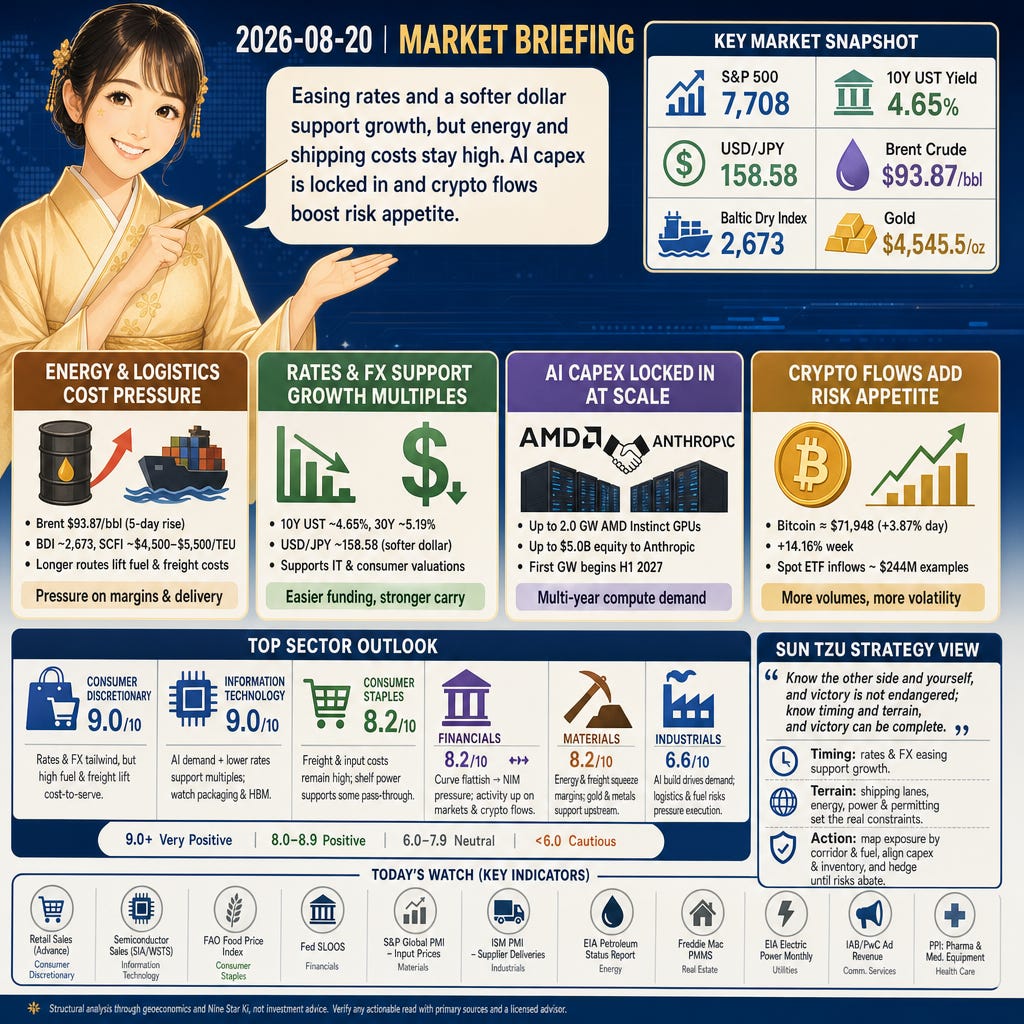
Good morning. Easing U.S. yields and a softer dollar are meeting stubborn energy and freight costs, while AI capex stays firmly in build mode. Brent near $93.9 and elevated ocean freight keep input costs tight just as the 10-year sits around 4.65%. The AMD–Anthropic tie anchors multi‑year compute demand even as crypto flows add a speculative layer to risk appetite.
Stocks and FX
7,708 on the S&P 500, USD/JPY at 158.58, and the 10Y UST near 4.653% set today’s tone (Investing.com/Reuters). A lighter dollar and lower long rates support growth‑stock and REIT multiples, and improve FX translation for global Consumer names. The 30Y sits near 5.19%, keeping real‑asset discount rates in focus. For Financials, lower long yields can compress net interest margin even as trading and payments activity benefit from the risk backdrop.
Commodities
Brent at $93.87/bbl and WTI at $86.70/bbl extended a five‑day climb as OPEC+ adjustments (~188 kbpd) and Red Sea shipping risk held supply premia (Economic Times, industry reporting). Higher crude lifts transport, packaging, and petrochemical inputs for Industrials, Consumer, and Materials, while supporting upstream Energy cash generation. Elevated oil can nudge inflation expectations and complicate rate‑path assumptions.
World Affairs
$4,545.5/oz gold alongside $93.87 Brent reflects persistent safe‑haven and supply‑risk premia tied to Red Sea and regional tensions (UNCTAD; MarketScreener/Reuters excerpts). UNCTAD highlights route‑specific SCFI spikes (e.g., ~$5,426/TEU), keeping shipping‑dependent sectors on margin watch. The channel is straightforward: pricier, slower lanes raise landed costs and encourage hedging across Financials and Industrials.
Supply Chain
2,673 on the Baltic Dry Index and SCFI route quotes in the ~$4,500–$5,500/TEU band confirm sustained ocean‑freight stress (OilPriceAPI; UNCTAD). Cape diversions lengthen voyages and tie up boxes, pushing out delivery windows and raising inventory carry. Retailers, staples, and manufacturers face higher cost‑to‑serve and tighter reorder buffers until lanes normalize.
AI
Up to 2.0 GW of AMD Instinct GPUs and up to $5.0B of potential equity into Anthropic, with the first GW slated to begin H1 2027, lock in multi‑year accelerator and data‑center demand (AMD press release; Reuters via Investing.com). Anthropic’s in‑house chip push (~$0.5B design program estimate) signals deeper verticalization. Implications: tighter advanced‑packaging/HBM supply, greater power and site requirements, and steadier pipelines for component and infrastructure vendors.
Industry News
$71,948 on Bitcoin (+3.87% day; +14.16% week) rides renewed spot‑ETF inflows (recent example ~$244.4M), concentrating activity in digital‑asset rails (DailyMarket.report, flow trackers). This supports transaction volumes for Payments/Fintech and brokerages and can lift risk sentiment in IT and Communication Services. Volatility also broadens hedging and liquidity needs in Financials.
Industry Forecast
Today’s Setup
2026-08-20 is a One White Water (Ippaku Suisei, 一白水星) day in a Two Black Earth (Jikoku Dosei, 二黒土星) month during the Risshuu (Beginning of Autumn) solar term; the year is also One White Water. Expect rates, FX, and logistics prints to drive the tape: easier funding supports IT and consumer demand signals, but shipping and fuel costs remain the constraint to margins and delivery reliability.
Focus Sectors
Consumer Discretionary (9.0/10): Brent $93.9 and SCFI routes ~$4,500–$5,500/TEU keep transport and delivery costs elevated, while last‑mile capacity and card/acquirer rails set checkout and fulfillment speed. Softer U.S. rates (10Y 4.65%) and a weaker dollar (USD/JPY 158.6) lift valuations and FX translation, supporting durable and travel/leisure demand. The rub is cost-to-serve: high diesel and container premiums stretch delivery times and inventory cycles, pressuring gross margin. Risk: oil anchored at $90–95 and any dollar rebound. Watch U.S. Census Advance Retail Sales for demand and the GDP‑feeding core.
Information Technology (9.0/10): Up to 2.0 GW of AMD Instinct GPUs and up to $5.0B equity into Anthropic signal multi‑year AI compute demand, cascading to accelerators, power, cooling, and cloud software pipelines. Lower discount rates (10Y 4.65%) extend tolerance for longer‑duration cash flows, sustaining multiples. Bottlenecks in advanced packaging (CoWoS) and HBM memory bandwidth may cap quarterly shipments, while site power and permits can gate data‑center go‑lives. Watch SIA/WSTS Global Semiconductor Sales for run‑rate confirmation and mix shifts between data‑center, PC, and handset silicon.
Consumer Staples (8.2/10): Freight remains a tax: BDI ~2,673 and SCFI route prints near $5,426/TEU lift ocean, packaging, and warehousing costs, while Brent $93.9 raises diesel and resin inputs. Shelf power supports partial pass‑through, but timing lags keep gross margin tight, notably in EM‑sourced categories. Easing rates help working capital and refinancing, stabilizing cash conversion. Risks: persistent diesel/freight premia and weather/crop shocks stacking on logistics stress. Watch the UN FAO Food Price Index for upstream cost pressure that flows directly into COGS and promotional cadence.
Financials (8.2/10): The yield curve is the instrument: with 10Y UST ~4.65%, NIM faces compression unless a bull steepener develops, even as activity picks up in brokerage, payments, and hedging amid oil and freight volatility. Crypto risk appetite has also re‑emerged (BTC ~$71,948; spot ETF inflow examples ~$244M), lifting transaction volumes at the margin. Risks: deposits repricing faster than assets, unsecured consumer normalization, and CRE refi cliffs raising provisions. Watch the Fed’s SLOOS for lending standards and demand across C&I, consumer, and CRE.
Materials (8.2/10): Maritime detours and energy input costs dominate: Red Sea diversions and BDI ~2,673 lengthen delivery times and raise landed costs, while Brent near $93.9 lifts mining and chemical energy spend. Safe‑haven metals pricing (gold ~ $4,545.5/oz) supports upstream revenue, but converters face squeezed spreads as feedstock and freight outrun pass‑through. Risk: a further oil spike compresses ammonia/plastics margins; conversely, a rapid easing in shipping risk can whipsaw pricing power and backlog quality. Watch S&P Global Manufacturing PMI — Input Prices for cost‑pressure direction.
Industrials (6.6/10): Order conversion hinges on supplier delivery and transport reliability: Red Sea detours keep schedules long and surcharges high (BDI ~2,673), while higher oil flows into diesel and jet fuel pass‑throughs. Offsetting, AI data‑center buildouts (AMD–Anthropic up to 2.0 GW) pull demand for electrical gear, switchgear, HVAC, and backup power, supporting backlogs. Risks: fuel/freight inflation eroding fixed‑bid margins and delivery slippage triggering liquidated damages on EPC contracts; capex crowd‑out in non‑AI verticals. Watch ISM Supplier Deliveries for lead‑time trend.
Watchlist
Consumer Discretionary: U.S. Census Bureau Advance Monthly Retail Sales (headline and control group) — real‑time retail demand and the core subset that feeds GDP.
Information Technology: SIA/WSTS Global Semiconductor Sales (monthly, Semiconductor Industry Association/World Semiconductor Trade Statistics) — worldwide chip sales run‑rate and mix.
Consumer Staples: FAO Food Price Index (monthly, UN FAO) — global food‑commodity prices that flow directly into COGS.
Financials: Federal Reserve SLOOS (quarterly Senior Loan Officer Opinion Survey) — lending standards and loan demand across C&I, consumer, and CRE.
Materials: S&P Global Manufacturing PMI — Input Prices (monthly) — producer cost pressure across major manufacturing hubs.
Industrials: ISM Manufacturing PMI — Supplier Deliveries Index (monthly) — whether supplier lead times are lengthening or improving.
Energy: EIA Weekly Petroleum Status Report (weekly U.S. crude inventories and refinery utilization) — stockpiles and throughput that drive cracks and spreads.
Real Estate: Freddie Mac Primary Mortgage Market Survey (weekly 30‑year fixed mortgage rate) — household mortgage financing costs and housing affordability.
Utilities: EIA Electric Power Monthly — generation mix, retail sales, and average revenues by customer class.
Communication Services: IAB/PwC U.S. Internet Advertising Revenue Report (quarterly) — digital ad spend across formats and sectors.
Health Care: BLS Producer Price Index — Pharmaceuticals and Medical Equipment (monthly) — input and pricing pressure along the health‑care supply chain.
Caveats
The next solar‑term transition within late August can shift rate and demand tone around month‑end, changing the balance between funding relief and cost pressure. Route‑specific shipping quotes are illustrative; firm exposure depends on lanes and contracts, and a rapid move in crude or the dollar would alter the sector skew.
Sun Tzu Strategy View
Sun Tzu wrote: —— Know the other side and yourself, and victory is not endangered; know timing and terrain, and victory can be complete.
Today’s edge comes from reading timing (rates and FX) together with terrain (shipping lanes, power grids, and permitting). Cheaper funding helps IT and consumers, but margins hinge on chokepoints in freight and energy. Align capex and inventory with the corridors you can reliably use; hedge where the terrain is still shifting.
Action: Map exposure by corridor and fuel: pair funding plans with assured routes and power, and keep oil/freight hedges until Red Sea risk demonstrably abates.
Today’s Points
Energy and logistics squeeze: Brent $93.87/bbl and BDI ~2,673 imply higher fuel and freight costs for Industrials and Consumer Discretionary.
Rates and FX relieve growth carry: 10Y UST ~4.65% with USD/JPY ~158.58 helped the S&P 500 hold at 7,708 while boosting Information Technology multiples.
AI capex confirmed at scale — AMD/Anthropic: up to 2.0 GW of GPUs and up to $5.0B equity commitment — keeps semiconductor and datacenter demand intact even as Bitcoin (≈ $71,948) draws fresh ETF flows (~$244M examples).
This is structural analysis through geoeconomics and Nine Star Ki, not investment advice. Verify any actionable read with primary sources and a licensed advisor.