Reader support is what makes Oracle Ayano Project possible. I am pouring my heart into building a generative AI system for large-scale data gathering, analytical synthesis, and article verification, so each piece can offer both accuracy and a fresh perspective. Please consider supporting the project.

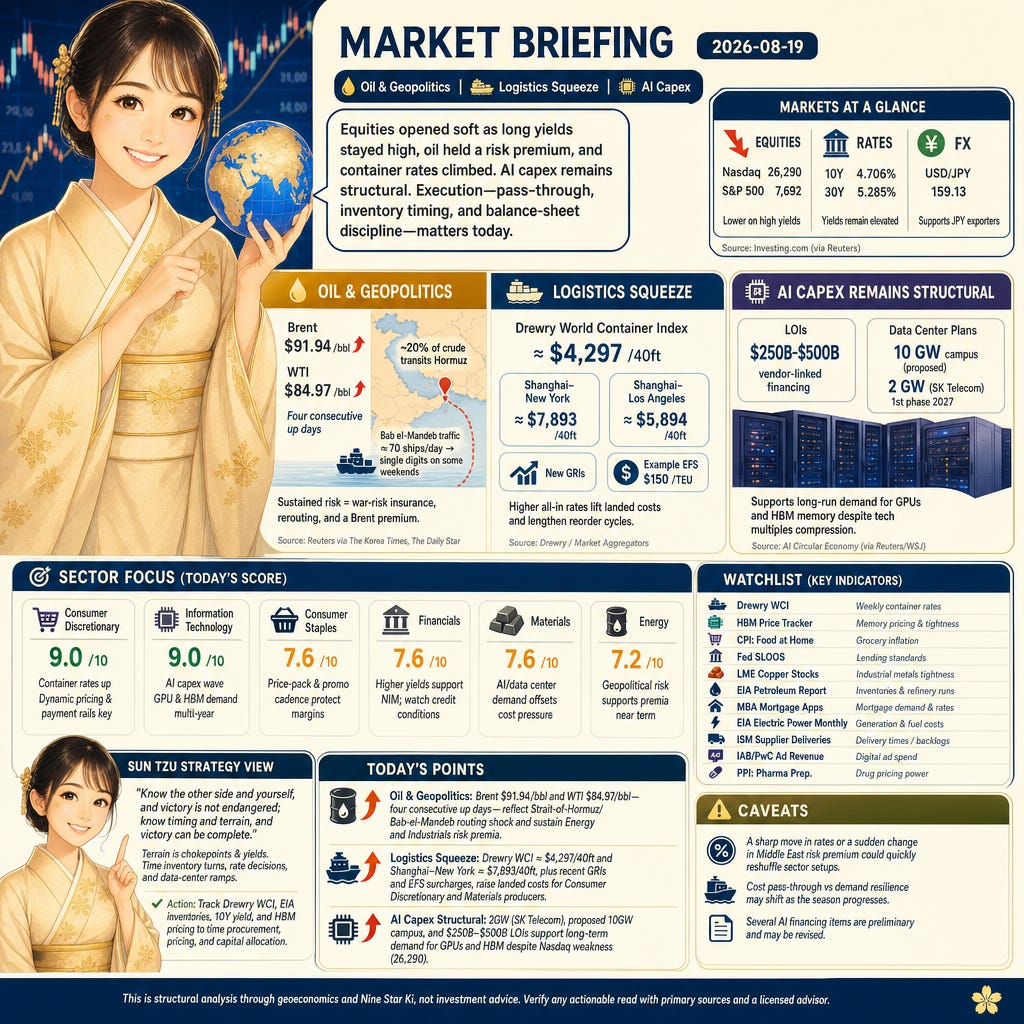
Good morning. Equities opened soft as long yields stayed high, oil held a risk premium, and container rates climbed. The cost stack—fuel plus freight—meets an AI capex wave that keeps chip and memory demand firm even as tech multiples compress. Two Black Earth emphasizes execution: pass-through, inventory timing, and balance-sheet discipline matter today.
Stocks and FX
Nasdaq 26,290 and S&P 500 7,692 fell as the U.S. 10-year yield printed 4.706% and the 30-year 5.285%, with USD/JPY near 159.13, per Investing.com reporting Reuters coverage. Higher discount rates pressure long-duration tech, shifting flows toward rate beneficiaries. The FX level supports Japanese exporters’ translations but tightens global hedging costs. Expect valuation sensitivity to persist while yields stay elevated.
Commodities
Brent $91.94/bbl and WTI $84.97/bbl extended a four-day rise, while gold printed $4,421.8/oz, The Daily Star reported via Reuters. Oil’s risk premium lifts input costs across transport and manufacturing and can feed back into inflation expectations and yields. Higher refined-product cracks squeeze fuel-intensive operators unless surcharges pass through quickly.
World Affairs
About 20% of global crude historically transits the Strait of Hormuz, and Bab el-Mandeb traffic has dropped from ~70 ships/day to single digits on some weekends, The Korea Times reported via Reuters. Embassy advisories urging departures underscore sustained risk, which translates into war-risk insurance, rerouting, and a Brent premium. Energy, Industrials, and Materials margins hinge on these chokepoints.
Supply Chain
Drewry’s World Container Index is ≈ $4,297/40ft, with Shanghai–New York at ≈ $7,893 and Shanghai–Los Angeles ≈ $5,894, alongside new GRIs and an example EFS of $150/TEU, per Drewry/market aggregators. Higher all‑in rates lift landed costs and lengthen reorder cycles, pressuring Consumer Discretionary and Industrials margins. Inventory planning leans toward tighter turns and selective onshoring.
AI
LOIs of $250B–$500B and a proposed 10GW campus, plus a 2GW SK Telecom facility (first phase 2027), were cited by AI Circular Economy (aggregating Reuters/WSJ). Multi‑year AI capex supports GPU and HBM demand and data‑center buildouts, aiding Information Technology and select Real Estate. Vendor‑embedded financing raises balance‑sheet risk for suppliers if rates rise further.
Industry News
SK Group’s ~ $750B package inside a near-$950B Korea-wide AI initiative, including an Nvidia–SK Hynix component ‘more than $500B,’ was reported by AOL citing Reuters. Such commitments support Materials and semiconductor supply chains but imply sustained capital intensity and potential component price firmness. Construction demand for high‑power data centers extends into 2027 and beyond.
Industry Forecast
Today’s Setup
2026-08-19 aligns day and month in Two Black Earth (Jikoku Dosei, 二黒土星) under Risshuu (Beginning of Autumn), with the year set by One White Water (Ippaku Suisei, 一白水星). Expect markets to reward cost pass‑through and cash conversion while routing and rate paths—shipping lanes, payment rails, and bond yields—set the longer‑run contour.
Focus Sectors
Consumer Discretionary (9.0/10): Container rates (Drewry WCI ≈ $4,297/40ft) and carrier fuel surcharges lift COGS, but scaled platforms lean on payment rails and dynamic pricing to keep conversion and gross margin resilient. This favors marketplaces and omnichannel operators with strong ad‑to‑checkout funnels and loyalty loops. Watch for credit normalization—rising revolve rates can trim ticket sizes where BNPL and cards drive baskets—and for port congestion extending inventory cycles.
Information Technology (9.0/10): AI capex headlines—$250B–$500B vendor‑linked financing and 2–10GW data‑center plans—anchor multi‑year demand for GPUs and HBM, even as the 10Y at ~4.706% pressures valuations. CoWoS‑class packaging and HBM availability remain the cadence setters for shipments and pricing power. Embedded financing can migrate risk to supplier balance sheets if funding costs climb; memory price trackers will signal margin direction.
Consumer Staples (7.6/10): With Brent near $91.94 and freight elevated, price‑pack architecture and promo cadence are the margin valves. Large staples can pace pass‑through by mix and shelf strategy while negotiating timing with retailers to recover gross margin. Private‑label gains remain the key risk if branded pricing runs ahead of value perception. FX and port delays can stretch working capital; expect cautious inventory posture into peak seasons.
Financials (7.6/10): The curve at ~4.706% (10Y) and ~5.285% (30Y) supports net interest margin if funding costs lag asset yields, while oil’s inflation bid can sustain higher rates. Fee income depends on credit formation without a jump in delinquencies; CRE valuations remain a swing factor for capital and reserves. A further rate spike or tighter standards would slow loan growth; easing would lift origination but compress NIM.
Materials (7.6/10): AI/data‑center programs support copper, specialty chemicals, and substrates demand, while oil and freight inflate opex and stretch reorder cycles. Tight LME copper inventories would confirm throughput strength and pricing power; permitting remains the gating factor for capacity. A China growth air pocket would weaken base‑metals pricing; sustained freight surcharges raise working‑capital needs and could shift sourcing closer to end markets.
Energy (7.2/10): Brent $91.94 and WTI $84.97 reflect Hormuz/Bab el‑Mandeb risk, with war‑risk insurance and rerouting lifting product cracks and supporting downstream margins near term. Inventory draws are the confirmation point for sustained premia. Rapid de‑escalation or policy moves (e.g., SPR) could compress spreads; escalation risks disrupting physical flows and refining runs, adding volatility across the barrel.
Watchlist
Consumer Discretionary: Drewry World Container Index (weekly global 40ft container rates; a live read on landed-cost pressure).
Information Technology: TrendForce DRAM/HBM price tracker (monthly contract and spot memory pricing; a proxy for supply tightness and margin trajectory).
Consumer Staples: BLS CPI: Food at Home (monthly U.S. grocery-price inflation; gauges pass-through effectiveness and consumer trade-down).
Financials: Federal Reserve SLOOS (Senior Loan Officer Opinion Survey; quarterly lending standards and demand for C&I and CRE loans).
Materials: LME Copper warehouse stocks (daily inventories reported by the London Metal Exchange; a tightness gauge for industrial metals demand/supply).
Energy: EIA Weekly Petroleum Status Report (weekly U.S. crude/product inventories and refinery utilization; confirms whether risk premia translate into draws and margin shifts).
Real Estate: MBA Weekly Mortgage Applications (weekly U.S. mortgage volume and average rates; proxy for financing conditions and housing demand).
Utilities: EIA Electric Power Monthly (U.S. generation mix, retail prices, and fuel costs; tracks pass-through and load trends).
Industrials: ISM Manufacturing PMI — Supplier Deliveries (monthly U.S. supplier delivery times; higher readings imply slower deliveries and potential backlog risk).
Communication Services: IAB/PwC U.S. Digital Ad Revenue Report (quarterly industry ad-spend totals; confirms budget growth or cuts across channels).
Health Care: BLS PPI: Pharmaceutical preparations (monthly producer prices for drugs; a direct read on pricing power and reimbursement pressure).
Caveats
A sharp move in rates or a sudden change in the Middle East risk premium would quickly reshuffle sector setups, especially for tech valuations and transport costs. As Risshuu progresses toward the next solar term, cost pass-through versus demand resilience could shift; several AI financing items are preliminary and may be revised.
Sun Tzu Strategy View
Sun Tzu wrote: —— Know the other side and yourself, and victory is not endangered; know timing and terrain, and victory can be complete.
Today’s terrain is literal: chokepoints in Hormuz and Bab el‑Mandeb set oil and freight, while the yield path sets valuation contours. Pair that with timing—inventory turns, rate decisions, and data‑center build schedules—to judge when pass‑through sticks and where financing risk sits.
Action: Map exposures to routes, rates, and ramps: track Drewry WCI, EIA inventories, the 10Y yield, and HBM pricing to time procurement, pricing, and capital allocation.
Today’s Points
Oil and geopolitics: Brent $91.94/bbl and WTI $84.97/bbl — four consecutive up days — reflect Strait-of-Hormuz/Bab-el-Mandeb routing shock and sustain Energy and Industrials risk premia.
Logistics squeeze: Drewry WCI ≈ $4,297/40ft and Shanghai–New York at ≈ $7,893/40ft, plus recent carrier GRIs and EFS surcharges, raise landed costs for Consumer Discretionary and Materials producers.
AI capex remains structural: announced initiatives and LOIs cite 2GW (SK Telecom) and a reported 10GW campus plus $250B–$500B headline commitments, supporting long‑run demand for GPUs and HBM memory despite near-term Nasdaq weakness (26,290).
This is structural analysis through geoeconomics and Nine Star Ki, not investment advice. Verify any actionable read with primary sources and a licensed advisor.