Reader support is what makes Oracle Ayano Project possible. I am pouring my heart into building a generative AI system for large-scale data gathering, analytical synthesis, and article verification, so each piece can offer both accuracy and a fresh perspective. Please consider supporting the project.

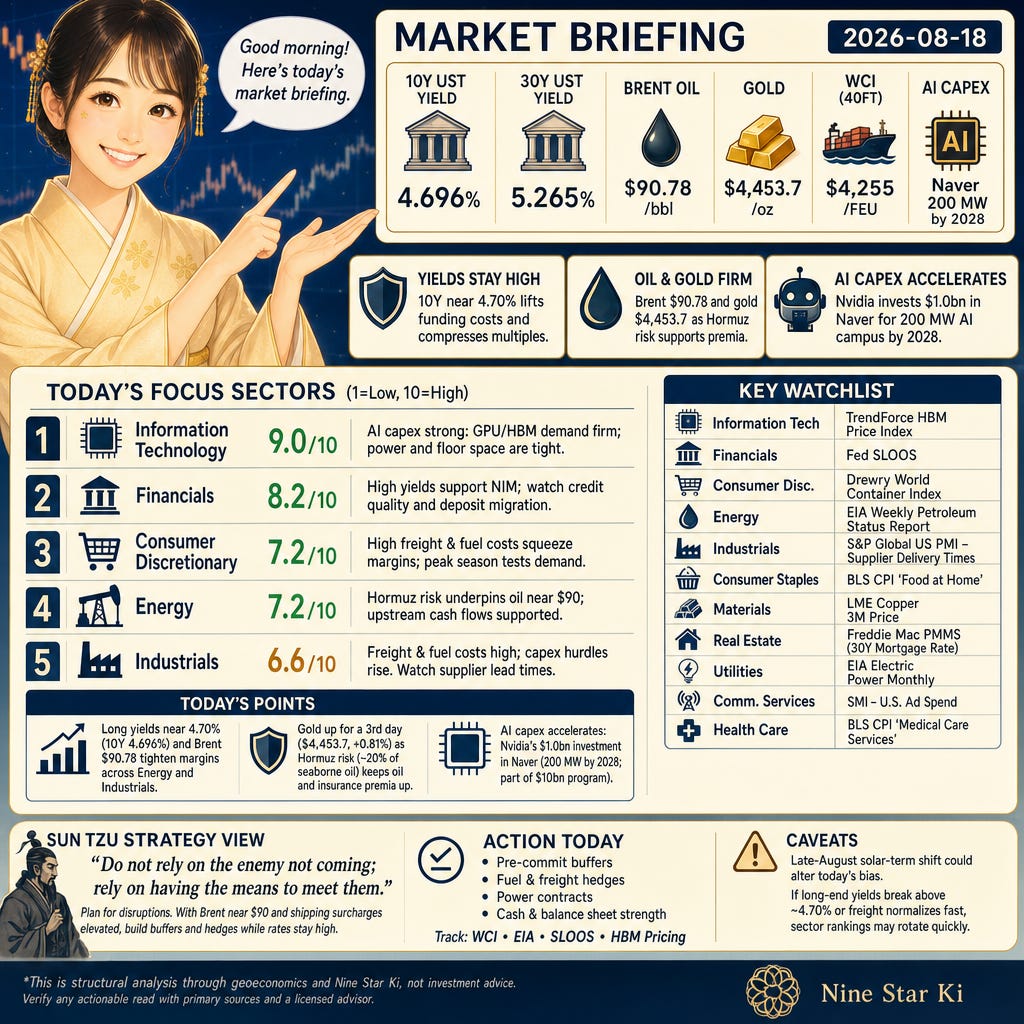
Good morning — long yields near 4.70% and Brent around $90.78 frame funding and input costs today. Container rates in the mid‑$4k/FEU keep delivered costs elevated into peak season. At the same time, AI capex stays firm with Nvidia’s $1.0bn funding of Naver’s 200 MW build. Expect dispersion between rate‑sensitive names and infrastructure beneficiaries.
Stocks and FX
10Y UST is 4.696% and 30Y is 5.265% (AP), while USD/JPY is 159.727; the S&P 500 prints 7,786 and the Nikkei 67,461. Higher long yields lift discount rates and mortgage spreads, compressing equity multiples in long‑duration names. A firm dollar/yen transmits earnings volatility to Japan‑linked exporters and global suppliers, while banks’ net interest margin can widen if deposit betas lag.
Commodities
Gold is $4,453.7/oz (+0.81% day, +9.40% month) and Brent is $90.78/bbl with WTI at $84.01/bbl (FXCM). Bullion’s rise reflects safe‑haven demand alongside rate and geopolitical risk, while $90‑ish oil sustains CPI pressure. Higher crude lifts upstream cash flows but raises transport and packaging costs, squeezing margins in Industrials, Consumer Staples, and Discretionary until pricing adjusts.
World Affairs
About 20% of seaborne oil flows through the Strait of Hormuz, Reuters notes, keeping a premium in Brent near $90.78/bbl and pushing up war‑risk insurance. Elevated shipping surcharges and energy costs raise delivered prices across manufacturing and retail. The same tensions support safe‑haven bids for gold, reinforcing the rates‑plus‑geopolitics market setup.
Supply Chain
Drewry’s WCI is $4,255 per 40ft, the SCFI composite near $1,875, and Shanghai→LA lanes around $6,272/40ft; carriers are adding 7.5–10% war‑risk and fuel surcharges (Global Container Network/logistics coverage). Elevated benchmarks extend lead times and keep landed costs high into peak season. Importers face tighter gross margins and more variable delivery windows, complicating inventory and promo planning.
AI
$1.0bn equity, 200 MW by 2028, up to $10bn funding: Reuters reports Nvidia buying into Naver to underwrite a Sejong AI campus. The build signals multi‑year demand for GPUs, HBM memory, and advanced packaging, with power procurement and floor space as binding constraints. Utilities and Real Estate see load and interconnection pressure as data‑centre construction scales.
Industry News
67,461 on the Nikkei, down 1.82% on the day (Reuters), highlights FX‑linked volatility and a tech rotation in Japan. Currency swings around USD/JPY ~159.7 feed through to component suppliers and exporters, nudging regional portfolios toward Financials and defensives. Global electronics supply chains may see near‑term demand recalibration.
Industry Forecast
Today’s Setup
2026-08-18: Three Blue Wood (Sanpeki Mokusei, 三碧木星) in a Two Black Earth month and One White Water year, during Risshuu (Beginning of Autumn). Execution bias favors build‑outs and information‑driven capex even as higher long‑end yields and tight logistics raise financing and conversion risk; watch power/freight costs and rate‑sensitive demand.
Focus Sectors
Information Technology (9.0/10): Nvidia’s $1.0bn equity into Naver for a 200 MW campus (Reuters) keeps GPU/HBM and advanced‑packaging demand firm while power and floor space stay tight. With the 10Y UST near 4.70% (AP) compressing duration, multi‑year hyperscaler and sovereign budgets still convert. Risk is on HBM/CoWoS bottlenecks and interconnection delays; watch TrendForce’s HBM pricing to gauge supply tightness and potential margin shifts.
Financials (8.2/10): A 10Y at 4.696% and 30Y at 5.265% (AP) supports net interest margin if deposits reprice slowly and loan books reset higher. Oil near $90.78 (FXCM) risks stickier CPI that keeps rates elevated—good for NIM but tougher for credit quality and CRE as cap rates reset. Watch the Fed’s SLOOS for lending‑standards tightening and loan demand; deposit migration remains the swing factor.
Consumer Discretionary (7.2/10): Drewry’s WCI at $4,255/FEU and fuel surcharges keep shipping expensive, while Brent at $90.78 (FXCM) lifts parcel and travel fuel costs. Promotions can still convert where logistics have normalized, but gross margins are tighter and delivery windows longer. Monitor Drewry WCI into peak season; persistent surcharges would pressure big‑ticket and online categories until carrier capacity loosens.
Energy (7.2/10): Hormuz risk over a corridor moving ~20% of seaborne oil (Reuters) underpins Brent near $90.78 and supports upstream cash flows. Equity transmission runs through crack spreads and inventory prints more than flat crude, with insurance surcharges lifting delivered costs. Watch EIA Weekly Petroleum Status Report for product stocks and refinery utilization; rapid de‑escalation could compress the risk premium quickly.
Industrials (6.6/10): Freight benchmarks remain elevated—WCI $4,255 and Shanghai→LA ~$6,272—while oil near $90.78 (FXCM) raises operating and landed costs. Higher global yields lift capex hurdle rates, so converting orderbooks hinges on supplier delivery times and pricing discipline. Track S&P Global’s Supplier Delivery Times; sustained bottlenecks and fuel costs risk bid‑margin erosion and schedule slippage.
Watchlist
Information Technology: TrendForce HBM contract price index (monthly pricing for high‑bandwidth memory used in AI accelerators).
Financials: Federal Reserve SLOOS (Senior Loan Officer Opinion Survey—quarterly bank lending standards and loan demand).
Consumer Discretionary: Drewry World Container Index (weekly global 40‑ft container spot rates).
Energy: EIA Weekly Petroleum Status Report (weekly U.S. crude inventories and refinery utilization).
Industrials: S&P Global US Manufacturing PMI – Supplier Delivery Times (monthly gauge of vendor lead times and bottlenecks).
Consumer Staples: BLS CPI ‘Food at Home’ (monthly U.S. grocery price inflation, a proxy for pass‑through conditions).
Materials: LME Copper 3‑month official price (daily London Metal Exchange benchmark for industrial‑metal demand/price).
Real Estate: Freddie Mac Primary Mortgage Market Survey (weekly U.S. 30‑year fixed mortgage rate and points).
Utilities: EIA Electric Power Monthly (monthly U.S. generation mix, load growth, and retail sales by sector).
Communication Services: Standard Media Index (SMI) – U.S. Ad Spend (monthly aggregated advertiser outlays across major media owners).
Health Care: BLS CPI ‘Medical Care Services’ (monthly U.S. price index for healthcare services, a proxy for reimbursement/pricing trends).
Caveats
A late‑August solar‑term shift could alter today’s build‑out bias, and geopolitics around Hormuz remain headline‑sensitive. If long‑end yields break above the recent ~4.70% range or freight normalizes faster than expected, the sector ranking could rotate quickly.
Sun Tzu Strategy View
Sun Tzu wrote: —— Do not rely on the enemy not coming; rely on having the means to meet them.
With Brent near $90 and container surcharges elevated, planning on smooth passage through Hormuz or quick freight relief is risky. Balance sheets, hedges, and power contracts should be sized to absorb shocks while rates stay high.
Action: Pre‑commit buffers—fuel hedges, freight flexibility, power contracts, and cash—while tracking WCI, EIA, SLOOS, and HBM pricing.
Today’s Points
Long yields near 4.70% (10Y UST 4.696%) and Brent at $90.78/bbl tighten margin pressure across Energy and Industrials — higher commodity inputs and rates raise funding costs.
Gold’s third consecutive up‑day (4,453.7 $/oz, +0.81% today) reflects safe‑haven flows as Hormuz risk (strait carries ~20% of seaborne oil) keeps oil and insurance premia elevated.
AI capex accelerates structural demand: Nvidia’s $1.0bn equity for Naver (200 MW target by 2028; part of a $10bn program) links Information Technology capex to Utilities and Real Estate power/space needs.
This is structural analysis through geoeconomics and Nine Star Ki, not investment advice. Verify any actionable read with primary sources and a licensed advisor.