Thank you for reading. Please subscribe and support Ayanomics 9 Trends so this work can continue.

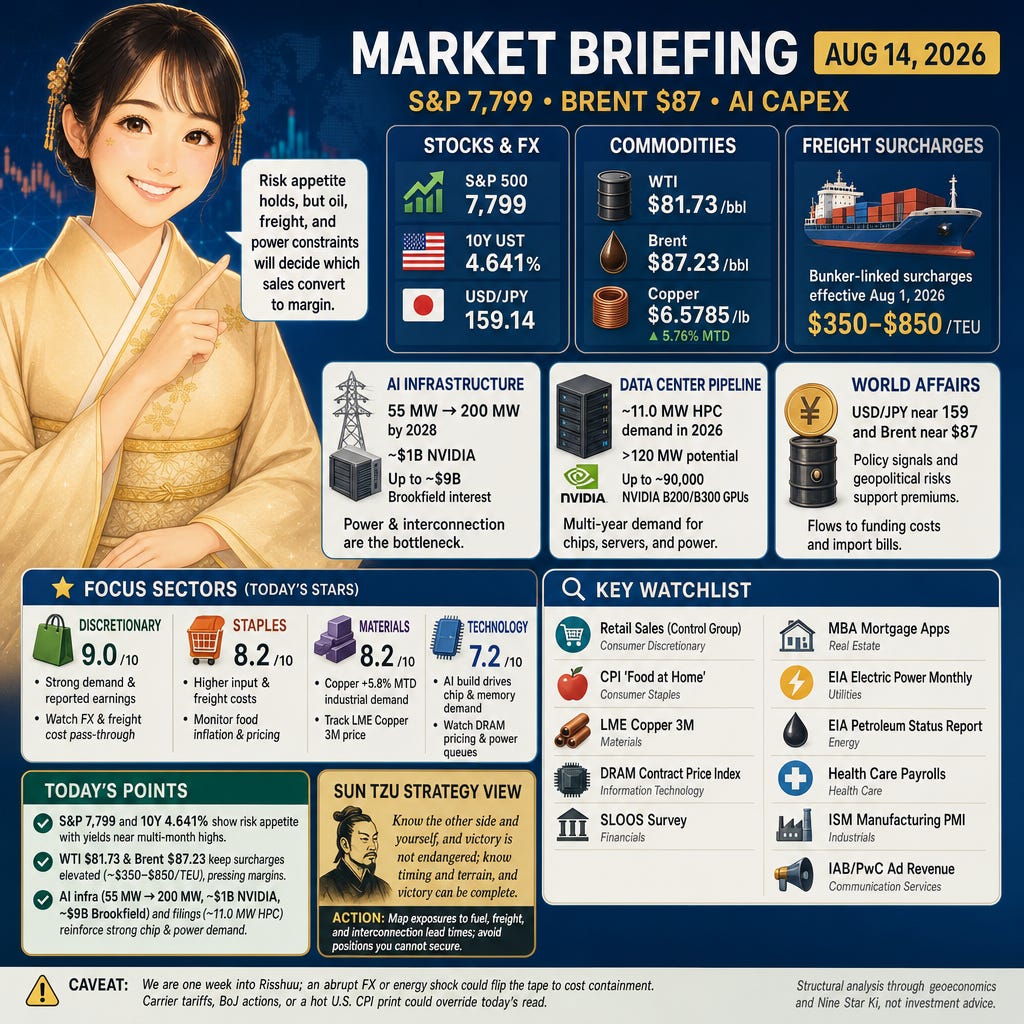
Good morning. Risk appetite holds with the S&P 500 at 7,799 while the 10-year UST sits at 4.641% and USD/JPY near 159. Oil near $87 Brent keeps freight surcharges elevated at roughly $350–$850/TEU. Large AI builds (55 MW to 200 MW plans) concentrate demand on power, memory, and advanced servers, shaping today’s sector tilt toward sales conversion and cost control.
Paywall
Stocks and FX
USD/JPY is 159.138 and the 10-year UST yield 4.641% alongside an S&P 500 at 7,799 (FXStreet market snapshot). That wide rate differential supports carry flows into U.S. risk and boosts reported earnings for Japanese exporters, while it raises import-cost pressure for Japan. A firmer dollar and yields near recent highs can compress long-duration tech valuations at the margin, but the tape remains led by AI-heavy indices.
Commodities
WTI trades at $81.73/bbl and Brent at $87.23/bbl, while copper is $6.5785/lb, up about 5.76% month-to-date (MarketScreener snapshot). Higher crude feeds fuel and packaging costs for Consumer Staples and Industrials and can lift inflation expectations, pressuring rate-sensitive assets. Copper’s MTD strength signals resilient industrial demand, aligning with steady data-center construction pull on metals.
World Affairs
USD/JPY at 159.138 and Brent near $87.23/bbl track with AP reporting that U.S. diplomatic signals and intervention talk have influenced currency and oil risk premia. Policy messaging can cap yen rallies even as BoJ-hike bets build, while Iran-related tensions embed a crude premium. The channel is funding costs and import bills, which flow through Financials and Energy margins.
Supply Chain
Carrier notices show bunker-linked surcharges at roughly $350–$850 per TEU effective Aug 1, 2026 (Handybulk/ZIM), with WTI $81.73 and Brent $87.23 reinforcing fuel components. Elevated landed costs compress retailer and FMCG margins unless pricing resets keep pace. Inventory planning and promotional calendars will need tighter freight-allocation and mode-mix choices until surcharges ease.
AI
An AI build from 55 MW to 200 MW by 2028 with about $1B from NVIDIA and up to $9B in Brookfield interest (TECHi; NVIDIA filings) puts power and financing center stage. That scale sustains demand for GPUs, HBM memory, networking, and substations, with interconnection queues the binding constraint. The implication is persistent component tightness and capex visibility for chipmakers and data-center suppliers.
Industry News
A QumulusAI S‑1 details ~11.0 MW of HPC IT load in 2026, optionality to >120 MW total, and capacity for up to ~90,000 NVIDIA B200/B300 GPUs (SEC filing). Those figures confirm multi-year procurement for servers, racks, and power, supporting vendor revenue pipelines. Real estate positioned near substations and available transmission benefits from earlier revenue starts.
Industry Forecast
Today’s Setup
On 2026-08-14, the day-star is Seven Red Metal (Shichiseki Kinsei, 七赤金星), with the month under Two Black Earth (Jikoku Dosei, 二黒土星) and the year shaped by One White Water (Ippaku Suisei, 一白水星) during Risshuu (Beginning of Autumn). Translation: a sales-driven day favors swift checkout and ad rails, but oil-linked freight, FX at ~159/USDJPY, and power interconnection constraints determine which revenues convert to margin.
Focus Sectors
Consumer Discretionary (9.0/10): USD/JPY at 159 and Brent near $87/bbl lift reported exporter earnings and travel/luxury spend while raising delivery and fulfillment costs. With $350–$850/TEU surcharges, gross margins hinge on pass-through and stable delivery times. If checkout friction stays low, operating leverage improves as more sales drop to profit. Watch for BoJ action or FX intervention risk that could swing cross-border demand and reported margins quickly.
Consumer Staples (8.2/10): WTI $81.73/bbl, Brent $87.23/bbl, and bunker surcharges of $350–$850/TEU push up transport and packaging costs. Margin stability rests on pricing cadence and private-label mix as retailers and brands phase through increases. FX near 159/USDJPY can raise import costs ahead of shelf resets in Asia. Monitor CPI ‘Food at Home’ to confirm pass-through effectiveness and category-level elasticity.
Materials (8.2/10): LME copper around $6.58/lb, up ~5.8% MTD, aligns with steady industrial and data-center demand, while firmer oil raises mining and smelting energy costs. AI campuses (55 MW → 200 MW plans) and filings showing >120 MW potential sustain pull for copper, aluminum, cement, and specialty inputs. Freight surcharges widen delivered cash costs. Track LME Copper 3‑Month for demand strength versus smelter margin pressure.
Information Technology (7.2/10): AI factory plans scaling from 55 MW to 200 MW, ~$1B NVIDIA and up to ~$9B Brookfield interest, plus S‑1 indications of ~11 MW near-term and >120 MW potential, confirm multi-year demand for GPUs, HBM, and networking. The chokepoints are power interconnection and memory/packaging availability, not end-demand. Higher 10Y yields at ~4.64% can re-rate long-duration names. Watch TrendForce DRAM pricing for BOM cost and supply tightness signals.
Watchlist
Consumer Discretionary: US Census Bureau Monthly Retail Trade (advance estimates of retail sales, including the ‘control group’ that feeds GDP).
Consumer Staples: BLS CPI ‘Food at Home’ (monthly price changes for grocery categories that proxy FMCG input pass-through).
Materials: LME Copper 3‑Month price (London Metal Exchange benchmark for industrial metal demand and smelter/refiner margins).
Information Technology: TrendForce DRAM contract price index (monthly memory pricing that signals datacenter server BOM costs and supply tightness).
Financials: Federal Reserve SLOOS — Senior Loan Officer Opinion Survey (quarterly lending standards and loan demand across C&I and consumer).
Real Estate: MBA Weekly Mortgage Applications (Mortgage Bankers Association; application volumes and 30‑year fixed rates as a proxy for property financing conditions).
Utilities: EIA Electric Power Monthly (US generation mix, retail sales, and capacity factors that confirm load growth and fuel-cost pass-through).
Energy: EIA Weekly Petroleum Status Report (weekly US crude/product inventories and refinery utilization that drive cracks and near-term price direction).
Health Care: BLS Employment Situation — Health care and social assistance payrolls (monthly hiring and hours that proxy demand and capacity).
Industrials: ISM Manufacturing PMI — Supplier Deliveries and New Orders (monthly diffusion indexes for delivery times and demand that drive backlog conversion).
Communication Services: IAB/PwC Internet Advertising Revenue Report (semiannual US digital ad revenue totals that confirm budget growth or pullbacks).
Caveats
We are one week into Risshuu; an abrupt FX or energy shock would flip the sales-led bias toward a cost-containment tape and reorder sector leadership. Carrier tariff updates, BoJ actions, or a hot U.S. CPI print could override today’s terrain read by moving fuel, freight, and discount rates faster than pricing can adjust.
Sun Tzu Strategy View
Sun Tzu wrote: —— Know the other side and yourself, and victory is not endangered; know timing and terrain, and victory can be complete.
Today’s terrain is literal and financial: shipping lanes and bunker costs, power interconnection queues, and rate differentials that steer FX. Read counterparties (carriers, grid operators, central banks) as closely as your own cost stack and delivery schedules to keep margins converting.
Action: Map exposures to fuel, freight, and interconnection lead times; avoid positions that rely on routes you cannot secure.
Today’s Points
US equities at S&P 7,799 trade alongside a 10Y UST yield of 4.641%, signaling risk appetite even as bond yields remain near multi-month levels.
Oil at WTI $81.73/bbl and Brent $87.23/bbl is keeping container and bunker surcharges elevated (~$350–$850/TEU), pressuring margins for Consumer Staples and Industrials.
AI infrastructure commitments (NAVER/NVIDIA expansion 55 MW → 200 MW; ~$1B NVIDIA and ~$9B potential Brookfield backing) and data‑center filings showing ~11.0 MW HPC load reinforce sustained chip and power demand for Information Technology and Real Estate.
This is structural analysis through geoeconomics and Nine Star Ki, not investment advice. Verify any actionable read with primary sources and a licensed advisor.