Thank you for reading. Please subscribe and support Ayanomics 9 Trends so this work can continue.

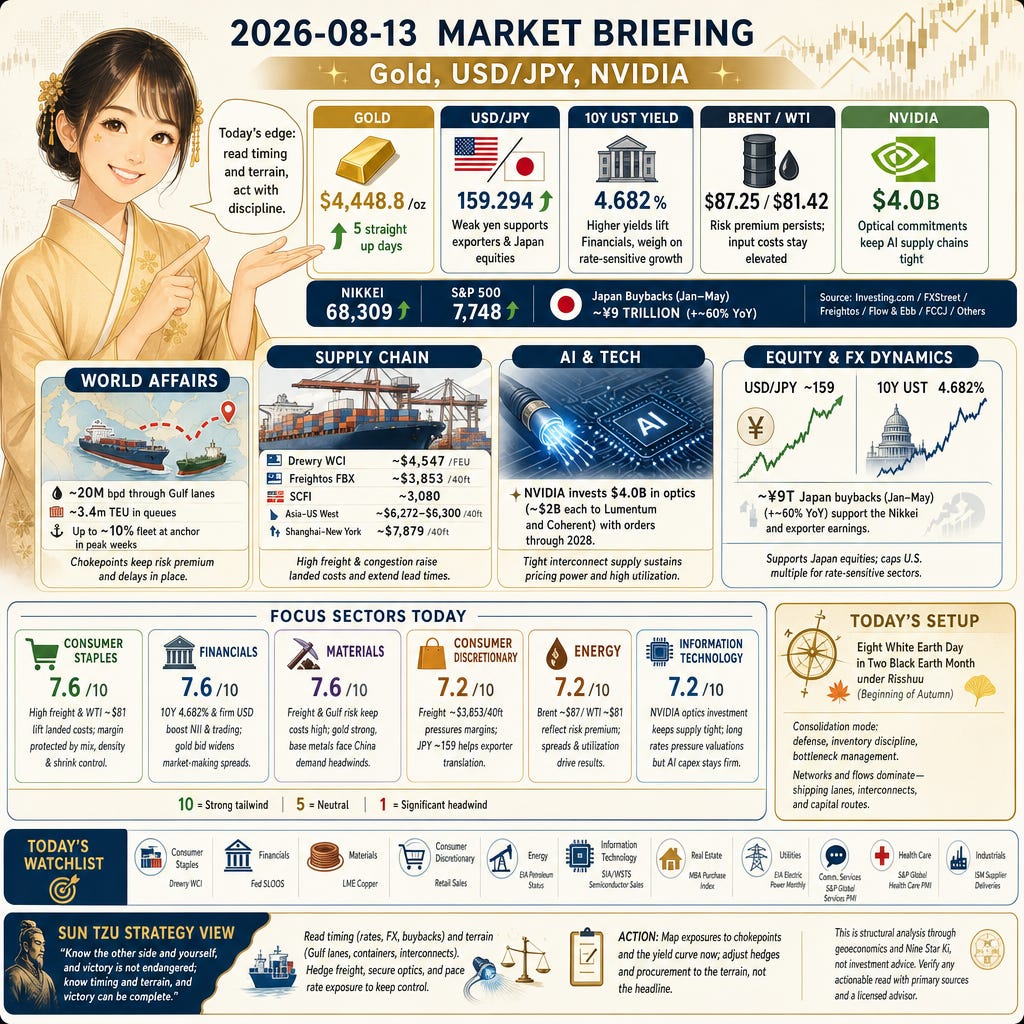
Good morning. Gold at $4,448.8/oz, USD/JPY near 159, and Brent/WTI around $87/$81 frame today’s terrain. Elevated container rates keep landed costs sticky while AI capex remains firm. Expect rate sensitivity in equities, margin focus in goods sectors, and continued attention to chokepoints and interconnect capacity.
Paywall
Stocks and FX
USD/JPY is ~159.294 with the Nikkei at 68,309 and the S&P 500 at 7,748, while the 10Y UST yield prints 4.682% (FXStreet / eFXdata). A weak yen lifts exporter earnings translation and supports Japan equities, but higher U.S. yields cap multiples in rate‑sensitive U.S. sectors. The firm dollar and curve levels aid Financials’ net interest income and trading flow while pressuring long‑duration growth names.
Commodities
Brent is $87.25/bbl and WTI $81.42/bbl (both softer intraday), while gold is $4,448.8/oz after five straight up days (Investing.com / Flow & Ebb). Oil near these levels sustains input and freight surcharges for goods producers and shippers, feeding through to Consumer sectors and Industrials. Gold’s safe‑haven bid signals a higher liquidity preference that can influence FX reserves and bank funding spreads.
World Affairs
~20 million bpd of crude flows run through affected Gulf lanes and ~3.4m TEU have been reported in queues with up to ~10% of the fleet at anchor in peak weeks (Flow & Ebb / Nautica). That keeps a risk premium embedded in Brent $87.25 and WTI $81.42 and extends dwell times. The transmission channel is clear: higher insurance, rerouting, and delays raise landed costs and inventory buffers across Energy, Consumer, and Industrial supply chains.
Supply Chain
Drewry WCI is about $4,547/FEU, the Freightos Baltic Index ~ $3,853/40ft, and SCFI near 3,080; Asia–US West Coast lanes print ~$6,272–$6,300 and Shanghai–New York ~$7,879/40ft (Freightos / FreightFA). Elevated rates and congestion extend lead times and tie up working capital, pressuring margins for Consumer Discretionary and Staples and delaying inputs for Industrials and Materials. Inventory planning must account for longer transit and higher variability.
AI
NVIDIA’s $4.0B commitments to optical suppliers (roughly $2B each to Lumentum and Coherent) and multi‑year orders stretching to 2028 keep interconnect supply tight (Tom’s Hardware / Bloomberg). Tight optics and packaging capacity support pricing power for component makers and sustain high utilization across AI hardware. The implication: elevated capex for Information Technology and network operators, and continued power and space demand for data centers.
Industry News
~¥9 trillion of Japan share buybacks in Jan–May (+~60% YoY) are supporting equity demand alongside USD/JPY near 159.294, helping the Nikkei hold 68,309 (FCCJ). Buybacks lift EPS and bolster valuations for Financials and Industrials, while the weak yen amplifies exporter profits for Consumer Discretionary and Information Technology. Governance reforms add persistence to the bid for domestically listed firms.
Industry Forecast
Today’s Setup
2026-08-13 is an Eight White Earth (Happaku Dosei, 八白土星) day in a Two Black Earth month, under Risshuu (Beginning of Autumn). Expect consolidation behavior: defense, inventory discipline, and bottleneck management. With One White Water shaping the year, networks and flows dominate — shipping lanes, interconnects, and capital routes — so costs, financing, and lead‑time control matter more than expansion today.
Focus Sectors
Consumer Staples (7.6/10): Drewry WCI ≈ $4,547/FEU and Asia–US lanes near $6,300 keep landed costs elevated, while WTI holds around $81, lifting distribution and packaging expenses. Grocers and CPG defend margin via private‑label mix, density, and shrink control; pass‑through timing is the swing factor. Risk: a renewed spike in ocean rates or port dwell times would compress margin before pricing adjusts; watch labor talks at key distribution hubs.
Financials (7.6/10): A 10Y UST at 4.682% and a firm USD underpin net interest income and trading flow, while gold at ~$4,448.8/oz signals a stronger liquidity preference that can widen market‑making spreads. FX translation benefits from USD/JPY near 159, but duration assets face valuation pressure. Risks: a sharp bull‑steepener or BOJ intervention whipsaw could squeeze NIMs; monitor credit via SLOOS for turns in standards and loan demand.
Materials (7.6/10): Elevated container benchmarks (WCI ≈ $4,547/FEU; FBX ≈ $3,853/40ft) and Gulf risk keep logistics and bunker surcharges high, tying up working capital in transit. Precious metals ride gold’s safe‑asset bid, while base metals juggle pass‑through to downstream buyers. Risks: another leg up in freight or fuel costs would erode realized premiums; China demand softness could undercut base‑metal pricing power; permitting delays can bottleneck new supply.
Consumer Discretionary (7.2/10): FBX around $3,853 and Asia–US rates near $6,300–$7,879/40ft pressure apparel and hardgoods margins until pricing and promotions reset. USD/JPY ~159 helps Japan‑exposed brands on translation and unit costs, partly offsetting freight drag. Watch labor and rent inflation that can outpace ticket growth, capping operating leverage. A sentiment dip into peak season would hit conversion and mix; track U.S. Advance Retail Sales for demand signals.
Energy (7.2/10): Brent ~$87 and WTI ~$81 reflect a persistent Gulf risk premium even after intraday easing. Refining and product spreads remain the key earnings channel, with inventory and utilization swings driving near‑term results. Risks: escalation around Hormuz would lift freight, insurance, and feedstock strain; a swift détente would compress spreads. OPEC+ quota moves or permitting shifts can reprice volumes quickly; monitor EIA weekly inventory and utilization.
Information Technology (7.2/10): NVIDIA’s $4.0B optical commitments and multi‑year order books keep interconnect capacity tight, sustaining utilization and pricing for chips, optics, and advanced packaging. Higher long rates near 4.682% pressure valuations, but AI capex and supply bottlenecks (HBM, CoWoS packaging) anchor shipment visibility. Risks: slips in HBM/optical ramps or export‑control shifts could reroute demand and add compliance cost; power and real estate constraints can defer deployments.
Watchlist
Consumer Staples: Drewry World Container Index (weekly global container freight rates for 40-foot containers, published by Drewry).
Financials: Federal Reserve SLOOS (Senior Loan Officer Opinion Survey on Bank Lending Practices; quarterly U.S. lending standards and loan demand).
Materials: LME 3-month Copper price (London Metal Exchange benchmark for industrial metal demand/price).
Consumer Discretionary: U.S. Census Advance Monthly Retail Sales (monthly nominal retail spending by category, published by the U.S. Census Bureau).
Energy: EIA Weekly Petroleum Status Report (weekly U.S. crude and product inventories, refinery utilization; U.S. Energy Information Administration).
Information Technology: SIA/WSTS Global Semiconductor Sales (monthly worldwide semiconductor sales published by the Semiconductor Industry Association using WSTS data).
Real Estate: MBA Weekly Mortgage Applications Survey – Purchase Index (weekly U.S. home-purchase loan applications, Mortgage Bankers Association).
Utilities: EIA Electric Power Monthly (monthly U.S. electricity generation, fuel mix, and retail sales; U.S. Energy Information Administration).
Communication Services: S&P Global U.S. Services PMI – New Business (monthly measure of new demand in services, a proxy for advertising and communications activity; published by S&P Global).
Health Care: S&P Global U.S. Sector PMI – Health Care (monthly activity index for Health Care, published by S&P Global).
Industrials: ISM Manufacturing PMI – Supplier Deliveries (monthly U.S. supplier delivery speed index, published by ISM).
Caveats
A sharp shift in the yield curve or a BOJ intervention would quickly alter FX, valuation, and NIM dynamics that underpin several sectors. A rapid normalization in Gulf lanes or a break lower in freight benchmarks would ease landed costs and change margin math; conversely, escalation would amplify the choke. Solar‑term transition later in August could tilt the day‑to‑day balance from inventory discipline toward demand signaling; watch for inflection in high‑frequency prints.
Sun Tzu Strategy View
Sun Tzu wrote: —— Know the other side and yourself, and victory is not endangered; know timing and terrain, and victory can be complete.
Today’s edge comes from reading both timing (rates, FX, buybacks) and terrain (Gulf lanes, container capacity, data‑center interconnects). Sectors that align to this map — hedging freight, securing optics, and pacing rate exposure — keep control as conditions shift.
Action: Map exposures to chokepoints and the yield curve now; adjust hedges and procurement to the terrain, not the headline.
Today’s Points
Gold at $4,448.8/oz (5 straight up days) and 10Y UST yield at 4.682% are driving safe‑haven flows that lift Financials and weigh on rate‑sensitive growth.
USD/JPY ~159.294 combined with ~¥9 trillion of Japan buybacks (Jan–May) helps explain the Nikkei at 68,309 and supports exporter earnings for Industrials and Consumer Discretionary.
Drewry WCI ≈ $4,547/FEU and Freightos FBX ≈ $3,853/40ft keep landed costs elevated, while NVIDIA’s $4.0B optics commitment tightens AI supply chains and sustains IT sector capex demand.
This is structural analysis through geoeconomics and Nine Star Ki, not investment advice. Verify any actionable read with primary sources and a licensed advisor.