Thank you for reading. Please subscribe and support Ayanomics 9 Trends so this work can continue.

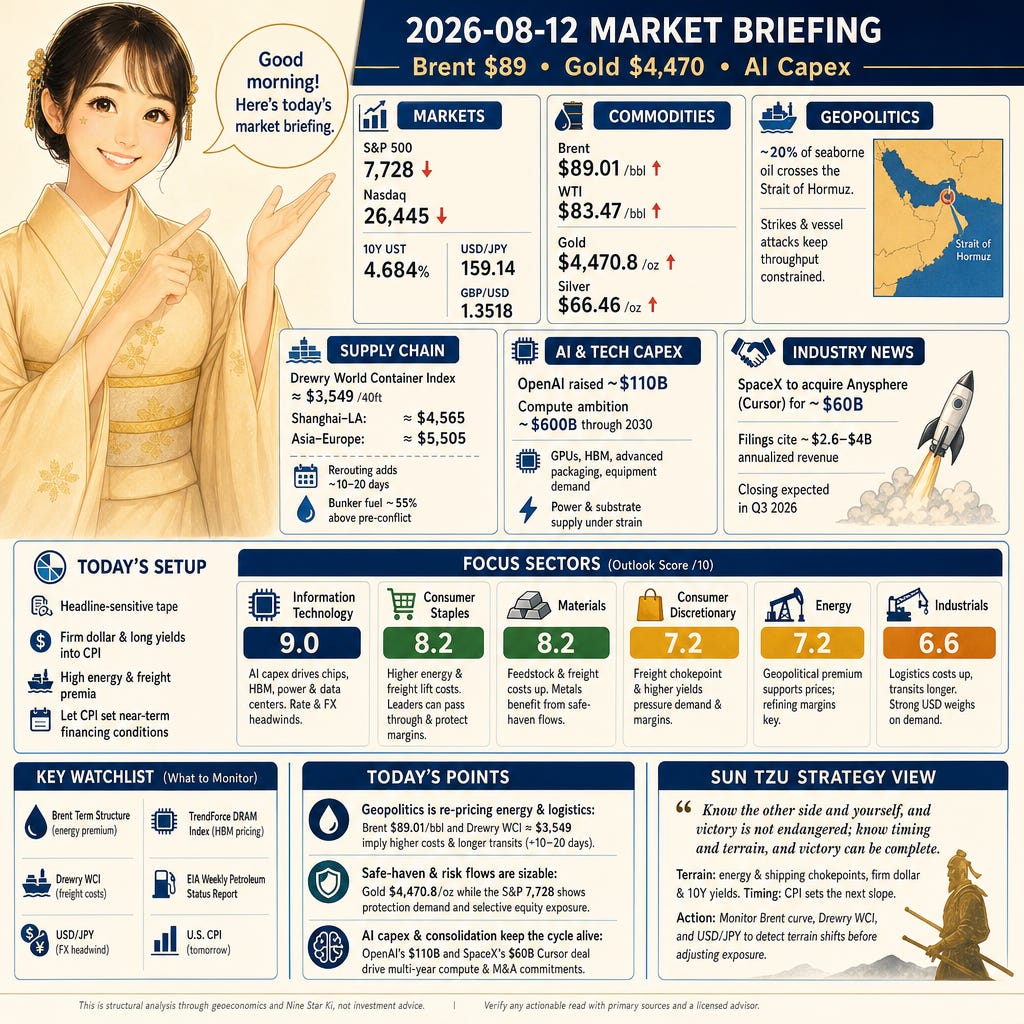
Good morning. Energy and shipping premia remain elevated, the dollar and long yields are firm into tomorrow’s CPI, and big‑ticket AI capex continues to anchor tech demand. Those three forces set today’s transmission channels: input costs and lead times, equity duration via rates/FX, and semiconductor/data‑center pull‑through.
Paywall
Stocks and FX
S&P 500 at 7,728 and Nasdaq at 26,445 slipped as the 10‑year UST held 4.684% and USD/JPY hovered near 159.14, AP reports. GBP/USD printed 1.3518. A firm dollar and higher discount rates typically compress growth‑stock multiples and add FX headwinds to offshore earnings, keeping tech‑heavy indices sensitive into the CPI release.
Commodities
Brent 89.01 $/bbl and WTI 83.47 $/bbl extended their up streaks; gold hit 4,470.8 $/oz and silver 66.46 $/oz on safe‑haven flows, per AP. Higher crude lifts fuel, plastics, and petrochemical inputs, pressuring margins downstream, while precious‑metals strength signals risk aversion that can tighten financial conditions via inflation expectations and term yields.
World Affairs
About 20% of seaborne oil normally crosses the Strait of Hormuz; AP notes renewed strikes and vessel attacks keeping throughput constrained, with Brent at $89.01 and WTI at $83.47. Constrained lanes force reroutes and longer voyages, tightening spot barrels and raising bunker costs, which flow into Energy, Industrials, and Staples pricing and freight insurance.
Supply Chain
Drewry’s World Container Index reached roughly $3,549 per 40ft and Shanghai–LA spot near $4,565, with Asia–Europe around $5,505; rerouting adds ~10–20 days and bunker fuel is ~55% above pre‑conflict, Reuters notes. Higher ocean rates and longer transits raise landed costs, extend cash conversion cycles, and heighten stockout risk for retailers and manufacturers.
AI
OpenAI’s ~$110B funding and an ambition of ~$600B compute through 2030, plus multi‑gigawatt capacity commitments, signal multi‑year AI capex, Reuters reports. That supports semiconductor demand (GPUs, HBM memory, advanced packaging), equipment orders, and data‑center buildouts, while straining power and substrate supply. Valuations remain rate‑sensitive as the 10‑year sits near 4.684%.
Industry News
SpaceX’s about $60B acquisition of Anysphere (Cursor) advances consolidation in enterprise AI; filings cite ~$2.6–$4B annualized revenue and closing expected in Q3 2026, per Reuters. Large strategic deals can reset software comps, shift pricing power, and add integration risk for acquirers while customers reassess vendor concentration.
Industry Forecast
Today’s Setup
2026-08-12 is a Nine Purple Fire (Kyushi Kasei, 九紫火星) day in a Two Black Earth (Jikoku Dosei, 二黒土星) month and One White Water (Ippaku Suisei, 一白水星) year, during Risshuu (Beginning of Autumn). Expect headline‑sensitive tape where signaling and narratives move rate‑ and FX‑exposed groups; with crude and freight premia elevated, watch input costs and lead times, and let CPI set near‑term financing conditions.
Focus Sectors
Information Technology (9.0/10): $110B in OpenAI funding and compute targets near $600B through 2030 keep hyperscaler capex firm, pulling through GPUs, HBM (high‑bandwidth memory), power gear, and CoWoS (chip‑on‑wafer‑on‑substrate) packaging. That sustains order books for chips and equipment, though the 10‑year at 4.684% tightens equity duration and a strong dollar adds FX headwinds to overseas revenue. Watch supply constraints in HBM and substrates that can shift pricing power upstream and elongate lead times.
Consumer Staples (8.2/10): Brent at $89 and higher ocean freight (Drewry WCI ≈ $3,549/FEU) lift landed costs for food and household goods. Category leaders with negotiating leverage and private‑label mix can pass through inputs and protect margin, while emerging‑market suppliers face squeeze from logistics and dollar strength. Monitor sustained Hormuz constraints and incremental carrier surcharges; sharper spikes risk compressing promo calendars and pressuring shelf‑price elasticity in lower‑income markets.
Materials (8.2/10): Energy‑linked feedstocks (naphtha, gas‑oil) rise with Brent $89, and elevated container rates extend working capital and delivery times. Miners may benefit from safe‑haven metals interest (gold $4,470/oz), but commodity chemicals and packaging face spread compression until inputs ease or contracts reset. The transmission is direct: higher input costs and slower logistics reduce throughput and pricing flexibility. Track S&P Global PMI Input Prices for pass‑through capacity and signs of buyer resistance in key end markets.
Consumer Discretionary (7.2/10): Freight is the chokepoint: Drewry’s WCI near $3,549 and Asia→US/Europe transits extended by ~10–20 days raise landed costs and stockout risk into back‑to‑school and holiday builds. Higher yields (10Y 4.684%) and a firm dollar temper financing for big‑ticket goods and cross‑border pricing. Operators with flexible sourcing and omnichannel fulfillment can mitigate delays. Watch off‑contract spot spikes and port congestion that could erode gross margin and distort promotional cadence.
Energy (7.2/10): Brent $89.01 and WTI $83.47 embed a geopolitical premium from constrained Hormuz flows, tightening spot barrels and shaping refining slates. Upstream benefits from resilient pricing, but downstream margins hinge on product spreads and refinery utilization. The key swing factors are OPEC+ discipline, U.S. inventory trends, and de‑/escalation in shipping lanes. A rapid risk‑premium unwind would hit leveraged exposures; deeper disruptions raise demand‑destruction risk if retail fuels spike.
Industrials (6.6/10): Container rates (WCI ≈ $3,549) and bunker/diesel costs are lifting cost‑to‑serve as reroutes extend delivery by ~10–20 days. That raises working‑capital needs and challenges on‑time performance, even where order books are solid. A strong dollar can weigh on international demand and reported revenue. Firms with diversified suppliers and resilient logistics will convert orders more cleanly. Watch for additional surcharges or port delays that could compress margins and push revenue recognition into later quarters.
Watchlist
Information Technology: TrendForce DRAM contract price index (monthly pricing for DRAM/HBM that signals data‑center memory tightness and capex urgency).
Consumer Staples: FAO Food Price Index (UN FAO’s monthly global food commodity price basket signaling upstream pressure on grocery costs).
Materials: S&P Global Manufacturing PMI – Input Prices (monthly gauge of raw‑material cost pressure across producers).
Consumer Discretionary: U.S. Census Bureau Retail Sales, Advance Monthly (top‑line retail demand momentum that frames margin and inventory decisions).
Energy: EIA Weekly Petroleum Status Report (weekly U.S. crude inventories, product stocks, and refinery utilization to track supply tightness).
Industrials: ISM Manufacturing Supplier Deliveries Index (monthly measure of supplier speed that signals backlog stress or easing).
Financials: Federal Reserve H.8 – Assets and Liabilities of Commercial Banks (weekly deposits and loan growth that signal funding pressure and credit creation).
Communication Services: Nielsen The Gauge (monthly U.S. TV/streaming share that signals shifts in viewer attention and ad inventory mix).
Real Estate: MBA Weekly Mortgage Applications (purchase applications and 30‑year mortgage rate—timely read on financing conditions and housing demand).
Utilities: EIA Electric Power Monthly (U.S. generation mix, retail sales, and implied load growth that frame fuel needs and revenue).
Health Care: BLS JOLTS – Health Care and Social Assistance job openings rate (monthly labor‑tightness signal for providers and services).
Caveats
Risshuu sits mid‑window; seasonal turns can shift consumption patterns and energy demand quickly. Tomorrow’s CPI can reprice the dollar and the yield curve in a single print, reshuffling sector order; freight indices are spot snapshots that can swing week to week with carrier capacity and risk de‑escalation.
Sun Tzu Strategy View
Sun Tzu wrote: —— Know the other side and yourself, and victory is not endangered; know timing and terrain, and victory can be complete.
Energy and shipping chokepoints, plus a firm dollar and 10‑year yields, are today’s terrain; the CPI timing sets the next slope. Sectors aligned with that terrain—those that can pass through costs or monetize AI capex—have advantage, while rate‑ and freight‑sensitive names must respect lane constraints.
Action: Set monitoring on Brent term structure, Drewry WCI, and USD/JPY to detect terrain shifts before adjusting exposure to rate‑ and freight‑sensitive sectors.
Today’s Points
Geopolitics is re‑pricing energy and logistics: Brent $89.01/bbl and Drewry WCI ≈ $3,549 per 40ft imply higher input costs and longer transits (≈ +10–20 days) for Asia→US/Europe routes.
Safe‑haven and risk flows are sizable today — gold at $4,470.8/oz and the S&P at 7,728 underscore simultaneous demand for protection and selective equity exposure.
Big‑ticket AI capital and consolidation keep the tech capex cycle alive: OpenAI’s $110B funding and SpaceX’s $60B Cursor deal point to sustained multi‑billion compute and M&A commitments that lift semiconductor and data‑center demand.
This is structural analysis through geoeconomics and Nine Star Ki, not investment advice. Verify any actionable read with primary sources and a licensed advisor.