

Thank you for reading. Please subscribe and support Ayanomics 9 Trends so this work can continue.
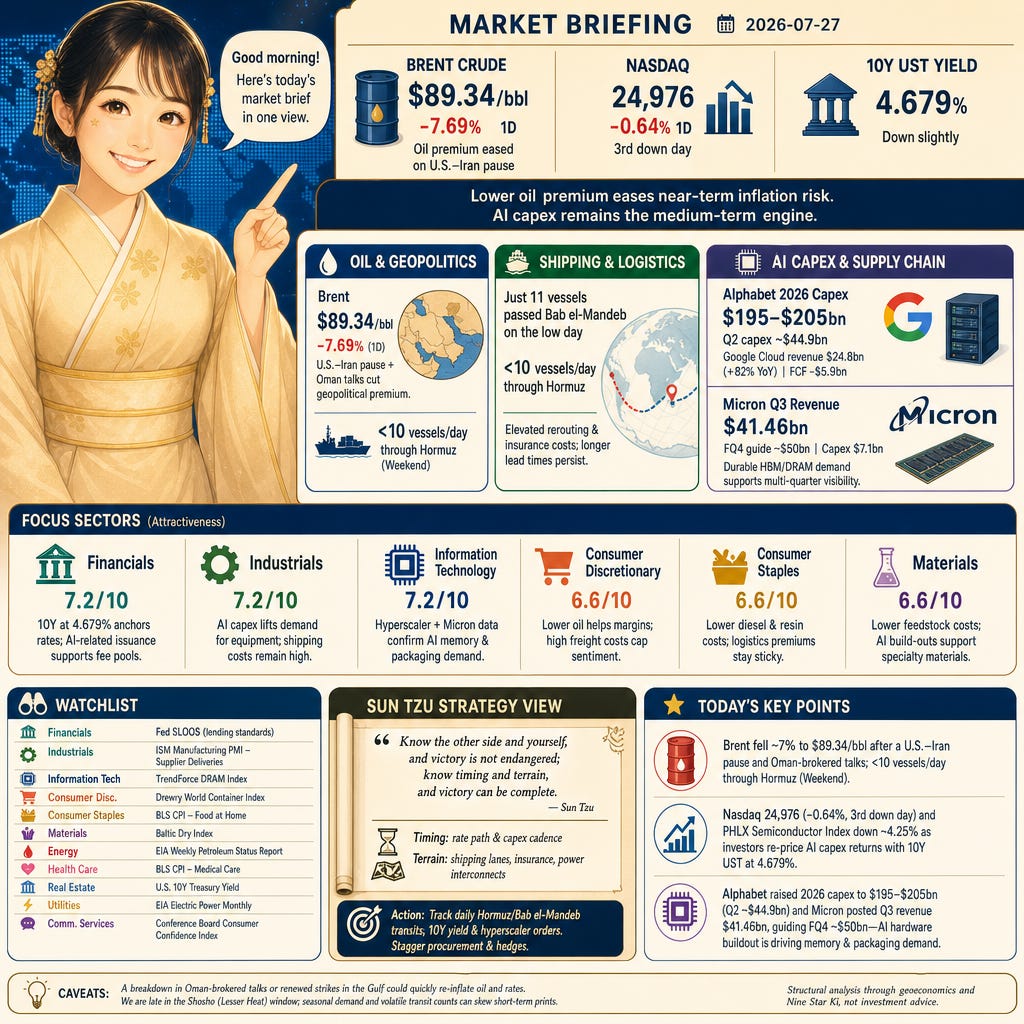
Good morning. Brent is $89.34/bbl after a ~7% drop, Nasdaq closed at 24,976 after a third down day, and the 10Y UST sits at 4.679%. Diplomacy around the Gulf eased the oil premium, but Kpler shows <10 Hormuz transits/day, so logistics risk persists. AI capex remains the medium‑term engine (Alphabet $195–$205bn) even as investors scrutinize returns and discount rates.
Paywall
Stocks and FX
Nasdaq 24,976 (-0.64% 1d), S&P 500 7,412, and Dow 51,947 closed Friday as the PHLX Semiconductor Index fell ~4.25% while the 10Y UST eased to 4.679% (Swingfolio). Profit‑taking in semis and return‑on‑AI‑capex scrutiny pressured long‑duration tech valuations. The rates level tightens discount rates for growth names and nudges rotation toward cash‑flow and capex beneficiaries in Industrials and Real Estate.
Commodities
Brent $89.34/bbl (-7.69% 1d) and WTI $83.27/bbl (-6.76% 1d) fell after a U.S.–Iran pause in strikes (Reuters via Euronext). Lower crude trims diesel, packaging‑resin, and shipping fuel costs, easing pass‑through inflation risk for Consumer sectors and Materials. Refining margins will pivot on crack spreads as utilization adjusts to the new price deck.
World Affairs
Fewer than 10 commodity vessels transited the Strait of Hormuz per day over the weekend as the U.S. paused strikes on Iran and Oman brokered talks (Reuters citing Kpler). The de‑risk cut Brent to the high‑$80s, lowering the immediate geopolitical premium in energy. Transmission channels: cheaper oil, slightly lower insurance premia, and softer short‑term inflation risk feeding into rates and sector rotation.
Supply Chain
Just 11 vessels passed Bab el‑Mandeb on the low day, with <10 Hormuz transits/day over the weekend (Reuters/Kpler). Persistently thin flows keep rerouting and insurance costs elevated, lengthening lead times for bulk and container freight. Operators should expect choppy spot rates and plan inventory with wider delivery windows until routes normalize.
AI
$195–$205bn: Alphabet’s 2026 capex plan, with ~$44.9bn spent in Q2 as Google Cloud revenue reached $24.8bn (+82% YoY) and free cash flow was -$5.9bn (Alphabet press release & coverage). The spend sustains demand for GPUs, advanced packaging (CoWoS — chip‑on‑wafer‑on‑substrate), and HBM (high‑bandwidth memory), supporting semiconductor and specialty‑materials suppliers. The flip side is heavier near‑term opex/FCF pressure at platforms, a key input to tech valuations.
Industry News
$41.46bn: Micron’s record Q3 revenue, with FQ4 guided to ~$50bn and $7.1bn in quarterly capex (Micron IR). Management cited durable AI‑driven HBM/DRAM demand, implying firm ASPs, extended lead times for advanced packaging, and support for equipment and specialty gases. This validates the hyperscaler capex corridor and reinforces multi‑quarter visibility across the AI memory stack.
Industry Forecast
Today’s Setup
2026-07-27 lands on a Seven Red Metal (Shichiseki Kinsei, 七赤金星) day in a Three Blue Wood (Sanpeki Mokusei, 三碧木星) month and a One White Water (Ippaku Suisei, 一白水星) year; solar term Shosho (Lesser Heat, 2026-07-07). Translation: spreads and execution matter while capex expansion and network chokepoints govern margins — lower oil eases costs, but fragile shipping lanes and a 10Y at 4.679% keep financing and delivery risks front‑of‑mind.
Focus Sectors
Financials (7.2/10): 10Y UST at 4.679% (Swingfolio) anchors discount rates and shapes deposit betas, while a Brent slide toward ~$89 (Reuters) softens near‑term inflation risk and steadies terminal‑rate assumptions. Primary issuance linked to AI build‑outs supports fee pools across ECM/DCM and advisory. Watch how curve moves re‑price loan demand and securities books; a renewed oil spike would re‑ignite rate volatility, lifting funding costs faster than assets re‑price.
Industrials (7.2/10): Kpler/Reuters show muted Hormuz and Red Sea transits, keeping routing and insurance costs elevated even as Brent’s drop eases fuel inputs. AI data‑centre capex (Alphabet $195–$205bn) underwrites demand for electrical gear, thermal management, and precision machinery. Order conversion hinges on delivery assurance and energy costs; a rates back‑up could elongate sales cycles on big‑ticket equipment while any chokepoint flare‑up would hit supplier delivery times.
Information Technology (7.2/10): Alphabet’s lifted 2026 capex to $195–$205bn with ~$44.9bn in Q2 and Micron’s $41.46bn Q3 plus ~$50bn FQ4 guide confirm durable HBM/DRAM and packaging demand. Near‑term, the PHLX Semiconductor Index fell ~4.25% as the 10Y at 4.679% pressures long‑duration valuations (Swingfolio). The fundamental tape is supported by GPUs, CoWoS, and memory, but ROI scrutiny at hyperscalers and HBM/packaging bottlenecks could push shipments right and raise working capital.
Consumer Discretionary (6.6/10): Brent at $89.34/bbl lowers gasoline and resin/diesel‑linked costs, improving merch margins (Reuters), while slow Hormuz/Red Sea lanes keep spot freight and parcel routing expensive (Kpler). Seven Red Metal’s commerce tilt favors conversion and promotions as operating leverage improves when freight intervals normalize. Risks: a Gulf relapse lifting fuel/shipping into peak season, and firm rates capping big‑ticket demand and basket size.
Consumer Staples (6.6/10): Lower oil eases diesel and packaging‑resin pressure, supporting margin cadence as contract resets roll through (Reuters). Logistics premiums remain sticky amid muted sea‑lane throughput (Kpler), so procurement timing and inventory discipline are central. Retailer pushback on list‑price increases could raise promo intensity; renewed shipping disruption would re‑inflate cold‑chain and freight costs just as food‑at‑home inflation stabilizes.
Materials (6.6/10): Brent’s decline reduces petrochemical feedstock costs (Reuters), but constrained Hormuz/Bab el‑Mandeb flows keep bulk shipping and insurance elevated (Kpler). AI build‑outs sustain demand for specialty gases, chemicals, substrates, and equipment‑adjacent inputs, aligning with multi‑quarter accumulation. Watch demurrage and voyage times that can compress spreads; any HBM/packaging timing slippage would ripple into materials call‑offs and inventory swings.
Watchlist
Financials: Federal Reserve SLOOS — Senior Loan Officer Opinion Survey (quarterly U.S. bank lending standards and demand).
Industrials: ISM Manufacturing PMI — Supplier Deliveries Index (monthly U.S. vendor lead times).
Information Technology: TrendForce DRAM contract index (monthly DRAM/HBM pricing for memory).
Consumer Discretionary: Drewry World Container Index (weekly global spot container freight rates).
Consumer Staples: BLS CPI — Food at Home (monthly U.S. grocery price inflation).
Materials: Baltic Exchange — Baltic Dry Index (daily global bulk freight rates).
Energy: EIA Weekly Petroleum Status Report (weekly U.S. crude/product inventories and refinery utilization).
Health Care: BLS CPI — Medical Care (monthly U.S. medical inflation trend).
Real Estate: U.S. 10‑Year Treasury Yield (daily benchmark for real‑estate financing costs; U.S. Department of the Treasury).
Utilities: EIA Electric Power Monthly (U.S. electricity generation, demand, and capacity mix).
Communication Services: The Conference Board Consumer Confidence Index (monthly U.S. household sentiment that leads ad budget risk).
Caveats
A breakdown in Oman‑brokered talks or renewed strikes in the Gulf would quickly re‑inflate Brent and re‑price rates, altering rotation and margin math. We are late in the Shosho window; seasonal demand and volatile transit counts can skew short‑term energy and shipping prints.
Sun Tzu Strategy View
Sun Tzu wrote: —— Know the other side and yourself, and victory is not endangered; know timing and terrain, and victory can be complete.
Today’s “timing” is the rate path and capex release cadence; the “terrain” is shipping lanes, insurance, and power interconnects. Read both: align exposure to hyperscaler procurement cycles while mapping around Hormuz/Bab el‑Mandeb constraints and the 10Y anchor.
Action: Track daily Hormuz/Bab el‑Mandeb transits alongside the 10Y yield and hyperscaler order updates; stagger procurement and hedges to the firmer timing/terrain pair.
Today’s Points
Brent fell ~7% intraday to the high‑$80s (snapshot $89.34/bbl), driven by a U.S.–Iran pause in strikes and talks brokered by Oman; shipping transits through Hormuz were <10 vessels/day over the weekend (Kpler). (live.euronext.com)
Tech rotation: Nasdaq at 24,976 (‑0.64% 1d, 3rd down day) and the PHLX Semiconductor Index down ~4.25% as investors re‑price AI capex returns amid a firmer rates backdrop (10Y UST 4.679%). (swingfolio.com)
Hyperscaler and supplier linkage: Alphabet capex raised to $195–$205bn with Q2 capex ~$44.9bn, while Micron posted Q3 revenue $41.46bn and guided FQ4 to ~$50bn — concrete evidence the AI hardware buildout is driving memory and advanced‑packaging demand. (publicnow.com)
This is structural analysis through geoeconomics and Nine Star Ki, not investment advice. Verify any actionable read with primary sources and a licensed advisor.
@whitefang137 さん、@tigercapitalresearch さん、いいねありがとうございます。読んでいただけてうれしいです。