Thank you for reading. Please subscribe and support Ayanomics 9 Trends so this work can continue.

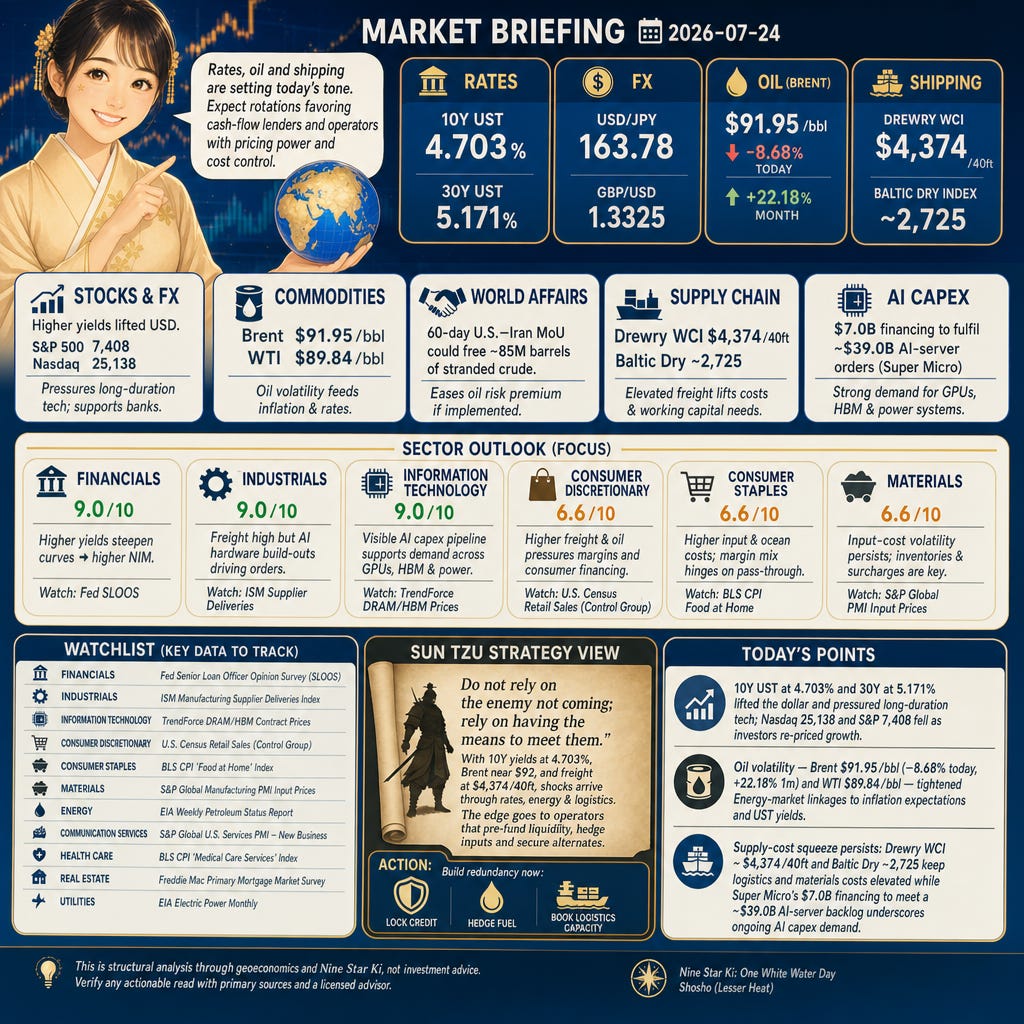
Good morning — rates, oil and shipping are setting today’s tone. The 10Y UST at 4.703% with USD/JPY 163.78 tightens financial conditions while Brent at $91.95/bbl keeps inflation expectations alive. Container and dry-bulk costs remain elevated, and funded AI capex continues to pull hardware and power demand forward. Expect rotations favoring cash‑flow lenders and operators with pricing power and cost control.
Paywall
Stocks and FX
10Y UST at 4.703% and 30Y at 5.171% (Investing.com/Reuters) pushed the dollar higher with USD/JPY at 163.780 as the S&P 500 printed 7,408 and Nasdaq 25,138. GBP/USD at 1.3325 marked six straight down days. Higher yields lift discount rates and corporate borrowing costs, pressuring long‑duration tech while supporting spread income for banks. FX translation also tightens for U.S. multinationals under a firmer dollar.
Commodities
Brent settled at $91.95/bbl and WTI at $89.84/bbl (Investing.com/Reuters), with Brent −8.68% on the day but +22.18% month‑on‑month. The swing reflects shifting Middle East risk premia and supply expectations, feeding directly into fuel surcharges and refinery margins. Higher crude lifts transport and packaging costs, reinforcing inflation expectations that link back to the 10Y at 4.703%, a cross‑asset tightening loop.
World Affairs
A 60‑day U.S.–Iran MoU and technical talks could free tens of millions of barrels of stranded crude, with reports citing ~57 ships and ~1,100 seafarers transiting since June 23 and estimates around 85 million barrels awaiting resolution (Al Jazeera, with Reuters figures). Lowered oil risk premia would ease Brent’s pressure point and, by extension, inflation expectations and safe‑haven demand. The channel runs through Energy and Materials margins, freight availability for Industrials, and rates for Financials.
Supply Chain
Drewry’s World Container Index printed $4,374 per 40ft for the week of July 23, while the Baltic Dry Index hovered near 2,725 (MTS Insights/TradingEconomics). Recent transpacific Shanghai–Los Angeles quotes were around $4,565/FEU at peak weeks. Elevated ocean rates lengthen lead times, raise working‑capital needs, and force retailers and manufacturers to revisit pricing and inventory buffers ahead of peak season.
AI
A $7.0B financing to fulfil roughly $39.0B of AI‑server orders (Super Micro 424B5, SEC) confirms funded demand across GPUs, HBM memory and boards. The pipeline tightens component markets and extends lead times, supporting utilization across the compute stack while raising power and grid‑connection needs for data centers. The capex visibility helps Industrials and IT even as higher yields keep growth valuations sensitive.
Industry News
Bitcoin traded near $64,923 as the S&P 500 hit 7,408 and Nasdaq 25,138, while Brent swung around the $92–$100 area intraday and the 10Y UST rose to 4.703% (Investing.com/Reuters; MarketBeat snapshot). The mix triggered a rotation away from long‑duration tech and crypto into cash‑flow sectors like Energy and Financials. Higher hurdle rates also raise funding costs for AI buildouts in the near term.
Industry Forecast
Today’s Setup
2026-07-24 is a One White Water (Ippaku Suisei, water) day overlaying the same year star, with month-star Three Blue Wood (Sanpeki Mokusei, wood) during Shosho (Lesser Heat). Flows and information effects run fast: oil and shipping volatility feed directly into financing costs and FX, shifting sector leadership. Expect cost control, funded orderbooks, and pricing power to matter more than top‑line growth.
Focus Sectors
Financials (9.0/10): 10Y UST at 4.703% and USD/JPY 163.78 (Reuters) steepen funding curves, lifting net interest margin (NIM — the spread between loan yields and funding costs) as deposit betas lag. Active payment and treasury rails support fee and float income when volumes hold. Risk: a curve re‑flattening or rising credit costs if oil/shipping squeeze borrowers. Watch the Fed’s SLOOS for lending standards and loan‑demand turns.
Industrials (9.0/10): Drewry’s $4,374/FEU and Baltic Dry ~2,725 keep freight, inventory and project logistics costs elevated, but funded AI hardware build‑outs (Super Micro’s $7.0B for ~$39.0B orders) are pulling through contract manufacturing and automation. Precision planners with pass‑throughs and stable supplier lead times benefit. Risks: route disruptions or fuel spikes; capex deferrals if yields stay high. Watch ISM Supplier Deliveries.
Information Technology (9.0/10): The 10Y at 4.703% raises hurdle rates for long‑duration cash flows, but a visible AI capex pipe — Super Micro’s $7.0B financing to fulfil ~$39.0B in orders — supports demand across GPUs, HBM and power systems. Tight components can sustain pricing and utilization even as multiples are yield‑sensitive. Risks: sustained real‑yield rise, HBM/packaging bottlenecks, strong dollar. Watch TrendForce DRAM/HBM pricing.
Consumer Discretionary (6.6/10): Container rates at $4,374/FEU and Brent near $91.95/bbl raise freight, bunker and surcharge lines into peak season, pressuring retail and travel margins. Higher UST yields tighten auto and big‑ticket financing, risking conversion even when traffic holds. Risks: surcharges staying elevated; further rate creep damping BNPL and card‑driven spend. Watch U.S. Census retail sales, especially the control group.
Consumer Staples (6.6/10): Elevated ocean ($4,374/FEU) and dry‑bulk (~2,725) costs push delivered COGS and working‑capital needs. Volumes are steadier, but margin mix hinges on pass‑through cadence and private‑label competition. Operators with disciplined promo and hedging can defend gross margin. Risks: inputs outrunning shelf‑price adjustments; trade‑down diluting mix. Watch BLS CPI ‘Food at home’ for pass‑through evidence.
Materials (6.6/10): A 60‑day U.S.–Iran MoU could release stranded crude, easing some petrochemical feedstocks, while container and bulk rates stay high, keeping delivered input costs elevated. Result: margin volatility across chemicals, metals and building materials. Inventories and surcharges become the buffer. Risks: oil/gas whipsaws and shipping diversions tying up working capital. Watch S&P Global Manufacturing PMI Input Prices.
Watchlist
Financials: Federal Reserve Senior Loan Officer Opinion Survey (quarterly U.S. bank lending standards and loan‑demand trends).
Industrials: ISM Manufacturing Supplier Deliveries Index (Institute for Supply Management; supplier lead times — higher readings mean slower deliveries).
Information Technology: TrendForce DRAM/HBM contract price trackers (monthly memory pricing that signals supply tightness and AI hardware cost curves).
Consumer Discretionary: U.S. Census Bureau Advance Monthly Retail Trade Report (monthly retail sales, including the control group that feeds GDP).
Consumer Staples: BLS CPI ‘Food at home’ index (monthly retail food‑price inflation that reflects pass‑through success).
Materials: S&P Global Manufacturing PMI Input Prices (monthly survey of producers’ input‑cost trends).
Energy: EIA Weekly Petroleum Status Report (weekly U.S. crude and products inventories, refinery utilization and implied demand).
Communication Services: S&P Global U.S. Services PMI — New Business (monthly gauge of services demand growth, including marketing and media).
Health Care: BLS CPI ‘Medical care services’ index (monthly measure of healthcare service pricing that influences payer behavior and provider margins).
Real Estate: Freddie Mac Primary Mortgage Market Survey (weekly 30‑year fixed mortgage rate, a proxy for household borrowing costs and property demand).
Utilities: EIA Electric Power Monthly (U.S. electricity demand growth and generation mix — a read on load and capex needs).
Caveats
Shosho (Lesser Heat) is mid‑season; a solar‑term transition next week can shift the cost‑and‑flows emphasis as new data prints land. The U.S.–Iran MoU remains contingent; a setback would re‑add oil risk premia and alter the rates and sector rotation read.
Sun Tzu Strategy View
Sun Tzu wrote: —— Do not rely on the enemy not coming; rely on having the means to meet them.
With 10Y yields at 4.703%, Brent near $92, and freight at $4,374/FEU, shocks are arriving through rates, energy and logistics. The edge goes to operators that pre‑fund liquidity, hedge inputs and secure alternates, not to those hoping volatility fades.
Action: Build redundancy now: lock credit, hedge fuel and book logistics capacity ahead of peak season.
Today’s Points
10Y UST at 4.703% and 30Y at 5.171% lifted the dollar and pressured long-duration tech; Nasdaq 25,138 and S&P 7,408 fell as investors re-priced growth.
Oil volatility — Brent $91.95/bbl (−8.68% today, +22.18% 1m) and WTI $89.84/bbl — tightened Energy-market linkages to inflation expectations and UST yields.
Supply-cost squeeze persists: Drewry WCI ~ $4,374/40ft and Baltic Dry ~2,725 keep logistics and materials costs elevated while Super Micro’s $7.0B financing to meet a ~$39.0B AI-server backlog underscores ongoing AI capex demand.
This is structural analysis through geoeconomics and Nine Star Ki, not investment advice. Verify any actionable read with primary sources and a licensed advisor.