Thank you for reading. Please subscribe and support Ayanomics 9 Trends so this work can continue.

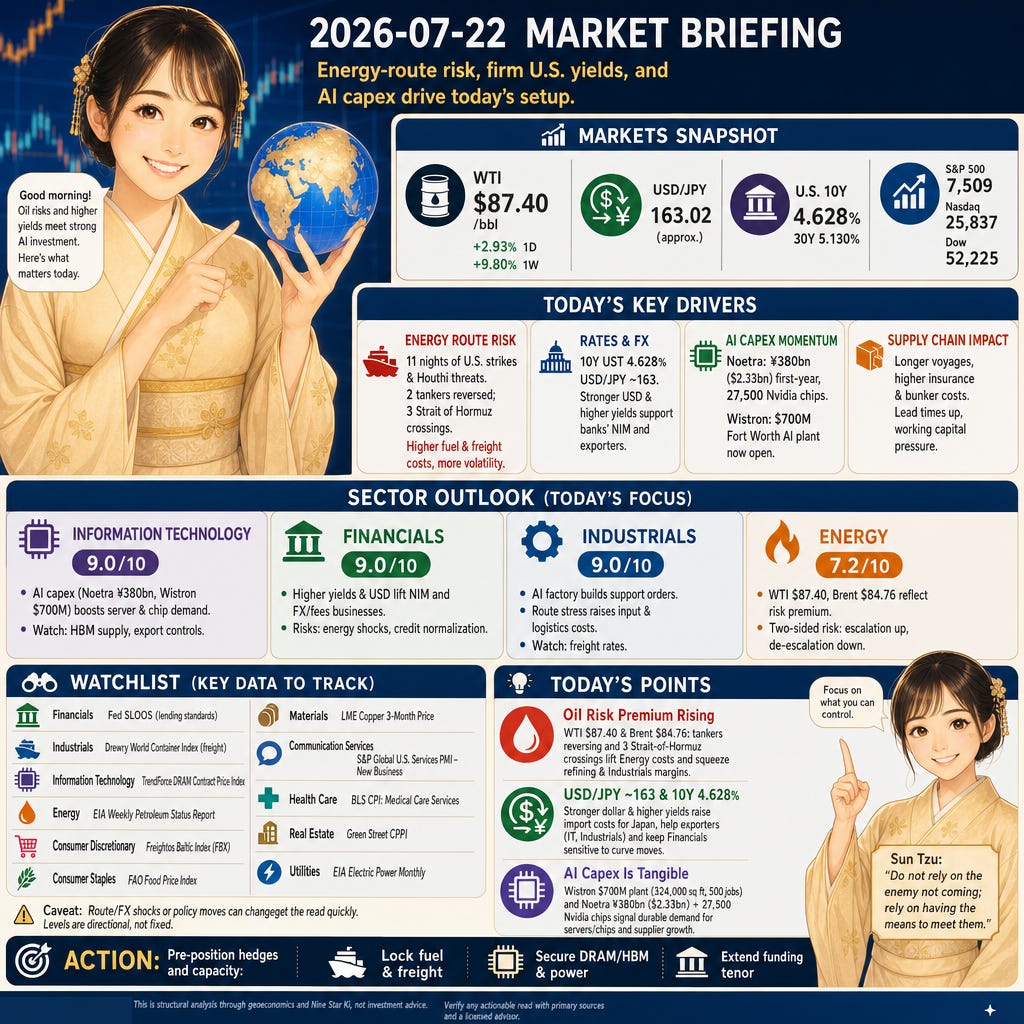
Good morning. Energy-route risk, firm U.S. yields, and a durable AI capex pipeline define today’s setup. WTI is near $87, USD/JPY sits around 163 as the 10Y UST holds near 4.63%, and AI manufacturing adds capacity in the U.S. and Japan. The mix supports Financials’ NIM and IT/Industrials order books while shipping friction raises costs for fuel‑ and freight‑exposed chains.
Paywall
Stocks and FX
USD/JPY 163.023 and the U.S. 10Y at 4.628% (30Y 5.130%) frame the tape, per Reuters/MarketScreener. The S&P 500 printed 7,509, the Nasdaq 25,837, and the Dow 52,225 against a stronger dollar and higher discount rates. A firmer USD and elevated yields tighten conditions for long‑duration equities while supporting bank net interest income and FX/flow businesses. Exporters with dollar revenue and yen costs gain translation and competitiveness, but import bills rise.
Commodities
WTI $87.40/bbl (+2.93% 1d, +9.80% 1w) and Brent $84.76/bbl anchor the complex, per Reuters/MarketScreener. Silver is $59.62/oz (four‑day rise) and copper $6.5185/lb (three‑day rise) on mixed safe‑haven and industrial demand. Shipping threats tied to U.S.–Iran strikes and Houthi warnings add risk premia, lifting fuel and packaging costs for Industrials, Materials, and Consumer goods and feeding headline CPI via energy.
World Affairs
11 consecutive nights of U.S. strikes and Houthi threats led 2 tankers to reverse and cut Hormuz crossings to 3, Reuters via Internazionale reports. No visible VLCC or LNG transits were seen that day. The route stress raises oil’s volatility and insurers’ premia, transmitting into refinery margins, global freight rates, and delivery risk for goods chains.
Supply Chain
3 Strait of Hormuz crossings (down from 4) and 2 Saudi‑crude tankers rerouted, per Kpler data cited by Reuters/Arab News; a Suezmax exited with its transponder off. Longer voyages and higher war‑risk insurance extend lead times and raise bunker costs, pushing up spot tanker and container rates. Expect tighter scheduling buffers and higher working capital for shippers and manufacturers.
AI
¥380bn ($2.33bn) first‑year funding and 27,500 Nvidia chips for Japan’s Noetra, Reuters via StreetInsider reports, with infrastructure construction slated for 2027–2028. The package signals ongoing demand for GPUs, advanced packaging (CoWoS/HBM), power systems, and contract manufacturing. It supports the semiconductor and data‑center stack even as a firm USD and higher yields pressure valuations.
Industry News
$700M, 324,000‑sq‑ft Wistron Fort Worth AI plant is open, with 500 jobs now and a ramp to “tens of thousands of boards/month” producing NVIDIA GB300 Grace Blackwell Ultra systems, per Wistron/NVIDIA. Added domestic capacity eases some upstream bottlenecks for cloud customers and lifts orders across server components, testing, and local infrastructure demand.
Industry Forecast
Today’s Setup
2026-07-22 falls on a Three Blue Wood (Sanpeki Mokusei, 三碧木星) day and month over a One White Water (Ippaku Suisei, 一白水星) year during Shosho (Lesser Heat). Translation: growth favors those converting capex and information into output while adapting to chokepoints — watch fuel and freight costs, rate sensitivity in valuations, and steady AI buildout converting orders into shipments.
Focus Sectors
Information Technology (9.0/10): ¥380bn first‑year backing for Noetra with 27,500 Nvidia chips and Wistron’s $700M U.S. ramp expand server and semiconductor demand across GPUs, advanced packaging (CoWoS/HBM), power, and EMS. That supports orders even as 10Y 4.628% and a firm USD compress long‑duration multiples. Risks: export‑control shifts and HBM substrate bottlenecks that re‑tighten supply. Watch TrendForce DRAM/HBM pricing for margin and allocation signals.
Financials (9.0/10): 10Y UST 4.628%, 30Y 5.130% and USD/JPY ~163 lift net interest margin (NIM, the spread between loan yields and funding costs) and revalue collateral pools. Active AI‑related pipelines — Noetra’s ¥380bn and Wistron’s $700M plant — support underwriting, fees, and trading. A steeper curve and firm USD aid transaction FX and payments. Risks: disorderly energy‑driven curve shifts or FX intervention; credit normalization as fuel/freight bite. Track SLOOS for lending‑standards tightness.
Industrials (9.0/10): 3 Hormuz crossings (down from 4) and tankers U‑turning extend voyages and raise insurance and bunker costs; WTI in the high‑$80s lifts inputs. Offsetting: onshoring and AI factory builds (Wistron Fort Worth) sustain machinery, electrical equipment, and project‑engineering backlogs. Expect higher working capital and schedule risk with supported order books. Risks: prolonged Hormuz/Red Sea friction and skilled‑labor tightness. Monitor Drewry WCI for freight pressure.
Energy (7.2/10): WTI $87.40 and Brent $84.76 reflect elevated risk premia as crossings fall and tankers reverse in the Red Sea. Routing changes tighten prompt barrels and can swing crack spreads; firms with flexible logistics and trading adapt faster. Risks are two‑tailed: escalation spikes crude and freight; de‑escalation deflates premia. Watch the EIA weekly balance for inventories, imports, and refinery utilization.
Watchlist
Financials: Federal Reserve SLOOS (Senior Loan Officer Opinion Survey — quarterly U.S. bank lending standards and loan demand).
Industrials: Drewry World Container Index (weekly global container freight rates by lane, published by Drewry).
Information Technology: TrendForce DRAM Contract Price Index (monthly DRAM/HBM pricing and supply commentary by TrendForce).
Energy: EIA Weekly Petroleum Status Report (weekly U.S. crude and product inventories, refinery utilization, and imports, published by the U.S. EIA).
Consumer Discretionary: Freightos Baltic Index (FBX — weekly global container freight rates by major lanes, published by Freightos).
Consumer Staples: FAO Food Price Index (monthly global food commodity price basket published by the UN FAO).
Materials: LME Copper 3‑Month Price (daily benchmark for copper futures, published by the London Metal Exchange).
Communication Services: S&P Global U.S. Services PMI – New Business (monthly measure of new orders in services, published by S&P Global).
Health Care: BLS CPI: Medical Care Services (monthly U.S. inflation gauge for medical services, published by the Bureau of Labor Statistics).
Real Estate: Green Street Commercial Property Price Index (monthly U.S. commercial real estate price level, published by Green Street).
Utilities: EIA Electric Power Monthly (monthly U.S. generation mix, retail prices, and utility fuel costs, published by the U.S. EIA).
Caveats
A rapid de‑escalation or escalation around Hormuz/Suez, or unexpected FX action in Japan, would quickly change the rate/FX and energy read. We sit near the Shosho-to-Taisho solar‑term handoff and freight/commodity snapshots are volatile intraday; treat levels as directional, not fixed.
Sun Tzu Strategy View
Sun Tzu wrote: —— Do not rely on the enemy not coming; rely on having the means to meet them.
With energy chokepoints live and USD/JPY near 163, plans that assume stable routes or FX are fragile. Build cushions via fuel hedges, alternative routings, committed HBM/power allocations, and term funding so curve swings and shipping delays do not force reactive cuts.
Action: Pre‑position hedges and capacity: lock fuel and freight, secure DRAM/HBM and power, and extend funding tenor.
Today’s Points
WTI $87.40 and Brent $84.76: renewed Middle East supply risks (tankers reversing and 3 Strait-of-Hormuz crossings) raise Energy input costs and pressure refining and Industrials margins.
USD/JPY ~163.02 and 10Y UST 4.628%: a stronger dollar and higher yields amplify import-cost stress for Japan and benefit exporters (Information Technology, Industrials) while keeping Financials sensitive to curve moves.
AI capex is tangible: Wistron’s $700M Fort Worth plant (324,000 sq ft, 500 jobs) plus Japan’s Noetra ¥380bn ($2.33bn) funding and 27,500 Nvidia chips point to durable server/chip demand for Information Technology and Industrials suppliers.
This is structural analysis through geoeconomics and Nine Star Ki, not investment advice. Verify any actionable read with primary sources and a licensed advisor.