Thank you for reading. Please subscribe and support Ayanomics 9 Trends so this work can continue.

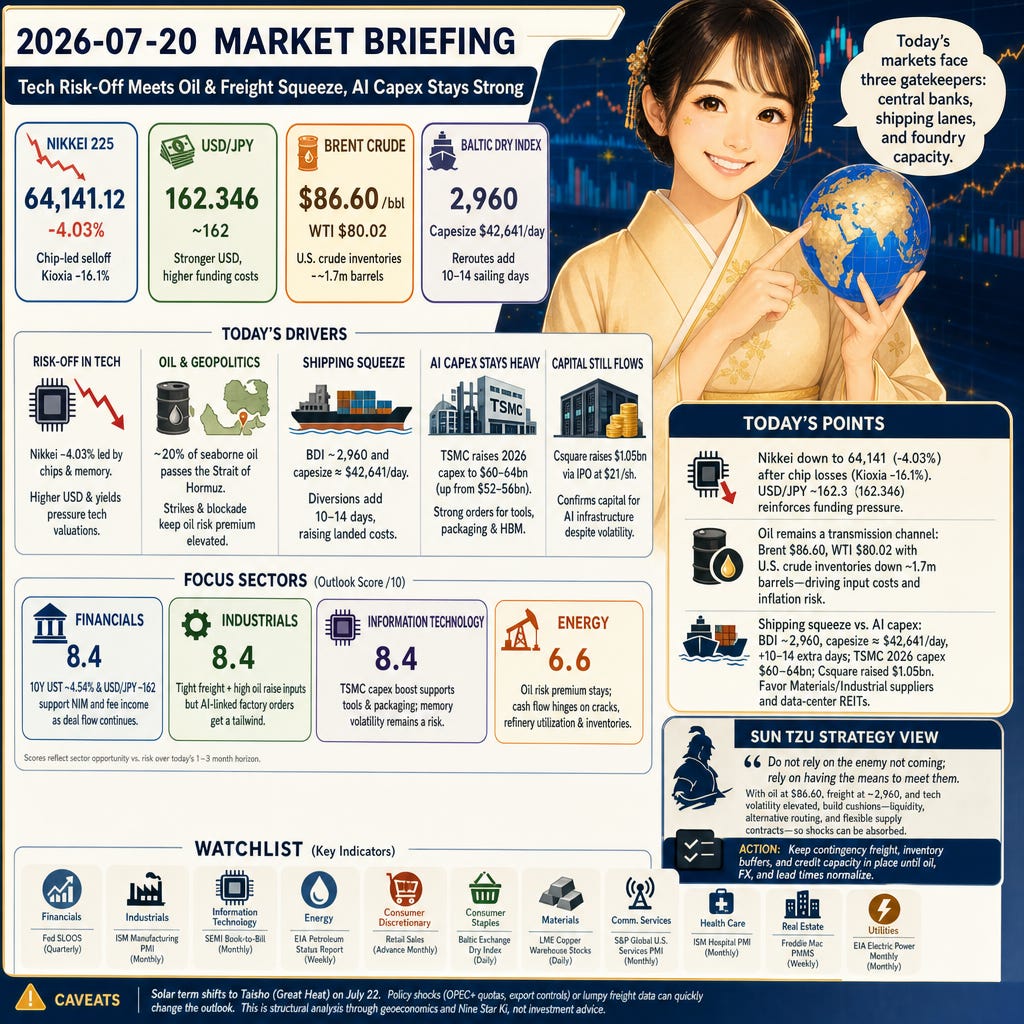
Good morning. A tech-led risk-off meets an oil-and-freight squeeze while AI infrastructure spend stays heavy. The result is tighter financial conditions (USD/JPY ~162, UST 10Y ~4.54%), elevated input costs (Brent $86.60), and sustained capex signals (TSMC $60–64bn). Today’s read emphasizes gatekeepers: central banks, shipping lanes, and foundry capacity.
Paywall
Stocks and FX
64,141.12 on the Nikkei 225 (-4.03%) and intraday losses of up to 6.18% marked a chip- and memory-led rout, with Kioxia down 16.1% (Reuters via MarketScreener). USD/JPY traded near 162.346 and the U.S. 10-year yield sat around 4.541%, reinforcing a stronger dollar and higher discount rates. The mix pressures Information Technology and Communication Services while lifting hedging and funding costs for global firms; volatility also supports trading-revenue pools for Financials.
Commodities
$86.60/bbl for Brent and $80.02/bbl for WTI, with U.S. crude inventories down about 1.7 million barrels in the week to July 10 (Reuters via EnergyNow). Elevated crude feeds fuel, shipping, and packaging costs into CPI, lifting margin pressure for Industrials and Consumer Discretionary while supporting Energy cash generation via product cracks and inventory draws. Sustained tension keeps the inflation channel open and bond-market term premia firm.
World Affairs
About 20% of global seaborne oil normally passes the Strait of Hormuz, and Reuters reports renewed U.S. strikes on Iran alongside a reinstated naval blockade. The operations sustain a geopolitical risk premium in crude (Brent $86.60, WTI $80.02) and raise shipping insurance and reroute costs. Transmission runs through inflation and freight, affecting Energy, Materials, and interest‑rate expectations that set real‑asset cap rates.
Supply Chain
~2,960 on the Baltic Dry Index and roughly $42,641/day on capesize rates reflect tight prompt tonnage, with diversions adding 10–14 sailing days on Asia–Europe loops (Handybulk). Longer transits absorb vessel-days, push up landed costs, and stretch reorder cycles and safety stocks. Inventory planning faces higher working-capital needs and greater schedule variance, particularly for bulk‑heavy inputs and import‑reliant categories.
AI
$60–64 billion is TSMC’s 2026 capex guide, up from $52–56bn, alongside record Q2 revenue near $40.2bn and a >40% y/y growth outlook (Bloomberg). The foundry and advanced‑packaging buildout signals durable orders for upstream equipment, specialty components, and HBM/CoWoS capacity, even as equity volatility reprices valuations. Data‑center power and memory availability remain gating factors for delivery and revenue conversion.
Industry News
$1.05 billion was raised by data‑centre operator Csquare, selling 50 million shares at $21 for a roughly $3.25 billion valuation, below the $23–$27 range (Reuters via Techmeme). The deal confirms capital formation for AI infrastructure despite market volatility, with implications for Real Estate exposure to data centers, IT supply chains, and Financials’ underwriting pipelines. It also sets a comp for follow‑on issuance and M&A in the space.
Industry Forecast
Today’s Setup
2026-07-20 sits on Five Yellow Earth (Goou Dosei, 五黄土星) in the Center (Chūkyū, 中宮) during Shosho (Lesser Heat), with Three Blue Wood (Sanpeki Mokusei, 三碧木星) for the month and One White Water (Ippaku Suisei, 一白水星) for the year. Expect central‑node dynamics: financing costs, shipping chokepoints, and foundry capacity steer pricing and flows, favoring balance‑sheet lenders, precision machinery, and AI capex suppliers while ad‑ and diffusion‑models face cost and attention constraints.
Focus Sectors
Financials (8.4/10): 10Y UST near 4.54% and USD/JPY around 162 tighten funding math while deal flow continues (Csquare’s $1.05bn IPO). That combination supports net interest margin (the spread banks earn between loans and deposits) and fee pools when primary markets stay open and volatility lifts trading. Watch for curve shifts that compress NIM or force hedging resets; a hotter oil‑led CPI print could harden the rate path and cool credit appetite.
Industrials (8.4/10): Baltic Dry ~2,960, capesize ~$42,641/day, and +10–14‑day diversions extend supplier deliveries but bolster pricing. Elevated oil (~$86.6 Brent) raises inputs, yet AI‑linked factory orders get a tailwind from TSMC’s $60–64bn 2026 capex. Backlogs convert if schedules hold and surcharges stick. Risk: a persistent freight premium that outpaces pass‑through, or a pause in semi‑tool orders rippling into high‑mix OEMs. Watch ISM Manufacturing new orders and supplier deliveries.
Information Technology (8.4/10): TSMC lifting 2026 capex to $60–64bn extends the equipment and advanced‑packaging cycle, but the tape is fragile after a memory‑led selloff in Tokyo (Nikkei 64,141; Kioxia -16.1%). Upstream tools, substrates, and HBM/CoWoS capacity look best supported if deliveries land on time; ad‑ or consumer‑exposed names face multiple compression. Key risks are packaging bottlenecks, export‑control shifts, and a deeper memory downcycle. Track SEMI book‑to‑bill for order momentum.
Energy (6.6/10): Brent $86.60 and WTI $80.02, alongside a ~1.7mb U.S. crude draw and Hormuz disruptions, keep a risk premium embedded. Near‑term cash flow hinges on product cracks, refinery utilization, and regional inventory prints more than headline crude alone. A swift diplomatic shift could deflate prices, while escalation would stress product flows and refining reliability. Watch EIA weekly data for stock changes and runs; OPEC+ quota surprises remain a wildcard.
Watchlist
Financials: Federal Reserve SLOOS (Senior Loan Officer Opinion Survey — quarterly U.S. lending standards and loan demand)
Industrials: ISM Manufacturing PMI (Institute for Supply Management — new orders and supplier deliveries components)
Information Technology: SEMI North America semiconductor equipment book‑to‑bill (monthly orders vs. shipments)
Energy: EIA Weekly Petroleum Status Report (weekly U.S. crude/product inventories and refinery utilization)
Consumer Discretionary: U.S. Census Bureau Advance Monthly Retail Sales (monthly retail spending levels and mix)
Consumer Staples: Baltic Exchange Dry Index (global bulk‑shipping costs affecting landed prices)
Materials: LME Copper warehouse stocks (London Metal Exchange — visible copper inventory and tightness gauge)
Communication Services: S&P Global U.S. Services PMI (monthly business activity and new orders in services, a proxy for ad and communications demand)
Health Care: ISM Hospital PMI (monthly hospital business activity, new orders, and employment)
Real Estate: Freddie Mac Primary Mortgage Market Survey (weekly U.S. 30‑year mortgage rates)
Utilities: EIA Electric Power Monthly (generation mix, retail sales, and average revenue per kWh)
Caveats
The solar term shifts to Taisho (Great Heat) on July 22; a turn in seasonal demand or weather‑driven loads around that transition could alter energy, freight, and grid conditions. Policy shocks—OPEC+ quota changes, export‑control updates—or lumpy freight data can quickly revise today’s sector skew.
Sun Tzu Strategy View
Sun Tzu wrote: —— Do not rely on the enemy not coming; rely on having the means to meet them.
With oil at $86.60, freight at ~2,960 on the BDI, and tech volatility elevated, it is risky to bet on calm. Build cushions—liquidity, alternative routing, and flexible supply contracts—so shocks in energy, FX, or packaging can be absorbed without derailing delivery or financing plans.
Action: Keep contingency freight, inventory buffers, and credit capacity in place until oil, FX, and lead times normalize.
Today’s Points
Nikkei down to 64,141 (-4.03%) after chip losses (Kioxia -16.1%), reinforcing pressure on Information Technology and pushing USD/JPY ~162.3 (snapshot 162.346).
Oil remains a transmission channel: Brent $86.60 and WTI $80.02 with U.S. crude inventories down ~1.7m barrels — a higher oil price backdrop lifts Energy input costs and inflation risk for Industrials and Consumer Discretionary.
Shipping and AI capex divergence: Baltic Dry ~2,960 and capesize rates ≈ $42,641/day with 10–14 extra days on diverted routings, while TSMC hikes 2026 capex to $60–64bn and Csquare raised $1.05bn — meaning supply-chain squeeze and long-cycle capex are coexisting, favoring Materials/Industrial suppliers and data-center REITs.
This is structural analysis through geoeconomics and Nine Star Ki, not investment advice. Verify any actionable read with primary sources and a licensed advisor.