

Thank you for reading. Please subscribe and support Ayanomics 9 Trends so this work can continue.
Good morning — the tape opens with oil risk premia elevated, a tech-led equity pullback, and ocean freight still tight. The Hormuz shock is feeding $80–86 crude and war-risk surcharges, while chips and memory correct after a strong first half. AI capex remains heavy, but financing and logistics are today’s constraints. Expect balance-sheet discipline to matter as funding costs and delivered costs both edge up.
Paywall
Stocks and FX
64,141 on the Nikkei 225 (-4.03%) and USD/JPY at 162.38 set a risk-off tone as chips and memory dragged regional markets, per Reuters (via Investing.com). The Nasdaq composite snapshot sat near 25,882, with Nvidia down ~2.4% and Micron ~5.6% in related trading. A weaker yen lifts exporters’ translated revenues but also tightens import-cost pressure, while the tech pullback compresses Information Technology multiples and rotates flows toward cash generators.
Commodities
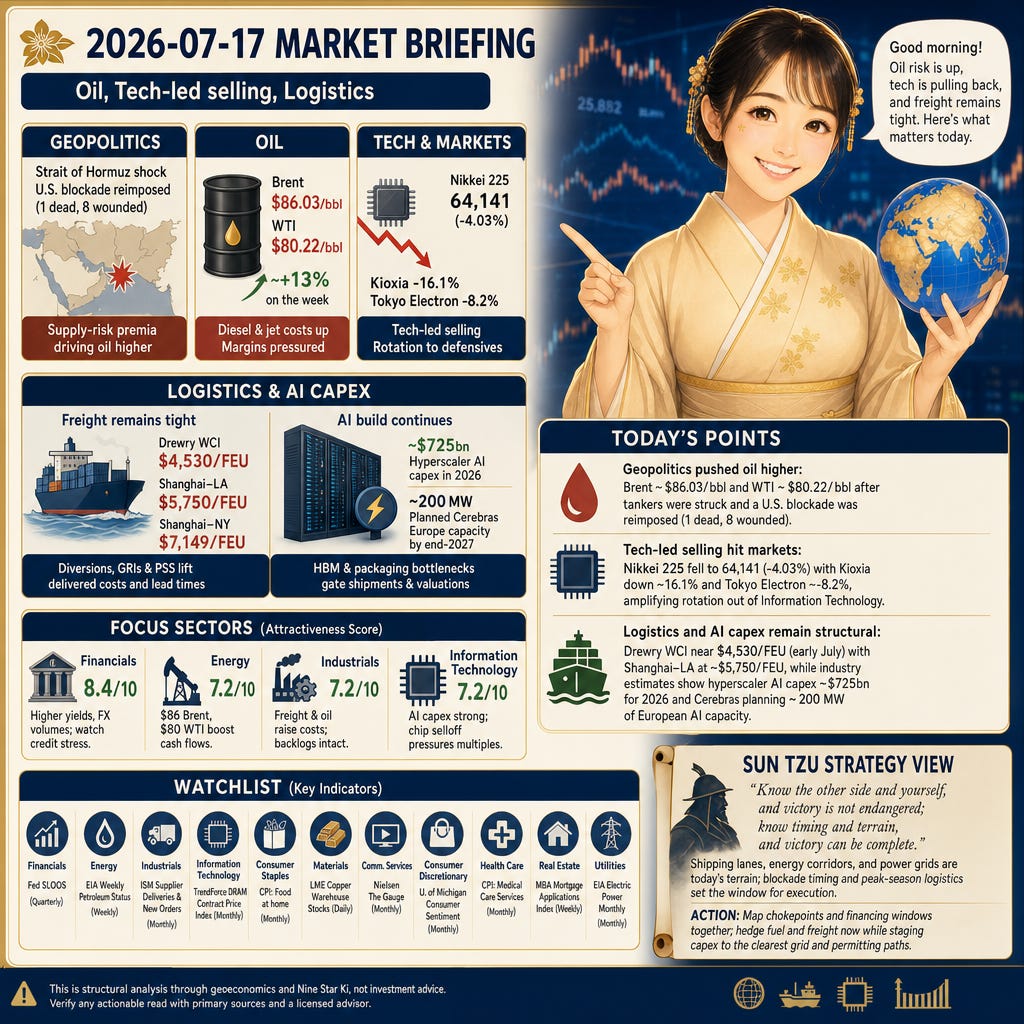
$86.03/bbl Brent and $80.22/bbl WTI, up roughly 13% on the week, mark the largest weekly gains in months amid U.S.–Iran hostilities, Reuters reports. Higher crude raises diesel and jet costs, compressing margins for Industrials and Consumer Discretionary while firming Energy revenues. The oil pop can lift inflation expectations and nominal yields, pressuring rate‑sensitive Real Estate funding and adding to working-capital needs across supply chains.
World Affairs
Two tankers were struck in the Strait of Hormuz (1 killed, 8 wounded) and the U.S. reimposed a naval blockade effective July 14, Reuters reports via syndication. With the strait historically handling about one‑fifth of global oil and LNG flows, perceived supply risk climbs, feeding $86 Brent and forcing diversions. The channel to markets is clear: higher war‑risk insurance, longer routes via the Cape, and tighter fuel budgets for shippers and carriers.
Supply Chain
$4,530/FEU on Drewry’s World Container Index, ~$5,750/FEU Shanghai–Los Angeles, and ~$7,149/FEU Shanghai–New York signal tight lanes into early peak season, per Transmodal (Drewry). Elevated GRIs and PSS, plus Red Sea/Hormuz diversions, raise delivered costs and inventory carry for retailers and OEMs. Lead times lengthen, and some importers pull forward orders, lifting near‑term trucking and warehousing demand but squeezing margins.
AI
200 MW of planned European AI capacity from Cerebras by end‑2027 and roughly $725bn in 2026 hyperscaler AI capex, per DataX Connect and industry tallies, extend the build cycle. That supports GPUs, HBM, advanced packaging, power systems, and thermal gear while pulling forward grid upgrades. Near term, the chip selloff tightens multiples; structurally, supply of memory and packaging remains the gating factor for shipments and valuations.
Industry News
64,141 on the Nikkei (-4.03%) came with sharp tech moves: Kioxia -16.1%, Tokyo Electron -8.2%, and Yaskawa Electric plunged to 5,972 yen after a 21.7% Q1 net‑profit drop, the AP notes. The repricing signals higher earnings risk for AI‑ and memory‑exposed suppliers, with currency at ~JPY 162 per USD shaping export math. Expect cautious capex and select M&A delays in affected subsectors.
Industry Forecast
Today’s Setup
July 17, 2026 is an Eight White Earth (Happaku Dosei, 八白土星) day in Shosho (Lesser Heat), a setup that favors control, safety, and measured balance‑sheet use. With the month in Three Blue Wood and the year in One White Water, capex programs continue but must navigate logistics frictions and funding costs; today’s pricing power sits with oil, freight, and FX‑sensitive flow businesses.
Focus Sectors
Financials (8.4/10): 86-dollar Brent, 80-dollar WTI, and USD/JPY at 162.38 can steepen the yield curve and lift net interest margin, while FX and market‑making volumes expand fee pools (risk‑off Nikkei 64,141). That supports deposit‑rich lenders and transaction platforms, but higher oil can raise credit stress in transport/retail and policy shifts (Basel III endgame) may restrain loan growth. Watch lending standards and demand to gauge credit creation and NPL risk.
Energy (7.2/10): Brent near $86 and WTI ~$80 on Hormuz strikes and a U.S. blockade expand upstream cash flows and boost trading, as reported by Reuters. War‑risk insurance and diversions reshape refinery slates and margins along the flow network. A sudden de‑escalation or coordinated stock releases could compress premia quickly; physical security and insurance OPEX remain swing variables for Gulf/Red Sea exposure.
Industrials (7.2/10): Drewry’s WCI at ~$4,530/FEU and Shanghai–LA ~$5,750 raise delivered costs and extend lead times just as oil near $86 tightens diesel/jet budgets. Short‑cycle machinery faces a risk‑off tape (e.g., Yaskawa profit miss) even as electrification and data‑centre projects keep multi‑year backlogs intact. Persistent freight and insurance surcharges can erode margins; FX against Asian suppliers complicates quotes and working capital.
Information Technology (7.2/10): Roughly $725bn in 2026 hyperscaler AI capex and a planned 200 MW Cerebras Europe build support GPUs, HBM, and packaging demand. Near term, chip weakness (Nvidia -2.4% cited) pressures multiples and exposes inventory resets; freight and insurance add to COGS for hardware. HBM and advanced‑packaging bottlenecks are the gating factors on shipments and revenue timing; export‑control shifts remain a policy risk.
Watchlist
Financials: Federal Reserve SLOOS (Senior Loan Officer Opinion Survey — quarterly U.S. bank lending standards and loan demand).
Energy: EIA Weekly Petroleum Status Report (weekly U.S. crude inventories, product stocks, and refinery utilization).
Industrials: ISM Manufacturing Report On Business — Supplier Deliveries and New Orders (monthly U.S. lead times and demand).
Information Technology: TrendForce DRAM contract price index (monthly memory pricing for DRAM/HBM supply-demand balance).
Consumer Staples: BLS CPI: Food at home (monthly U.S. grocery price inflation that signals pass-through capacity).
Materials: LME Copper Warehouse Stocks (daily exchange inventory levels indicating physical tightness/oversupply).
Communication Services: Nielsen The Gauge (monthly U.S. TV/streaming viewing share that tracks engagement mix).
Consumer Discretionary: University of Michigan Consumer Sentiment Index (monthly expectations and buying-conditions gauge).
Health Care: BLS CPI: Medical care services (monthly U.S. price trends affecting reimbursement and margins).
Real Estate: MBA Weekly Mortgage Applications Index (weekly U.S. purchase/refi activity signaling rate sensitivity).
Utilities: EIA Electric Power Monthly (U.S. generation mix, retail sales, and average revenues by class).
Caveats
A rapid de‑escalation around Hormuz or an abrupt policy pivot that flattens the yield curve would change the sector skew quickly. Freight prints are early‑July snapshots while spot lanes move week‑to‑week; upcoming inventory, lending‑standards, and CPI data may revise today’s read.
Sun Tzu Strategy View
Sun Tzu wrote: —— Know the other side and yourself, and victory is not endangered; know timing and terrain, and victory can be complete.
Shipping lanes, energy corridors, and power grids are today’s terrain; blockade timing and peak‑season logistics set the window for execution. Read counterparties (regulators, carriers, suppliers) alongside route risks to decide when to press capex and when to hedge or defer.
Action: Map chokepoints and financing windows together; hedge fuel and freight now while staging capex to the clearest grid and permitting paths.
Today’s Points
Geopolitics pushed oil higher: Brent ~ $86.03/bbl and WTI ~ $80.22/bbl after tankers were struck and a U.S. blockade was reimposed (1 dead, 8 wounded), increasing supply-risk premia.
Tech-led selling hit markets: Nikkei 225 fell to 64,141 (‑4.03%) with Kioxia down ~16.1% and Tokyo Electron ~‑8.2%, amplifying rotation out of Information Technology into defensive and commodity sectors.
Logistics and AI capex remain structural: Drewry WCI assessed near $4,530/FEU (early July) with Shanghai–LA at ~$5,750/FEU, while industry estimates show hyperscaler AI capex around $725bn for 2026 and Cerebras planning ~200 MW of European AI capacity.
This is structural analysis through geoeconomics and Nine Star Ki, not investment advice. Verify any actionable read with primary sources and a licensed advisor.
Tiger Capital Research さん、いいねありがとうございます。読んでいただけてうれしいです。