Thank you for reading. Please subscribe and support Ayanomics 9 Trends so this work can continue.
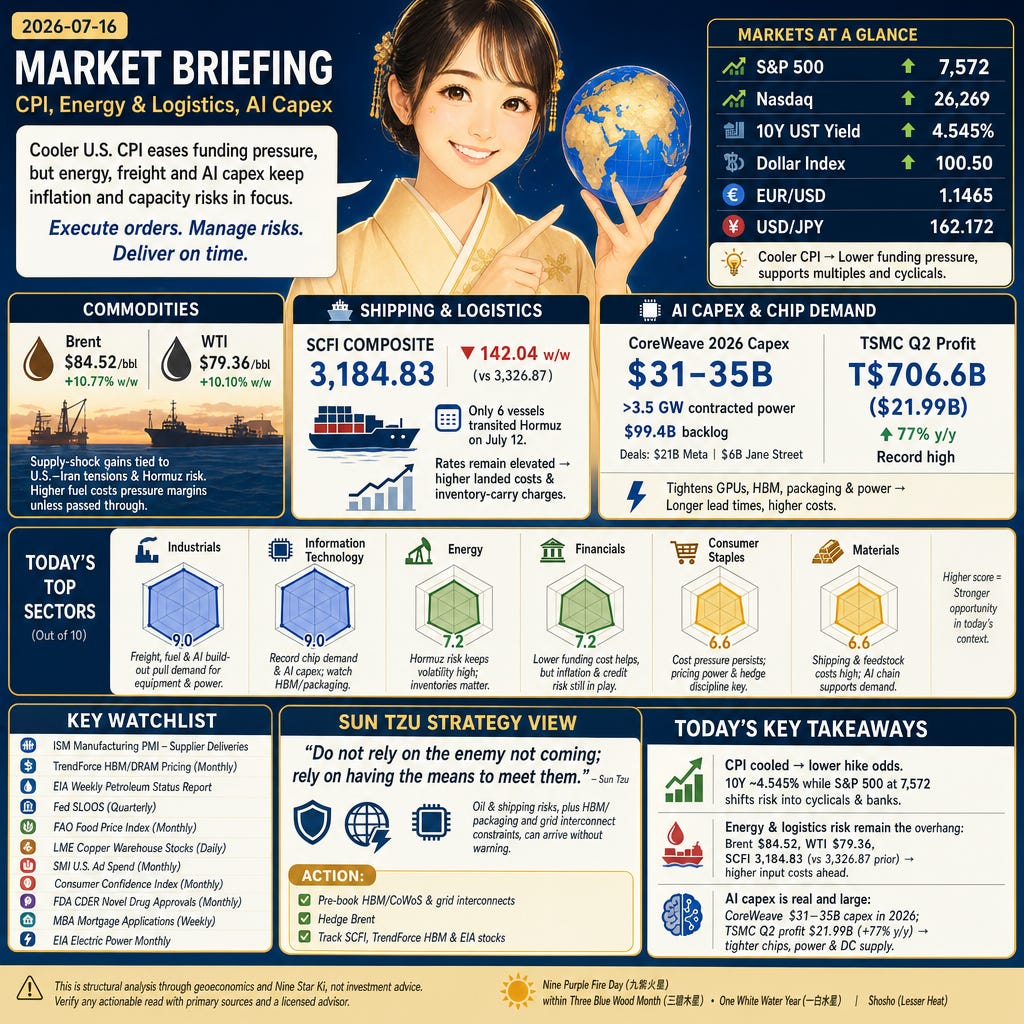
Good morning. S&P 500 at 7,572 and the 10-year UST near 4.545% reflect cooler U.S. CPI, easing some funding pressure. Brent at $84.52 and the SCFI at 3,184.83 keep fuel and freight inflation in focus. AI capex remains large (CoreWeave $31–35B; TSMC record profit), tightening chips, memory, and power. Today favors operators that can translate orders into on-time delivery while managing energy and routing risk.
Paywall
Stocks and FX
S&P 500 7,572 and Nasdaq 26,269 traded alongside a 10-year UST yield near 4.545%, with the dollar index around 100.50 (Reuters). EUR/USD printed 1.1465 while USD/JPY was 162.172, keeping the yen weak (Reuters). Softer U.S. inflation supports multiples for Information Technology and lowers funding strain for Financials, but a still‑weak yen raises import costs for Japan-exposed Industrials and Consumer Discretionary.
Commodities
Brent at $84.52/bbl and WTI at $79.36/bbl followed a week of supply‑shock gains (Brent +10.77%, WTI +10.10%) tied to U.S.–Iran tensions and a naval blockade around Hormuz (Reuters). Higher crude lifts airline, trucking, and petrochemical costs and can re‑add to headline inflation. If risk premia persist, margins compress downstream unless surcharges and hedges catch up.
World Affairs
About 15 million bpd of oil flows are exposed at the Strait of Hormuz, and a proposed 20% transit fee was estimated at roughly $240 million/day (Reuters). Recent tanker strikes caused casualties and lifted war‑risk insurance costs. The transmission is direct: higher energy prices and shipping insurance feed into Materials and Industrials inputs and keep inflation risk alive for Financials.
Supply Chain
SCFI composite printed 3,184.83, down 142.04 w/w from 3,326.87, the first dip after a long run, while only six vessels transited Hormuz on July 12 (Financial News citing Shanghai Shipping Exchange). Rates remain elevated, sustaining higher landed costs and inventory‑carry charges for Industrials and Consumer Discretionary. Carrier P&L estimates (e.g., HMM, PCL) signal pricing power and potential schedule volatility that buyers must plan around.
AI
CoreWeave guided 2026 capex at $31–35B with >3.5 GW contracted power and a $99.4B backlog, plus large deals ($21B Meta; $6B Jane Street), per Reuters via MarketScreener. Reports also flagged OpenAI discussing a potential 5% U.S. government stake. The build-out tightens GPUs, HBM memory, advanced packaging, and power interconnects, lifting lead times and costs for Information Technology and data‑center Real Estate while squeezing downstream margins for cloud users.
Industry News
TSMC posted a record Q2 net profit of T$706.6 billion ($21.99B), up 77% y/y, beating estimates on AI/HPC mix (Reuters via Investing.com). The same coverage noted regional rotation risk with the Nikkei at 66,836 (-2.79%). The print validates premium‑node demand, supports tool and specialty-material suppliers, and keeps capex plans elevated — but also raises the bar for guidance and exposes cross‑market re‑pricing within chips.
Industry Forecast
Today’s Setup
2026-07-16 is a Nine Purple Fire (Kyushi Kasei, 九紫火星) day within a Three Blue Wood (Sanpeki Mokusei, 三碧木星) month and a One White Water (Ippaku Suisei, 一白水星) year during Shosho (Lesser Heat). Expect guidance, pricing, and capacity disclosures to swing the tape while fuel and freight costs, memory/packaging bottlenecks, and grid interconnect queues set the real constraints.
Focus Sectors
Industrials (9.0/10): SCFI at 3,184.83 and Brent near $84.52 keep freight and fuel a live cost line, while AI build‑outs (CoreWeave $31–35B; >3.5 GW) pull through electrical gear, precision machinery, and HVAC. The playbook is order conversion and installation speed without margin slippage. Watch transformer and switchgear lead times and FX (USD/JPY ~162) that can distort import costs; a re‑acceleration in SCFI or a Hormuz shock would pressure project spreads.
Information Technology (9.0/10): TSMC’s record Q2 profit (+77% y/y to $21.99B) and CoreWeave’s 2026 capex ($31–35B) confirm multi‑year AI demand across GPUs, CoWoS packaging, and HBM memory. With the 10Y UST near 4.545% after cooler CPI, multiples have air if delivery schedules hold. Bottlenecks are packaging capacity, HBM supply, and power interconnects. Monitor TrendForce contract pricing; a sharp upswing in HBM/DRAM could squeeze downstream AI services and cloud margins.
Energy (7.2/10): Brent $84.52 and WTI $79.36 reflect Hormuz risk on ~15M bpd, inflating war‑risk premia and marine insurance. Upstream and trading desks benefit from volatility and wider spreads, while refined products transmit costs to industry and consumers. Inventories and refinery runs matter more than spot prints in this setup. A rapid de‑escalation or strategic stock releases would deflate premia; track EIA weekly stocks and utilization for crack‑spread direction.
Financials (7.2/10): The 10Y near 4.545% eases funding costs, helping NIM, while resilient equities support fee pools. But fuel at $84.52 Brent and sticky freight (SCFI 3,184.83) keep inflation tail risk alive, which could re-price duration and widen credit spreads. CRE remains a drag and reserve builds are in focus. Watch the Fed’s SLOOS for loan-demand and standards; a renewed inflation impulse would flatten origination pipelines and hit trading.
Consumer Staples (6.6/10): Elevated SCFI 3,184.83 and Brent $84.52 lift landed, packaging, and logistics costs, but category leaders can stagger list‑price moves, trade down, and hedge inputs. Execution is in procurement discipline and retailer negotiations to protect volumes and gross margin. Risks are agricultural and resin spikes or a container‑rate re‑acceleration that pre‑empts pricing rounds. Track the FAO Food Price Index to gauge input pressure and timing on pass‑through.
Materials (6.6/10): Shipping and feedstock costs are the choke points: high SCFI and Brent raise transit and petrochemical inputs. Demand gets support from AI supply chains — TSMC’s beat points to specialty gases, photoresists, and copper — partially offsetting weak China construction. Inventory and mine/mill run‑rate discipline is central to cushion price swings. Watch LME copper warehouse stocks for signals on tightness; permitting delays can stall debottlenecking just as demand firmed.
Watchlist
Industrials: Institute for Supply Management (ISM) Manufacturing PMI — Supplier Deliveries Index (supplier delivery times; lower values mean faster deliveries).
Information Technology: TrendForce DRAM/HBM contract price tracker (monthly memory contract pricing for DRAM and HBM).
Energy: EIA Weekly Petroleum Status Report (weekly U.S. crude and product inventories plus refinery utilization).
Financials: Federal Reserve Senior Loan Officer Opinion Survey (SLOOS) — quarterly lending standards and loan demand across business and household credit.
Consumer Staples: FAO Food Price Index (global basket of food commodity prices, monthly).
Materials: London Metal Exchange (LME) Copper Warehouse Stocks (daily exchange-registered copper inventories).
Communication Services: Standard Media Index (SMI) monthly U.S. ad spend (aggregated agency and publisher billing data).
Consumer Discretionary: The Conference Board Consumer Confidence Index (monthly consumer sentiment and buying plans).
Health Care: FDA CDER Novel Drug Approvals (monthly count of new drug approvals and major regulatory decisions).
Real Estate: Mortgage Bankers Association (MBA) Weekly Mortgage Applications Survey (purchase and refinance activity).
Utilities: EIA Electric Power Monthly (utility-scale generation mix, retail electricity sales, and average prices).
Caveats
Shosho (Lesser Heat) transitions to the next solar term soon, and peak‑heat dynamics could change utility loads, fuel draws, and outage risks that re-price power and logistics. A sudden de‑escalation around Hormuz or a snap higher in SCFI would invert today’s sector skew; data gaps between weekly freight/oil prints and monthly memory pricing can also whipsaw the read.
Sun Tzu Strategy View
Sun Tzu wrote: —— Do not rely on the enemy not coming; rely on having the means to meet them.
Oil and shipping risks, plus HBM/packaging and grid‑interconnect constraints, can arrive without warning. The edge goes to teams that pre‑book capacity, diversify routes and suppliers, and carry the right hedges and inventories to absorb shocks.
Action: Pre‑book HBM/CoWoS and grid interconnects, hedge Brent, and track SCFI, TrendForce HBM, and EIA stocks for early shift signals.
Today’s Points
U.S. CPI cooled to reduce July hike odds — 10‑year UST ~4.545% while the S&P 500 sits at 7,572, shifting risk into cyclicals and banks. (live.euronext.com)
Energy and logistics risk remain the overhang: Brent $84.52 and WTI $79.36, SCFI composite 3,184.83 (vs 3,326.87 prior) — higher fuel and freight will raise input costs for Industrials and Consumer Discretionary. (live.euronext.com)
AI capex is real and large: CoreWeave expects $31–35B capex in 2026 and TSMC posted T$706.6bn ($21.99bn) Q2 net profit — 2 concrete measures of demand that are tightening chips, power and data‑centre supply. (ca.marketscreener.com)
This is structural analysis through geoeconomics and Nine Star Ki, not investment advice. Verify any actionable read with primary sources and a licensed advisor.