Thank you for reading. Please subscribe and support Ayanomics 9 Trends so this work can continue.

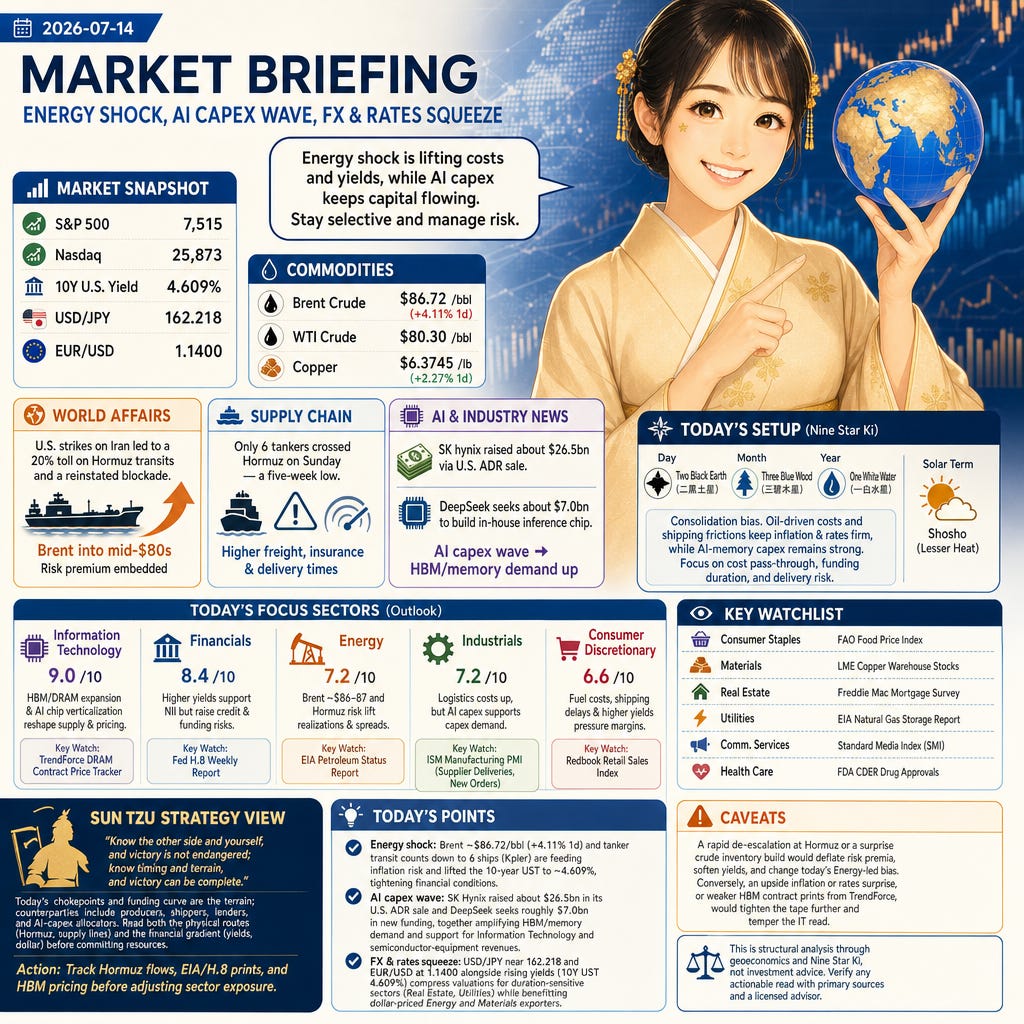
Good morning. Brent near the mid-$80s, a 10-year U.S. yield at 4.609%, and USD/JPY around 162 set a tighter funding backdrop as the Hormuz shock ripples through prices. At the same time, AI financing continues: SK Hynix’s $26.5bn raise and DeepSeek’s $7bn plan point to heavier memory capex. Today’s read connects energy-driven cost pressure, firmer rates/FX, and capital reallocation into AI infrastructure.
Paywall
Stocks and FX
S&P 500 at 7,515 and Nasdaq at 25,873 traded against a 10-year U.S. Treasury yield of 4.609% while USD/JPY hovered near 162.218 and EUR/USD at 1.1400, per Reuters (republished on Euronext). Higher oil is feeding inflation risk into rates and the dollar, tightening financial conditions. This compresses valuations for duration-sensitive equities (Real Estate, Utilities) and raises discount rates for long-duration tech, while lifting net interest income for some lenders with asset-sensitive books.
Commodities
Brent traded at $86.72/bbl and WTI at $80.30/bbl as copper printed $6.3745/lb (+2.27% 1d), according to Reuters/Euronext. An oil move into the mid-$80s raises transport, packaging, and petrochemical input costs while widening upstream Energy margins. Base-metals firmness points to broader input-cost support, raising the odds of pass-through that keeps yields firm and the dollar supported, with knock-ons for Industrials and Consumer Discretionary margins.
World Affairs
A 20% toll on Hormuz transits and a reinstated blockade followed U.S. strikes on Iran; two Emirati tankers were hit, with one fatality and eight wounded, the Associated Press reported. The headlines pushed Brent into the mid-$80s, embedding an immediate risk premium into crude and shipping. The transmission channel is direct: tighter flows raise energy prices, lift inflation expectations and bond yields, and reprice cash flows across Energy, Materials, and rate‑sensitive sectors.
Supply Chain
Only six tankers crossed the Strait of Hormuz on Sunday, a five‑week low, with increased ship‑to‑ship transfers and vessels darkening AIS, Reuters (via Investing.com) noted from Kpler data. Lower visible transits and evasive routing lift insurance premia and voyage times, straining delivery schedules. That raises freight and inventory-carry costs for shippers and downstream refiners/chemicals, and can tighten refined-product availability for Industrials and Consumer sectors.
AI
DeepSeek is developing an in‑house inference chip and seeking about $7.0bn at a $52–$59bn valuation, in a China AI‑chip market estimated near $50bn, Reuters reported; Nvidia dipped ~1.6% on the initial headline. Verticalization by labs can redirect demand from GPUs toward bespoke inference silicon and reshape high‑bandwidth memory (HBM) procurement. That alters capex plans and pricing power across semis, HBM suppliers, and equipment makers, with implications for Information Technology valuations and order books.
Industry News
SK Hynix raised about $26.5bn via a U.S. ADR sale, pricing 177.9m ADRs at $149 and opening near $170, with books reportedly 7x oversubscribed, per Yahoo Finance citing Bloomberg data. Proceeds target HBM/DRAM expansion, tightening the memory‑supply narrative that supports higher contract pricing. The capital shift benefits semiconductor equipment, advanced packaging, and specialty materials suppliers tied to AI infrastructure build‑outs.
Industry Forecast
Today’s Setup
Today, 2026-07-14, is Two Black Earth (Jikoku Dosei, 二黒土星) within a month led by Three Blue Wood (Sanpeki Mokusei, 三碧木星) and a year of One White Water (Ippaku Suisei, 一白水星), under the solar term Shosho (Lesser Heat). Expect a consolidation bias that rewards risk control: oil-driven input costs and shipping frictions elevate inflation and keep financing conditions tight, even as AI-memory capex demand stays firm. Focus on cost pass-through, funding duration, and delivery risk signals.
Focus Sectors
Information Technology (9.0/10): SK Hynix’s ~$26.5bn ADR raise expands HBM/DRAM capacity while Reuters reports DeepSeek building an in‑house inference chip, reshaping pricing and procurement across GPUs, memory, and advanced packaging. With the 10Y UST at 4.609% and a stronger dollar, discount rates and FX translation are headwinds, but capital is rotating into the memory complex. Risk: hyperscaler/lab verticalization can erode incumbent margins and alter HBM cadence. Watch TrendForce’s DRAM Contract Price Tracker for HBM contract trends.
Financials (8.4/10): The 10Y UST near 4.609% and a firmer dollar tighten financial conditions, generally boosting asset‑sensitive net interest income while pressuring fee pools and duration-heavy securities books. An oil-led inflation pulse raises credit costs and risk‑weighted assets, particularly for energy‑intensive borrowers. Rapid FX moves can stress cross‑border funding and hedges. Key risk: a stickier policy path that elevates losses as growth cools. Watch the Fed’s H.8 for loans, securities, and deposit dynamics.
Energy (7.2/10): Brent around $86–87/bbl and Kpler’s count of only six Hormuz transits indicate elevated physical risk and higher insurance/rerouting costs. Upstream realizations and trading spreads widen, but downstream/refining and petrochemicals may face feedstock tightness and product imbalances. Risk runs two ways: rapid de‑escalation compresses premia; a prolonged chokepoint stresses complex margins. Monitor EIA Weekly Petroleum Status for inventories and refinery utilization to gauge crack spreads and tightness.
Industrials (7.2/10): Logistics and fuel dominate order conversion as constrained tanker flows and higher oil lift transport and input costs, potentially elongating delivery times. Offsetting this, the AI capex wave (anchored by SK Hynix’s $26.5bn raise and broader memory build‑outs) supports demand for capital goods, precision equipment, and factory automation. A stronger dollar can weigh on FX‑exposed orders. Risk: sustained energy costs squeeze transport margins. Watch ISM Manufacturing PMI (Supplier Deliveries, New Orders) for flow and backlog signals.
Consumer Discretionary (6.6/10): Oil at ~$80–$86/bbl raises fuel, parcel, and airfare costs, while rerouting around Hormuz can slow deliveries and add fees — compressing retail/logistics and travel margins. Higher yields firm monthly financing costs, testing consumer confidence in a budgets-first environment. FX swings can shift landed costs and tourist spend. Risk: a prolonged fuel spike tightens margins just as promotional intensity rises. Watch Redbook same‑store sales for near‑term demand momentum.
Watchlist
Information Technology: TrendForce DRAM Contract Price Tracker (monthly DRAM/HBM contract pricing — a direct read on AI memory supply–demand).
Financials: Federal Reserve H.8 Weekly Report (commercial bank loans, securities, and deposits — near‑term read on balance-sheet growth and funding).
Energy: EIA Weekly Petroleum Status Report (U.S. crude and product inventories plus refinery utilization — gauges tightness and crack spreads).
Industrials: ISM Manufacturing PMI — Supplier Deliveries and New Orders (monthly U.S. factory flow and backlog conversion).
Consumer Discretionary: Redbook Weekly U.S. Retail Sales Index (same‑store sales — a high-frequency read on discretionary demand).
Consumer Staples: FAO Food Price Index (global food commodity prices — a lead on input cost pressure for grocers and packaged foods).
Materials: LME Copper Warehouse Stocks (London Metal Exchange daily inventories — a barometer of physical tightness).
Real Estate: Freddie Mac Primary Mortgage Market Survey (weekly 30‑year fixed mortgage rate — a direct read on real estate financing costs).
Utilities: EIA Weekly Natural Gas Storage Report (U.S. inventories — near‑term signal for fuel costs that influence utility margins).
Communication Services: Standard Media Index (SMI) U.S. Ad Market Tracker (monthly agency-billed ad spend — real-time gauge of advertising demand).
Health Care: FDA CDER Monthly Drug Approvals (new molecular entity and supplemental approvals — a pipeline-to-revenue catalyst feed).
Caveats
A rapid de-escalation at Hormuz or a surprise crude inventory build would deflate risk premia, soften yields, and change today’s Energy-led bias. Conversely, an upside inflation or rates surprise, or weaker HBM contract prints from TrendForce, would tighten the tape further and temper the IT read.
Sun Tzu Strategy View
Sun Tzu wrote: —— Know the other side and yourself, and victory is not endangered; know timing and terrain, and victory can be complete.
Today’s chokepoints and funding curve are the terrain; counterparties include producers, shippers, lenders, and AI-capex allocators. Read both the physical routes (Hormuz, supply lines) and the financial gradient (yields, dollar) before committing resources; misreading either magnifies risk.
Action: Align exposure with chokepoints and the yield curve: track Hormuz flows, EIA/H.8 prints, and HBM pricing before adding or reducing sector risk.
Today’s Points
Energy shock: Brent ~$86.72/bbl (+4.11% 1d) and tanker transit counts down to 6 ships (Kpler) are feeding inflation risk and lifted the 10-year UST to ~4.609%, tightening financial conditions.
AI capex wave: SK Hynix raised about $26.5bn in its U.S. ADR sale and DeepSeek seeks roughly $7.0bn in new funding, together amplifying HBM/memory demand and support for Information Technology and semiconductor-equipment revenues.
FX & rates squeeze: USD/JPY near 162.218 and EUR/USD at 1.1400 alongside rising yields (10Y UST 4.609%) compress valuations for duration-sensitive sectors (Real Estate, Utilities) while benefitting dollar-priced Energy and Materials exporters.
This is structural analysis through geoeconomics and Nine Star Ki, not investment advice. Verify any actionable read with primary sources and a licensed advisor.