Thank you for reading. Please subscribe and support Ayanomics 9 Trends so this work can continue.
Good morning. Tech leadership is running against a higher‑rates backdrop while oil and freight premia climb on Middle East risk. The thread across markets: AI‑driven capex keeps orders and data‑center buildouts funded, but energy and shipping chokepoints push costs higher and keep yields volatile. Flows matter as much as growth today — in funds, freight, and fuel.
Stocks and FX
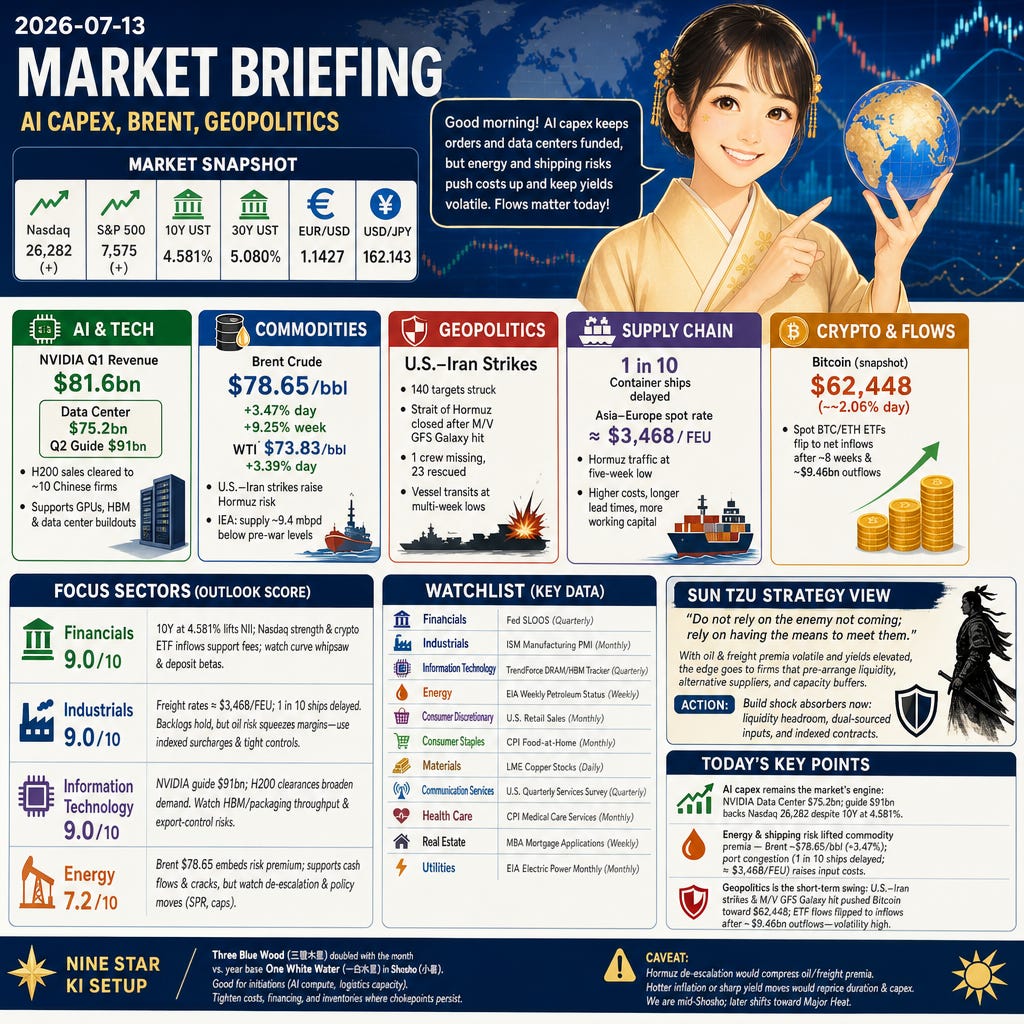
26,282 on the Nasdaq and 7,575 on the S&P 500 per SWI/Newsquawk, even as the 10‑year UST printed 4.581% and the 30‑year 5.080%. EUR/USD was 1.1427 and USD/JPY 162.143. Higher long yields lift discount rates, pressuring long‑duration names, but AI optimism tied to reported H200 export clearances keeps Tech bid. A weaker yen at 162 also tilts regional capital flows and supports U.S. dollar revenues for multinationals.
Commodities
$78.65/bbl for Brent (+3.47% day, +9.25% week) and $73.83/bbl for WTI (+3.39% day) per Reuters/AP as U.S.–Iran strikes raised Hormuz risk. IEA figures point to supply still ~9.4 million bpd below pre‑war levels. Higher crude raises freight, packaging, and petrochemical costs and can lift CPI prints, sustaining tighter financial conditions that weigh on rate‑sensitive sectors.
World Affairs
140 targets were reportedly struck in a U.S. volley while Iran declared the Strait of Hormuz closed after the M/V GFS Galaxy was hit, leaving one crew missing and 23 rescued (Reuters/CBS/AP). Vessel transits dropped to multi‑week lows. The channel to markets runs through energy security — Brent near $78.65 — and shipping insurance/freight premia, with spillovers into yields volatility and cyclicals’ risk appetite.
Supply Chain
1 in 10 container ships are delayed and Asia–Europe spot rates are ≈ $3,468/FEU, per CLECAT, with Hormuz traffic at a five‑week low (Kpler/Gulf News). Longer lead times raise inventory‑days and working‑capital needs for retailers and manufacturers. Insurance and rerouting premia lift delivered costs and complicate budgeting for peak season, even as logistics equipment orders stay supported.
AI
$81.6 billion in NVIDIA Q1 revenue with Data Center at $75.2 billion and a $91 billion guide signal ongoing hyperscaler capex; market reports add H200 sales cleared to roughly 10 Chinese firms. That supports demand for GPUs, HBM (high‑bandwidth memory), and advanced packaging, and increases grid/power demand tied to data‑center buildouts. Valuations still face higher discount rates, but funded orders keep the supply chain tight.
Industry News
$62,448 for Bitcoin on the snapshot (−~2.06% day) as risk assets wobbled on Middle East headlines, while spot Bitcoin/Ethereum ETFs flipped to net inflows after about eight weeks and ~$9.46bn of cumulative outflows (Bloomingbit/PlainlyCrypto). Re‑opening the institutional channel can support trading venues and custody revenues, but macro shocks continue to drive quick 1–3% crypto moves.
Industry Forecast
Today’s Setup
2026-07-13 sits under Three Blue Wood (Sanpeki Mokusei, 三碧木星) doubled with the month, against a year base of One White Water (Ippaku Suisei, 一白水星) during Shosho (Lesser Heat). Translation: green‑lights for initiations where capex and orderbooks meet open channels (AI compute, logistics capacity), but higher oil, port delays, and yields argue for tighter cost control, financing discipline, and buffer inventory where chokepoints persist.
Focus Sectors
Financials (9.0/10): 4.581% on the 10‑year improves net interest income on rate‑sensitive books, while Nasdaq strength and crypto ETFs flipping to inflows refill underwriting and trading fees (SWI/Newsquawk; Bloomingbit). USD/JPY 162 boosts cross‑border FX flow for dealer desks. Watch for curve whipsaw if
oil‑driven CPI sparks rate repricing, and for deposit betas compressing spreads as funding competition heats up.
Industrials (9.0/10): ≈$3,468/FEU Asia–Europe spot rates and 1 in 10 ships delayed (CLECAT) keep freight premia elevated as Hormuz risk raises insurance and bunker costs. Backlog execution should hold where supplier delivery is reliable, but fixed‑price contracts face squeeze if oil spikes again. Tighten project controls and contingencies on commissioning timelines; de‑risk margins with indexed surcharges where possible.
Information Technology (9.0/10): $81.6bn NVIDIA Q1 with a $91bn guide underscores durable AI capex, while reported H200 clearances to ~10 Chinese firms broaden near‑term demand. That supports GPUs, HBM, and advanced packaging, even as higher yields pressure long‑duration valuations. Execution hinges on memory and packaging throughput (HBM/CoWoS). Monitor export‑control shifts and supply bottlenecks that could cap shipments against strong orders.
Energy (7.2/10): $78.65/bbl Brent on U.S.–Iran escalation embeds a risk premium that supports upstream cash flows and refined‑product cracks, with transmission through marine insurance and routing costs (Reuters/AP). Inventory prints will set follow‑through on spreads. Key risks are rapid de‑escalation that erases premia and policy responses (SPR, caps); prolonged disruption risks demand destruction and margin volatility.
Watchlist
Financials: Federal Reserve SLOOS (Senior Loan Officer Opinion Survey; quarterly U.S. banks’ lending standards and loan demand).
Industrials: ISM Manufacturing PMI (monthly U.S. manufacturing activity with supplier deliveries and new‑orders components).
Information Technology: TrendForce DRAM/HBM contract price tracker (quarterly contract pricing for server memory and high‑bandwidth memory).
Energy: EIA Weekly Petroleum Status Report (weekly U.S. crude and product inventories and refinery utilization).
Consumer Discretionary: U.S. Census Advance Monthly Retail Sales (monthly retail spending, including the control‑group subset used in GDP).
Consumer Staples: BLS CPI Food‑at‑Home (monthly U.S. grocery price inflation for packaged and fresh foods).
Materials: LME Copper warehouse stocks (daily London Metal Exchange inventories indicating near‑term tightness/looseness).
Communication Services: U.S. Census Quarterly Services Survey (quarterly revenue for the Information sector, including telecom and media).
Health Care: BLS CPI Medical Care Services (monthly prices for health insurance, hospital, and physician services).
Real Estate: MBA Weekly Mortgage Applications (weekly purchase index and 30‑year contract mortgage rate).
Utilities: EIA Electric Power Monthly (monthly U.S. utility‑scale generation mix, retail sales, and average retail prices).
Caveats
A quick Hormuz de‑escalation would compress oil premia and reverse some freight/insurance pressures, changing the read on margins and rates. Conversely, a hotter inflation print or a sharp yield move would reprice duration and capex. We are mid‑Shosho; the shift toward Major Heat later this month can pivot emphasis from initiation to heat‑management costs and power load.
Sun Tzu Strategy View
Sun Tzu wrote: —— Do not rely on the enemy not coming; rely on having the means to meet them.
With oil and freight premia volatile and yields elevated, the edge goes to firms that pre‑arrange liquidity, alternative suppliers, and capacity buffers rather than betting on calm. In AI, funded backlogs help, but shipment risk remains in HBM and export policy — design around single points of failure.
Action: Build shock absorbers now: liquidity headroom, dual‑sourced inputs, and indexed contracts tied to fuel and freight.
Today’s Points
AI capex remains the market’s engine: Nvidia Data Center revenue $75.2bn and company Q2 guide $91bn underpin Nasdaq strength (Nasdaq 26,282) despite higher 10Y yields at 4.581%. (s201.q4cdn.com)
Energy and shipping risk lifted commodity premia — Brent ~$78.65/bbl (+3.47% today) — while port congestion (1 in 10 ships delayed; Asia–Europe rates ≈ $3,468/FEU) raises input costs for Industrials and Consumer Discretionary. (live.euronext.com)
Geopolitics is the short‑term macro swing: U.S.–Iran strikes and a hit to the M/V GFS Galaxy (engine damage; 1 crew missing, 23 rescued) pushed Bitcoin toward $62,448 and briefly flipped ETF flows into net inflows after ~ $9.46bn of prior outflows, keeping volatility elevated across risk assets. (tucson.com)
This is structural analysis through geoeconomics and Nine Star Ki, not investment advice. Verify any actionable read with primary sources and a licensed advisor.