Thank you for reading. Please subscribe and support Ayanomics 9 Trends so this work can continue.
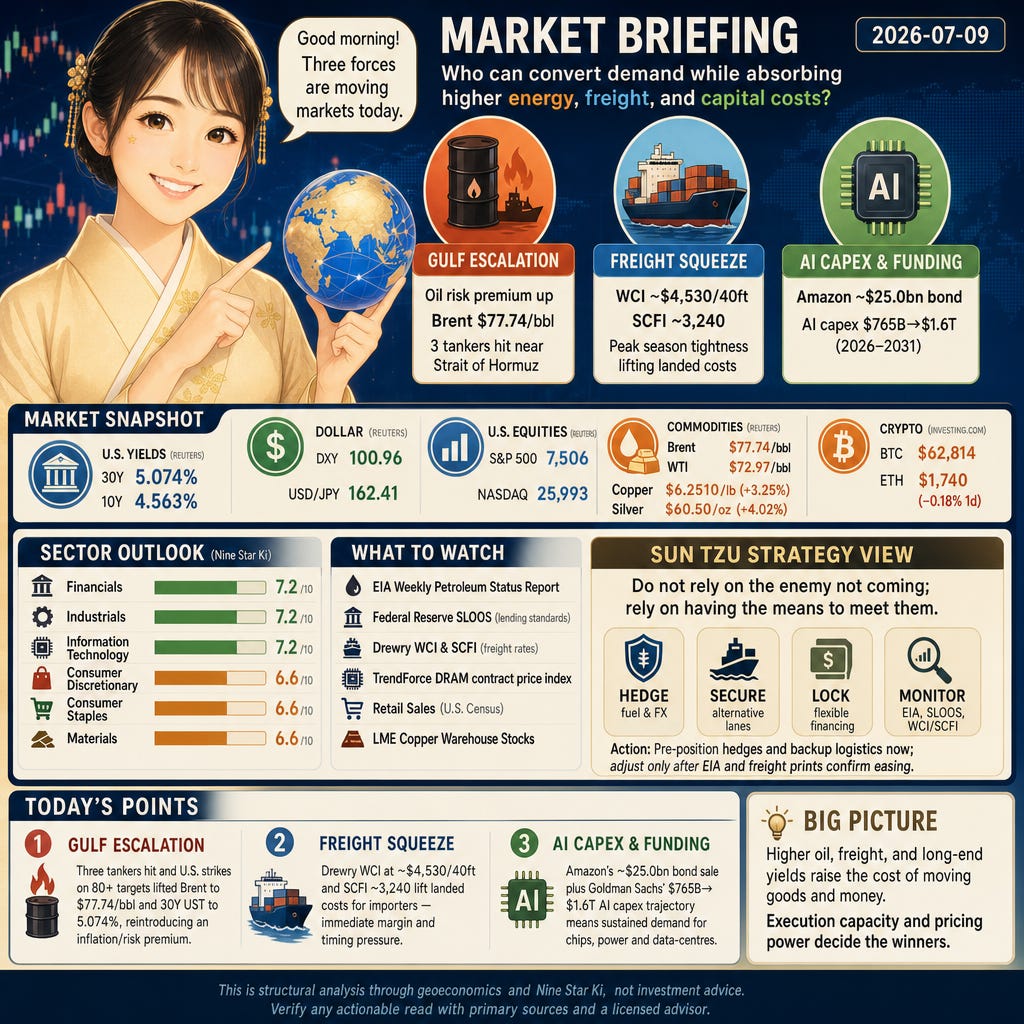
Good morning. Markets are repricing around three linked forces: Gulf escalation lifting oil and shipping risk, long-end U.S. yields pushing funding costs higher, and hyperscalers still financing AI buildouts. Freight benchmarks are spiking into peak season, raising landed costs just as the dollar firms. Today is about who can convert demand while absorbing higher energy, freight, and capital costs.
Stocks and FX
5.074% on the 30-year UST and 4.563% on the 10-year anchored the tape in Reuters’ snapshot, with USD/JPY at 162.41 and the U.S. dollar index near 100.96. The S&P 500 printed 7,506 and the Nasdaq 25,993 as higher long-end yields compressed multiples and lifted the dollar. The funding channel tightens for long-duration tech and real estate, while Financials’ net interest margin and hedging programs move to the foreground.
Commodities
$77.74/bbl for Brent and $72.97/bbl for WTI in Reuters’ read-through signal an oil risk premium after the Gulf flare-up. Copper at $6.2510/lb (+3.25% 1d) and silver at $60.50/oz (+4.02% 1d) show broader commodity firmness. Higher oil and metals raise transport, packaging, and power costs, feeding inflation expectations that can keep yields elevated and squeeze margins in Industrials, Consumer Discretionary, and Consumer Staples.
World Affairs
3 tankers were struck near the Strait of Hormuz and the U.S. reported strikes on 80+ Iranian targets, per Reuters, alongside a revoked licence for Iranian oil sales. The shipping-risk premium lifts insurance and rerouting costs, threatens physical energy flows through Hormuz, and reinforces the oil-led inflation impulse. That shock feeds directly into bond yields, FX, and operating costs for logistics-heavy sectors.
Supply Chain
$4,530 per 40ft on Drewry’s World Container Index and ~3,240 on the SCFI, reported by Drewry/Daily Cargo News, mark a sharp July surge; Shanghai–LA spot near $6,349/FEU underscores peak-season tightness. Higher freight inflates landed costs and stretches working capital, particularly for import-reliant retailers and hardware builders. Expect longer lead times, more blank sailings, and tighter booking windows.
AI
$25.0 billion is the size of Amazon’s multi-tranche bond to fund AI/data-centre buildout, per CNBC/Bloomberg coverage; Goldman Sachs pegs AI capex rising from ~$765B in 2026 to ~$1.6T by 2031. That pipeline supports semiconductors, advanced packaging, power equipment, and data-centre real estate even as 30Y UST at 5.074% raises weighted average cost of capital. Corporate debt supply can also widen credit spreads at the margin.
Industry News
$62,814 for Bitcoin and $1,740 for Ether in Investing.com/Reuters’ roundup reflect crypto risk-off after the Gulf escalation and higher yields; ETH logged a third straight down day (-0.18% 1d). Crypto liquidity swings can tighten conditions for exchanges, payments, and fintechs exposed to ETF and on-chain flows. High-beta segments in IT and Communication Services face added volatility when risk appetite thins.
Industry Forecast
Today’s Setup
2026-07-09 is a Seven Red Metal (Shichiseki Kinsei, 七赤金星) day in a Three Blue Wood (Sanpeki Mokusei, 三碧木星) month and a One White Water (Ippaku Suisei, 一白水星) year during Shosho (Lesser Heat). Commerce and platform monetization sit at center stage, but higher oil, freight, and long-end yields raise the cost of moving goods and money. Execution capacity and pricing power matter: firms that manage freight, fuel, and funding will convert demand while others face margin slip.
Focus Sectors
Financials (7.2/10): 5.074% on the 30Y and 4.563% on the 10Y (Reuters) reset asset–liability marks and raise funding costs, while USD/JPY ~162.4 supports FX hedging revenue. Primary markets remain open—Amazon’s ~$25bn multi‑tranche shows depth—but wider credit spreads can tax issuance. Banks with deposit stability and asset sensitivity can expand net interest margin; insurers benefit from reinvestment yields. Risk: further Gulf stress widens spreads and hits VaR as issuance stays heavy; crypto ETF outflows add idiosyncratic pressure to exposed platforms.
Industrials (7.2/10): $4,530/FEU on Drewry’s WCI and ~3,240 on SCFI lift landed costs and elongate cycle times; Brent near $77.7 raises diesel and jet fuel. Shipping insurance premia and detours around Hormuz add routing risk and working‑capital stretch. Execution edge is scheduling, fuel hedging, and supplier
delivery stability to convert backlog. Risk: if long yields stay high, financed equipment orders can slip; prolonged detours strand inventory and inflate demurrage.
Information Technology (7.2/10): Amazon’s ~$25bn bond and Goldman’s $765B→$1.6T AI capex glidepath extend demand for semis, HBM/advanced packaging, power gear, and data‑centre builds. The offset is funding: 30Y at 5.074% lifts WACC and can delay marginal projects; freight spikes (WCI/SCFI) raise BOM costs into peak PC/server season. Net demand is durable, but conversion depends on supply, memory capacity, and logistics. Risk: sustained long‑end yields and packaging tightness cap upside near term.
Consumer Discretionary (6.6/10): WCI ~$4,530 and SCFI ~3,240 push ocean freight and peak-season surcharges higher, while Brent ~$77.7 raises delivery and travel fuel costs. Seven Red Metal sharpens checkout and conversion: faster turns, dynamic pricing, and omnichannel fulfillment can preserve throughput despite cost pressure. Risk: a stronger dollar and pump prices can pinch tourism and big-ticket demand; extended blank sailings force inventory carry and markdowns into back‑to‑school.
Consumer Staples (6.6/10): Higher oil (Brent ~$77.7) and container rates (WCI ~$4,530; SCFI ~3,240) lift packaging, transport, and some ingredients, testing pricing power. Operators with resilient procurement, hedging, and private‑label balance can protect shelf availability and gross margin. Retailer pushback rises if freight stays elevated into Q3. Risk: strong USD trims reported EM revenues and squeezes local‑currency consumers; sticky freight erodes mix.
Materials (6.6/10): Copper at $6.2510/lb (+3.25% 1d) and silver at $60.50/oz (Reuters) tighten spreads alongside Brent ~$77.74/bbl, boosting revenue potential for miners/processors while raising energy and haulage costs. Inventory posture and hedge cover are the levers to manage volatility and preserve realized margins. Risk: persistent Hormuz risk elevates shipping/insurance and complicates hedging; a firmer dollar can curb ex‑U.S. demand for dollar‑priced metals.
Watchlist
Financials: Federal Reserve SLOOS — Senior Loan Officer Opinion Survey (quarterly lending standards and loan demand across C&I and consumer credit).
Industrials: ISM Manufacturing PMI — Supplier Deliveries Index (Institute for Supply Management; breadth of delivery delays that signal supply chain tightness).
Information Technology: TrendForce DRAM contract price index (TrendForce — monthly DRAM pricing that signals memory cycle strength and AI server bill-of-materials pressure).
Consumer Discretionary: U.S. Census Advance Monthly Retail Trade Report (monthly retail sales by category including discretionary segments).
Consumer Staples: FAO Food Price Index (Food and Agriculture Organization — global monthly food commodity prices indicating input-cost direction).
Materials: LME copper warehouse stocks (London Metal Exchange — daily visible inventories that signal tightness or slack in the copper market).
Energy: EIA Weekly Petroleum Status Report (U.S. Energy Information Administration — weekly crude and product inventories plus refinery utilization).
Health Care: BLS CPI Medical Care Services index (U.S. Bureau of Labor Statistics — monthly price changes for medical services reflecting reimbursement and cost trends).
Real Estate: Freddie Mac Primary Mortgage Market Survey — 30-year fixed rate (weekly benchmark for U.S. real-estate financing conditions).
Utilities: EIA Electric Power Monthly (U.S. Energy Information Administration — generation mix, capacity additions, and retail sales).
Communication Services: Nielsen The Gauge (Nielsen — monthly U.S. streaming and TV viewing share, a proxy for attention and ad inventory mix).
Caveats
A fast de-escalation in the Gulf would compress the oil/shipping risk premium and soften the yield impulse, changing today’s cost and funding read. Shosho began this week; heat-driven demand swings and logistics bottlenecks can evolve quickly. If long-end yields retreat on upcoming data, duration-sensitive sectors would re-rate.
Sun Tzu Strategy View
Sun Tzu wrote: —— Do not rely on the enemy not coming; rely on having the means to meet them.
With oil at $77–78 and the 30Y at 5.07%, shocks are arriving, not hypothetical. Build the capacity to absorb them: hedge fuel and FX, secure alternative lanes, and lock flexible financing so demand can still convert. Monitor high-frequency gauges (EIA, SLOOS, WCI/SCFI) and pre-plan triggers before spreads widen.
Action: Pre-position hedges and backup logistics now; adjust only after EIA and freight prints confirm easing.
Today’s Points
Gulf escalation: three tankers hit and U.S. strikes on 80+ targets pushed Brent to $77.74/bbl and sent 30Y UST to 5.074%, reintroducing an inflation/risk premium into markets.
Freight squeeze: Drewry WCI at ~$4,530/40ft and SCFI ~3,240 lift landed costs for importers — consumer goods and industrial supply chains face immediate margin and timing pressure.
AI capex and funding: Amazon’s ~$25.0bn bond sale plus Goldman Sachs’ $765B→$1.6T AI capex trajectory (2026–2031) mean sustained demand for chips, power and data-centre real estate even as higher yields raise funding costs.
This is structural analysis through geoeconomics and Nine Star Ki, not investment advice. Verify any actionable read with primary sources and a licensed advisor.