


Thank you for reading. Please subscribe and support Ayanomics 9 Trends so this work can continue.
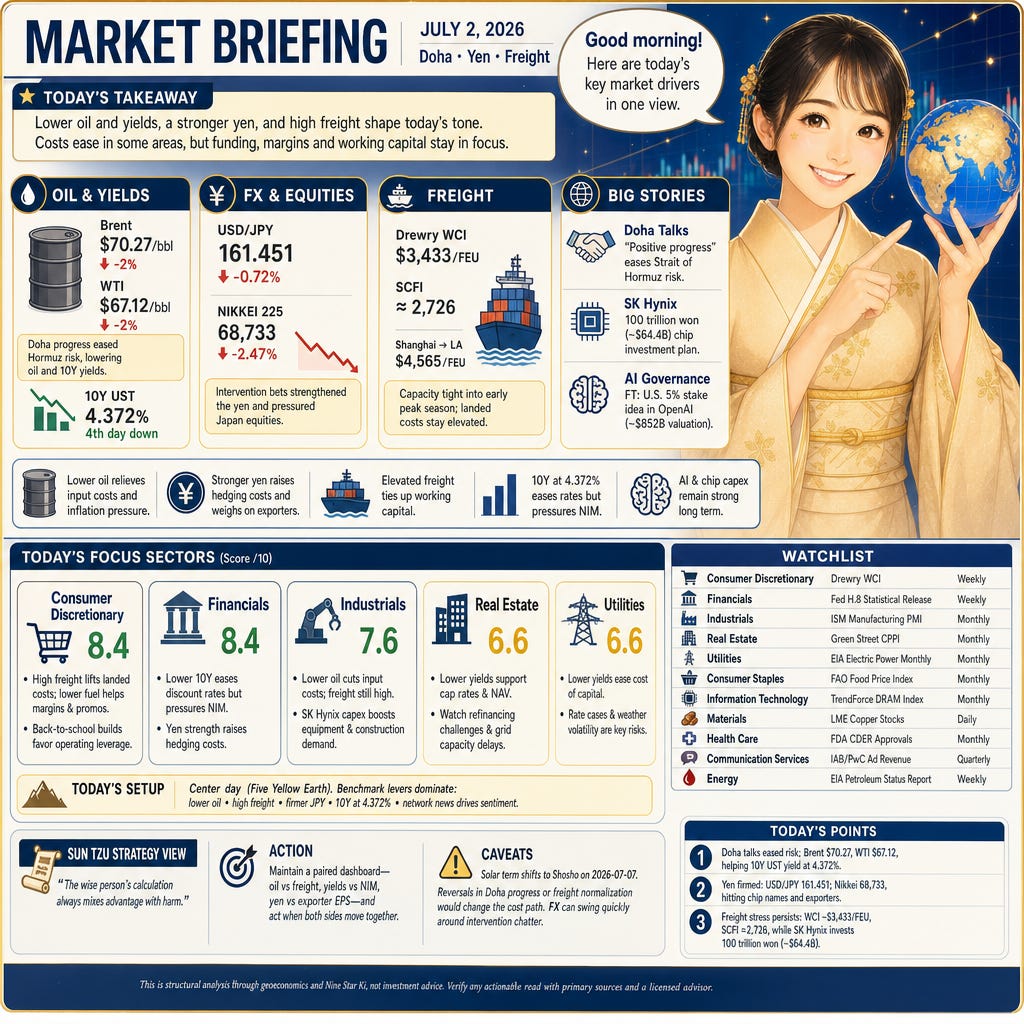
Good morning. Lower oil, a firmer yen and stubbornly high container rates set today’s tone. Doha progress pulled Brent and WTI to four‑month lows and helped nudge the U.S. 10‑year lower, while intervention chatter strengthened JPY and knocked Japan equities. Freight remains tight into early peak season even as AI‑era capex stays heavy, keeping logistics and funding costs in focus.
Stocks and FX
USD/JPY printed 161.451 (about -0.72% intraday) as intervention bets firmed the yen, while Japan’s Nikkei 225 closed 68,733 (-2.47%), per FXStreet and Reuters (via MarketScreener). The U.S. 10‑year Treasury yield eased to 4.372%, a fourth straight daily decline. Transmission: a stronger yen tightens earnings translation for Japan‑exposed exporters and raises hedging costs, while lower yields can compress banks’ net interest margins and support longer‑duration equities.
Commodities
WTI hovered near $67.12/bbl and Brent $70.27/bbl (≈-2% on the day), a third straight drop after positive U.S.–Iran talks in Doha, Reuters reported. Cheaper crude relieves transportation and packaging inputs and trims headline CPI pressure, contributing to the 10‑year UST at 4.372%. For Energy, softer benchmarks hit upstream cash flow unless offset by volume or refining spreads; for Materials and Industrials, cheaper feedstocks cushion margins.
World Affairs
About 20% of global oil and LNG once moved through the Strait of Hormuz; two days of U.S.–Iran technical talks in Doha produced “positive progress,” Onmanorama reported citing Reuters. Markets marked Brent at $70.27 and WTI at $67.12 on the headlines, reflecting a thinner disruption premium. If sustained, lower maritime risk also reduces insurance and rerouting costs that filter into freight and corporate margins.
Supply Chain
Drewry’s World Container Index printed $3,433/FEU and the SCFI hovered near 2,726, with Shanghai→Los Angeles around $4,565/FEU, per Drewry and industry trackers. Early peak‑season front‑loading and carrier GRIs keep capacity tight, lifting landed costs and tying up working capital for retailers and manufacturers. Persistently elevated benchmarks keep procurement cautious and may pull forward orders into Q3.
AI
A 5% U.S. government stake in OpenAI was discussed conceptually, the Financial Times reported, with coverage citing an ~$852B valuation and a prior ~$122B raise this year. Such a move would reframe platform governance and regulatory risk for AI leaders, influencing valuations, M&A, and capital allocation across Information Technology and Communication Services. Expect debate over data access, liability, and revenue shares to influence monetization timelines.
Industry News
SK Hynix committed 100 trillion won (~$64.4B): 80 trillion won for a new NAND fab (M17) by 2029 and 20 trillion won for advanced packaging by late‑2027 in Cheongju, Reuters/Yonhap reported. The buildout expands future memory and HBM‑adjacent capacity, shaping supply, lead times and pricing for AI compute stacks. It also drives orders for equipment, construction and specialty materials across Industrials and Materials.
Industry Forecast
Today’s Setup
2026-07-02 is a Five Yellow Earth (Goou Dosei, 五黄土星) center day in a Four Green Wood (Shiroku Mokusei, 四緑木星) month and a One White Water (Ippaku Suisei, 一白水星) year, with Shosho (Lesser Heat) due on 2026-07-07. Expect benchmark levers to dominate: lower oil softens input costs, elevated freight tests margins and working capital, firmer JPY and a 10Y at 4.372% reshape funding, and network news carries outsized weight.
Focus Sectors
Consumer Discretionary (8.4/10): Drewry’s WCI at $3,433 and SCFI ≈2,726 keep ocean freight elevated, raising landed costs and inventory carry for retailers. At the same time Brent $70.27/WTI $67.12 ease fuel surcharges and headline CPI, improving promo efficiency and conversion as checkout/delivery frictions abate. With fixed store and fulfillment costs largely set, stabilizing freight lets operating
leverage re‑emerge into back‑to‑school builds. Risk: sustained GRIs or capacity tightness into peak could still compress margins; yen strength also trims translation for Japan‑exposed brands.
Financials (8.4/10): The 10‑year UST at 4.372% extends a four‑day slide, easing discount rates but pressuring net interest margin (NIM, lending yield minus funding cost) if deposit repricing lags. USD/JPY at 161.451 and a firmer yen reduce carry and lift hedging costs for Japan linkages. Center‑of‑system positioning is supportive on a Five Yellow Earth day, yet returns hinge on curve shape and credit creation. Watch governance spillovers from the FT‑reported OpenAI 5% stake idea that could reshape compliance and valuation frameworks.
Industrials (7.6/10): Oil at Brent $70.27/WTI $67.12 cuts diesel and petro‑input costs, while container benchmarks (Drewry WCI $3,433; SCFI ≈2,726) keep ocean freight and working‑capital burdens high. Reuters reports SK Hynix’s 100‑trillion‑won program (NAND and advanced packaging), supporting equipment makers and construction in the semiconductor supply chain. Firms with dependable supplier‑delivery times can convert orderbooks faster and defend margins. Risks: persistent freight tightness into peak season, AI‑capex timing slips, and a stronger yen for Japan‑listed exporters.
Real Estate (6.6/10): A 10‑year UST at 4.372% offers discount‑rate relief that supports cap rates and REIT NAV math, while softer oil tempers inflation‑driven financing costs. Asset‑level chokepoints still dominate—office refinancing at higher coupons and utilization drags, plus power and interconnect queues for data‑heavy sites. Sponsors with secured grid capacity and termed‑out debt can start cash flows sooner. Risks: appraisal lags and rate‑reset walls; grid delays that push out data‑center revenue.
Utilities (6.6/10): Lower benchmark yields reduce the effective cost of capital for rate‑base growth, while Doha‑linked easing of LNG/oil premia steadies fuel procurement and hedging. Earnings cadence still runs through the rate‑case cycle that sets allowed return on equity (ROE). Grid and generation capex must stay on budget to avoid disallowances. Risks: adverse rate‑case rulings and extreme‑weather load volatility that spikes purchased power and restoration costs.
Watchlist
Consumer Discretionary: Drewry World Container Index (weekly global 40‑ft container spot rates).
Financials: Federal Reserve H.8 Statistical Release (weekly bank loans, securities and deposits).
Industrials: ISM Manufacturing PMI (new orders and supplier deliveries components).
Real Estate: Green Street Commercial Property Price Index (monthly U.S. commercial property price changes).
Utilities: EIA Electric Power Monthly (U.S. generation mix, retail electricity prices and demand).
Consumer Staples: FAO Food Price Index (monthly global food commodity prices).
Information Technology: TrendForce DRAM contract price index (monthly DRAM contract pricing levels).
Materials: LME Copper Warehouse Stocks (daily copper inventory levels in LME‑registered warehouses).
Health Care: FDA CDER drug approvals (monthly counts of new and supplemental approvals).
Communication Services: IAB/PwC Internet Advertising Revenue Report (quarterly U.S. digital advertising revenues).
Energy: EIA Weekly Petroleum Status Report (weekly U.S. crude inventories and refinery utilization).
Caveats
The solar term shifts to Shosho on 2026-07-07; seasonal heat and load patterns can alter power demand, logistics reliability and headline inflation dynamics mid‑window. A reversal in Doha progress or a rapid normalization in ocean freight would change today’s cost‑path read, while FX can swing quickly around intervention chatter.
Sun Tzu Strategy View
Sun Tzu wrote: —— The wise person’s calculation always mixes advantage with harm.
Lower oil and softer yields cut input and financing costs, but they also pressure Energy earnings and banks’ NIM. Elevated container rates still bite even as yen strength raises hedging costs and weighs on exporters. Today’s center‑driven setup rewards plans that net benefits against these frictions before reallocating resources or timelines.
Action: Maintain a paired dashboard—oil vs freight, yields vs NIM, yen vs exporter EPS—and only recalibrate plans when both sides of a pair move together.
Today’s Points
Doha talks eased Strait‑of‑Hormuz risk and helped push Brent to $70.27/bbl and WTI to $67.12/bbl, subtracting near‑term inflation pressure and contributing to a 10Y UST yield of 4.372%.
Intervention bets on the yen drove USD/JPY down to 161.451 and helped send the Nikkei to 68,733, linking FX moves to a regional equity rotation that hit chip names and exporters.
Freight stress remains acute: Drewry’s WCI near $3,433/FEU and SCFI ≈2,726 raise landed‑costs for retailers even as SK Hynix’s 100 trillion won (~$64.4B) chip‑capex plan points to sustained AI‑era investment demand for semiconductors.
This is structural analysis through geoeconomics and Nine Star Ki, not investment advice. Verify any actionable read with primary sources and a licensed advisor.
Tiger Capital Research さん、いいねありがとうございます。読んでいただけてうれしいです。