Thank you for reading. Please subscribe and support Ayanomics 9 Trends so this work can continue.
Good morning—today’s setup pairs softer oil and lower long-end yields with stubbornly high ocean freight and tight AI components. The AI trade is bifurcated: memory-led strength versus megacap softness. Logistics and input costs are the main filters on margins while USD/JPY near 161 raises translation risk.
Paid content below this line
Stocks and FX
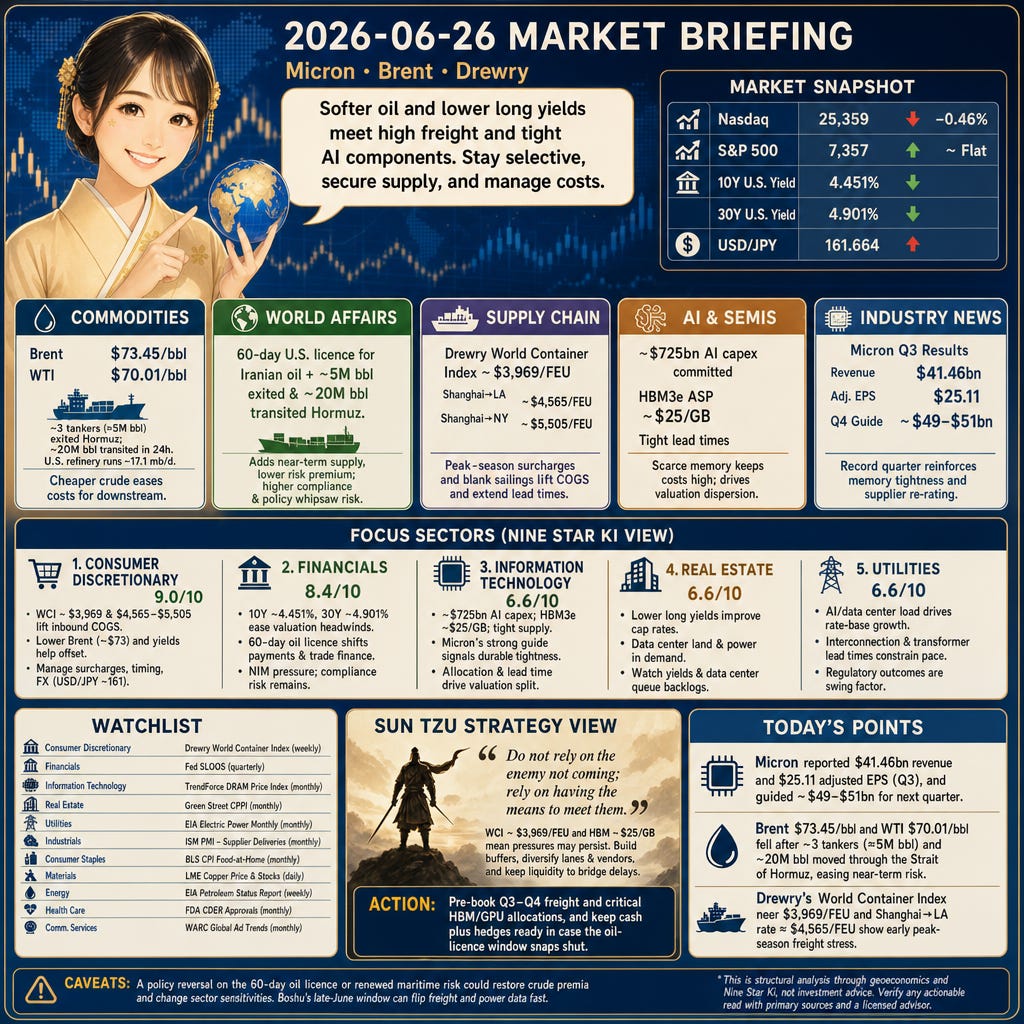
Nasdaq slipped to 25,359 (−0.46%) while the S&P 500 held near 7,357 as the 30Y U.S. Treasury yield eased to 4.901% and the 10Y to 4.451%, with USD/JPY around 161.664 (Business Recorder reporting Reuters). A softer long end lowers discount rates for long-duration earnings, but megacap underperformance keeps index breadth narrow. The strong dollar elevates FX-translation risk for multinationals, while a flatter curve pressures bank net interest margin before fee income catches up.
Commodities
Brent traded near $73.45/bbl and WTI $70.01/bbl as three stranded tankers carrying about 5 million barrels exited the Strait of Hormuz and roughly 20 million barrels transited in 24 hours; U.S. refinery runs were ~17.1 mb/d (Reuters via Investing.com). Cheaper crude trims fuel, plastics, and petrochemical costs for downstream users, easing inflation pass-through. For Energy producers, lower benchmarks compress upstream cash flows and shift focus to product cracks and inventories.
World Affairs
A 60‑day U.S. general licence allowing production, delivery, and sale of Iranian oil under an interim framework, alongside ~5 million barrels on three tankers exiting Hormuz and ~20 million barrels transiting in a day, adds near-term seaborne supply (Reuters via Investing.com). This reduces the crude risk premium, but raises sanctions-compliance workload and potential policy whipsaw for banks and shippers. Insurance and freight pricing adjust quickly to route clarity, impacting working capital and trade finance.
Supply Chain
Drewry’s World Container Index is about $3,969 per FEU, with Shanghai→Los Angeles near $4,565 and Shanghai→New York around $5,505, as carriers add peak-season surcharges and blank sailings (MoverDB compiling Drewry). Higher spot rates lift COGS for import-heavy categories and lengthen lead times, complicating inventory placement. Route diversions and capacity tightness increase cash tied in transit and the need for earlier order commitments.
AI
Hyperscaler AI buildout is estimated at roughly $725bn of committed infrastructure, with examples like AWS adding ~3.9 GW of power in 2025, while HBM3e ASPs sit near $25/GB and lead times remain tight (AlCapital Advisory). Scarce memory and advanced packaging keep input costs high for GPU makers and sustain elevated margins for memory suppliers. The result is valuation dispersion across semis versus platforms with rising AI COGS, and persistent power/land demand for data centers.
Industry News
Micron reported record quarterly revenue of $41.46bn with adjusted EPS of $25.11 and guided roughly $49–$51bn for the next quarter (Zacks). The print cements a memory-led re‑rating, signals durable HBM allocation tightness, and pulls forward orders across substrates, specialty gases, and equipment. Supply chains tied to AI memory and packaging should expect firmer pricing and prioritized allocation to top customers.
Industry Forecast
Today’s Setup
2026-06-26 is a Two Black Earth (Jikoku Dosei, 二黒土星) day in Boshu (Grain in Ear), a foundation-first setup that rewards cost control, precise inventory placement, and steady execution. Translate that into practice: watch freight surcharges and crude-flow normalization for COGS, lower long yields for financing math, and AI-component allocation for who converts demand into cash flow.
Focus Sectors
Consumer Discretionary (9.0/10): Drewry’s WCI near $3,969/FEU and transpacific quotes of $4,565–$5,505/FEU lift inbound COGS, while lower Brent (~$73) and easing long yields soften the blow. Payments rails that reduce checkout friction help conversion and operating leverage. Manage peak-season surcharges, delivery timing, and FX—USD/JPY near 161 can alter procurement math and dent overseas earnings translation if unhedged.
Financials (8.4/10): A 10Y ~4.451% and 30Y ~4.901% ease valuation headwinds and can reopen mortgage/refi and deal flow, even as NIM compresses. The 60‑day licence for Iranian oil shifts cross‑border payments, trade finance, and sanctions screening through bank books. Balance-sheet discipline and fee mix are key; monitor curve shape and SLOOS for loan demand and standards. Compliance missteps around evolving oil flows remain a tangible operational risk.
Information Technology (6.6/10): ~$725bn AI capex, HBM3e near $25/GB, and Micron’s $41.46bn quarter with higher guidance reinforce tight memory/packaging supply and pricing power upstream. Firms with secured HBM/GPU and advanced packaging (e.g., CoWoS) convert demand; others face BOM inflation and shipment delays. Expect valuation dispersion tied to allocation and lead times; export controls and USD strength add execution and translation risk.
Real Estate (6.6/10): Cap rates look better as long-end yields ease, while data‑centre land and power advance with hyperscaler builds (e.g., AWS ~3.9 GW in 2025). Utilities’ interconnection timelines and permitting dictate delivery, making power-adjacent assets and clear pass-through structures more attractive. Watch for a yield reacceleration that could widen cap-rate gaps, and monitor data‑centre queue backlogs that can delay monetization.
Utilities (6.6/10): Load growth from AI/data centers supports regulated rate-base expansion, with recoverable capex and commission-set ROEs underpinning earnings. Interconnection queues, transformer lead times, and siting drive project pacing; fuel clauses face hydrology and gas-basis variability. With oil a side note, execution rests on timely hookups and cost recovery. Regulatory pushback on rates is the swing factor; capacity-market outcomes matter for margin trajectory.
Watchlist
Consumer Discretionary: Drewry World Container Index (weekly global container spot rates for key lanes, published by Drewry).
Financials: Federal Reserve Senior Loan Officer Opinion Survey (SLOOS) on Bank Lending Practices (quarterly lending standards and loan-demand conditions).
Information Technology: TrendForce DRAM contract price index (monthly DRAM/HBM pricing trends and tightness, published by TrendForce).
Real Estate: Green Street Commercial Property Price Index (monthly U.S. commercial property price levels, published by Green Street).
Utilities: EIA Electric Power Monthly (U.S. generation mix, retail sales, and capacity factors, published by the Energy Information Administration).
Industrials: ISM Manufacturing PMI – Supplier Deliveries Index (monthly supplier delivery times and congestion, published by ISM).
Consumer Staples: BLS CPI Food-at-Home index (monthly U.S. grocery price inflation, published by the Bureau of Labor Statistics).
Materials: LME Copper cash price and warehouse stocks (daily copper pricing and inventory, published by the London Metal Exchange).
Energy: EIA Weekly Petroleum Status Report (weekly U.S. crude and product inventories plus refinery utilization, published by the Energy Information Administration).
Health Care: FDA CDER monthly drug approvals (new molecular entity approvals and major indications, published by the U.S. Food and Drug Administration).
Communication Services: WARC Global Ad Trends (monthly digital advertising spend growth and pricing metrics, published by WARC).
Caveats
A policy reversal on the 60‑day oil licence or renewed maritime risk would quickly restore crude premia and change sector sensitivities. Boshu’s late‑June window can flip freight and power data fast; if carriers add capacity or HBM supply loosens sooner than expected, today’s margin pressures could ease.
Sun Tzu Strategy View
Sun Tzu wrote: —— Do not rely on the enemy not coming; rely on having the means to meet them.
With WCI near $3,969/FEU and HBM around $25/GB, do not plan on pressures fading—secure buffers, diversify lanes and packaging vendors, and keep liquidity to bridge delays. The 60‑day oil waiver could whipsaw; resilience comes from pre‑arranged alternatives and hedges rather than hope.
Action: Pre-book Q3–Q4 freight and critical HBM/GPU allocations, and keep cash plus hedges ready in case the oil-licence window snaps shut.
Today’s Points
Micron reported $41.46bn revenue and $25.11 adjusted EPS (Q3), and guided roughly $49–$51bn for the next quarter, reshaping the memory/AI supplier complex.
Brent $73.45/bbl and WTI $70.01/bbl fell after reports that ~3 tankers (≈5 million barrels) and ~20 million barrels moved through the Strait of Hormuz, easing near‑term energy risk.
Drewry’s World Container Index near $3,969/FEU and Shanghai→LA rate ≈ $4,565/FEU show early peak‑season freight stress, pressuring Consumer Discretionary and Industrials margins.
This is structural analysis through geoeconomics and Nine Star Ki, not investment advice. Verify any actionable read with primary sources and a licensed advisor.