Thank you for reading. Please subscribe and support Ayanomics 9 Trends so this work can continue.
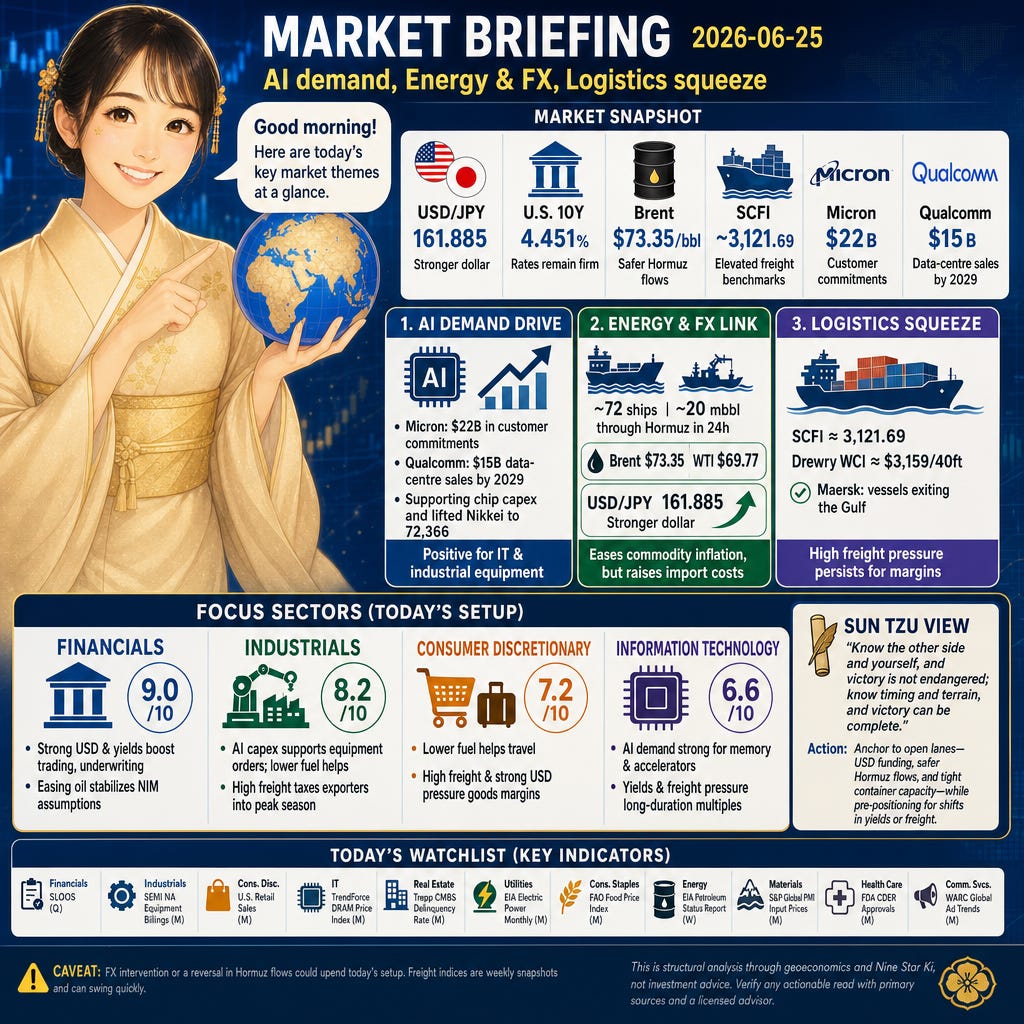
Good morning. USD/JPY at 161.885 with the U.S. 10-year at 4.451% keeps financial conditions tight even as Brent slips to $73.35 on safer Hormuz transits. AI orders (Micron $22B; Qualcomm $15B by 2029) are pulling semiconductor and equipment demand forward, while container benchmarks (SCFI ~3,121.69; WCI ~$3,159/40ft) cap margin relief for goods sectors.
Paid content below this line
Stocks and FX
USD/JPY at 161.885 and the 10-year U.S. Treasury yield at 4.451% framed a mixed U.S. tape as Asia bounced, with Japan’s Nikkei jumping to 72,366, up 4.61% (Reuters via Investing.com). The dollar index hovered near 101.8 and the 30-year U.S. yield printed 4.901% in the snapshot. Strong chip news supported semiconductors and related Industrials, while a firm dollar and higher long yields pressured duration-heavy growth names and FX-translation for multinationals.
Commodities
Brent fell to $73.35/bbl and WTI to $69.77/bbl after roughly 72 ships moved ~20 million barrels through the Strait of Hormuz in 24 hours (Reuters). Silver slid to $57.23/oz (five straight down days) as gold held near a $4,000/oz snapshot. Cheaper crude eases transport and packaging costs for manufacturers and retailers but compresses upstream Energy margins; the precious-metals move tightens cost signals for Industrials and Materials that use silver in components.
World Affairs
A preliminary U.S.-Iran understanding with a 60-day roadmap, plus a U.S. Senate 50-48 war-powers vote, coincided with ~72 ships and ~20 million barrels exiting Hormuz (Reuters). The de-escalation trims the energy risk premium and lowers commodity-driven inflation pressure, feeding back into yields and FX. Reopened corridors also stabilize petrochemical and materials flows, improving planning for Industrials and insurers’ assumptions in Financials.
Supply Chain
Drewry’s World Container Index is near $3,159 per 40ft and the SCFI (Shanghai Containerized Freight Index) around 3,121.69, while Maersk confirmed two vessels exited Hormuz (Reuters/Drewry). Some ports show short waits (e.g., Busan ~0.25 days in market updates), but high benchmarks signal tight effective capacity into peak season. Elevated landed costs pressure margins for Consumer Discretionary and hardware-heavy Industrials and Information Technology despite lower oil.
AI
Micron disclosed about $22 billion in customer commitments and Qualcomm guided to ~$15 billion in data-centre chip revenue by 2029, reinforcing AI-capex demand (Reuters). These concrete bookings support higher wafer-fab utilization and semiconductor equipment orders, helping lift Asian chip shares and the Nikkei to 72,366 in the session noted. Expect pull-through for memory, accelerators, and advanced-packaging supply nodes, with valuations still sensitive to yields and the dollar.
Industry News
SK hynix plans to raise up to about $29.4 billion via a U.S. ADR listing to tap AI-memory demand (Reuters). A deal of that size would expand access to U.S. investor pools, add supply to semiconductor equity benchmarks, and channel fresh capital toward memory, packaging, and equipment suppliers. It also lifts underwriting pipelines and trading volumes across Financials, with follow-on implications for sector ETFs and index weights.
Industry Forecast
Today’s Setup
2026-06-25 sits under Three Blue Wood (Sanpeki Mokusei, 三碧木星) over a Four Green Wood month and a One White Water year during Boshu (Grain in Ear). Translation for markets: speed and routing matter — lower oil from safer Hormuz narrows cost risk while elevated freight and firm USD funding conditions decide who converts AI order momentum into margins as yields anchor valuations.
Focus Sectors
Financials (9.0/10): USD/JPY 161.885 and UST 10Y 4.451% keep FX and rates volatility high, lifting trading and underwriting flow as SK hynix eyes a $29.4B ADR. Easing oil on safer Hormuz (72 ships; ~20 mbbl) stabilizes inflation assumptions that underpin net interest margin (NIM, the spread between loan yields and deposit costs). Dollar strength channels liquidity into USD assets. Risk: a sudden MoF/BoJ FX intervention or a rates snapback could jar risk and shut issuance windows.
Industrials (8.2/10): AI-capex signals (Micron $22B; Qualcomm $15B by 2029) support machinery and semi-equipment orderbooks, while Brent $73.35 lowers fuel and inputs. Yet container baselines are high (SCFI ~3,121.69; WCI ~$3,159/40ft), taxing exporters and logistics-heavy manufacturers. Gulf transit normalization reduces feedstock disruption and improves schedule reliability. Watch sustained SCFI/WCI elevation into peak season; a rates-driven capex pause would push out deliveries.
Consumer Discretionary (7.2/10): Landed-cost math stays tight: freight benchmarks (SCFI/WCI) remain elevated even as cheaper oil trims fuel; a strong USD helps U.S. import COGS but cuts translated overseas revenue. Travel and leisure gain from lower fuel while goods margins hinge on logistics execution and promotions into back-to-school. Risk: a persistent freight plateau compresses gross margin, and stronger USD can soften inbound tourism spend in local terms.
Information Technology (6.6/10): Concrete demand prints — Micron’s $22B commitments and Qualcomm’s $15B 2029 outlook — reinforce the AI build-out, pulling orders into memory/accelerators and equipment. But UST 10Y ~4.451% and a firm dollar pressure long-duration multiples, and elevated freight keeps hardware margins tight until supply chains diffuse. Bottlenecks in HBM (high-bandwidth memory) or CoWoS (chip-on-wafer-on-substrate) would delay revenue recognition despite healthy orders.
Watchlist
Financials: Federal Reserve Senior Loan Officer Opinion Survey (SLOOS) — quarterly read on bank lending standards and loan demand across C&I and CRE.
Industrials: SEMI North America semiconductor equipment billings (monthly 3-month average; factory equipment spending pace).
Consumer Discretionary: U.S. Census Advance Monthly Retail Sales (topline retail demand and category mix).
Information Technology: TrendForce DRAM contract price index (monthly memory pricing as a proxy for demand/supply balance).
Real Estate: Trepp CMBS Delinquency Rate (monthly U.S. commercial mortgage delinquencies by property type).
Utilities: EIA Electric Power Monthly (U.S. generation mix, fuel costs, and retail sales).
Consumer Staples: FAO Food Price Index (global food-commodity price levels affecting sourcing costs).
Energy: EIA Weekly Petroleum Status Report (U.S. crude/product inventories and refinery utilization).
Materials: S&P Global Manufacturing PMI — Input Prices (monthly gauge of producers’ input-cost inflation/deflation).
Health Care: FDA CDER monthly drug approvals (new molecular entity and biologic approvals as a proxy for pipeline throughput).
Communication Services: WARC Global Ad Trends (monthly benchmarks of digital and traditional ad spending by market and format).
Caveats
A sharp BoJ/MoF FX intervention or a reversal in Hormuz flows would upend today’s dollar and energy assumptions, changing financing conditions and cost curves quickly. Freight indices are weekly snapshots; sudden carrier capacity moves or port disruptions can swing landed costs before they show up in earnings.
Sun Tzu Strategy View
Sun Tzu wrote: —— Know the other side and yourself, and victory is not endangered; know timing and terrain, and victory can be complete.
Today’s “terrain” is the routing of oil through Hormuz, containers through Asia lanes, and capital through a strong dollar and 4.45% U.S. 10-year yields. Read those corridors alongside AI order timing to decide where margins and issuance windows truly open.
Action: Anchor positioning to the lanes that are open now—USD funding, safer Hormuz flows, and tight container capacity—while pre-positioning for shifts in yields or freight baselines.
Today’s Points
AI demand drive: Micron’s $22B in customer commitments and Qualcomm’s $15B data‑centre sales outlook are reinforcing chip capex and helped lift the Nikkei to 72,366 — positive for Information Technology and Industrial equipment suppliers.
Energy and FX link: Roughly 72 ships moved ~20 million barrels through the Strait of Hormuz in 24 hours, pushing Brent to $73.35 and WTI to $69.77 and coinciding with a stronger dollar (USD/JPY 161.885), which eases commodity‑price pressure but raises import costs for export-heavy sectors.
Logistics squeeze persists: Container benchmarks remain high (SCFI ≈ 3,121.69; Drewry WCI ≈ $3,159/40ft) even as Maersk reports vessels exiting the Gulf, implying sustained freight cost pressure for Industrials and Consumer Discretionary margins.
This is structural analysis through geoeconomics and Nine Star Ki, not investment advice. Verify any actionable read with primary sources and a licensed advisor.