


Thank you for reading. Please subscribe and support Ayanomics 9 Trends so this work can continue.
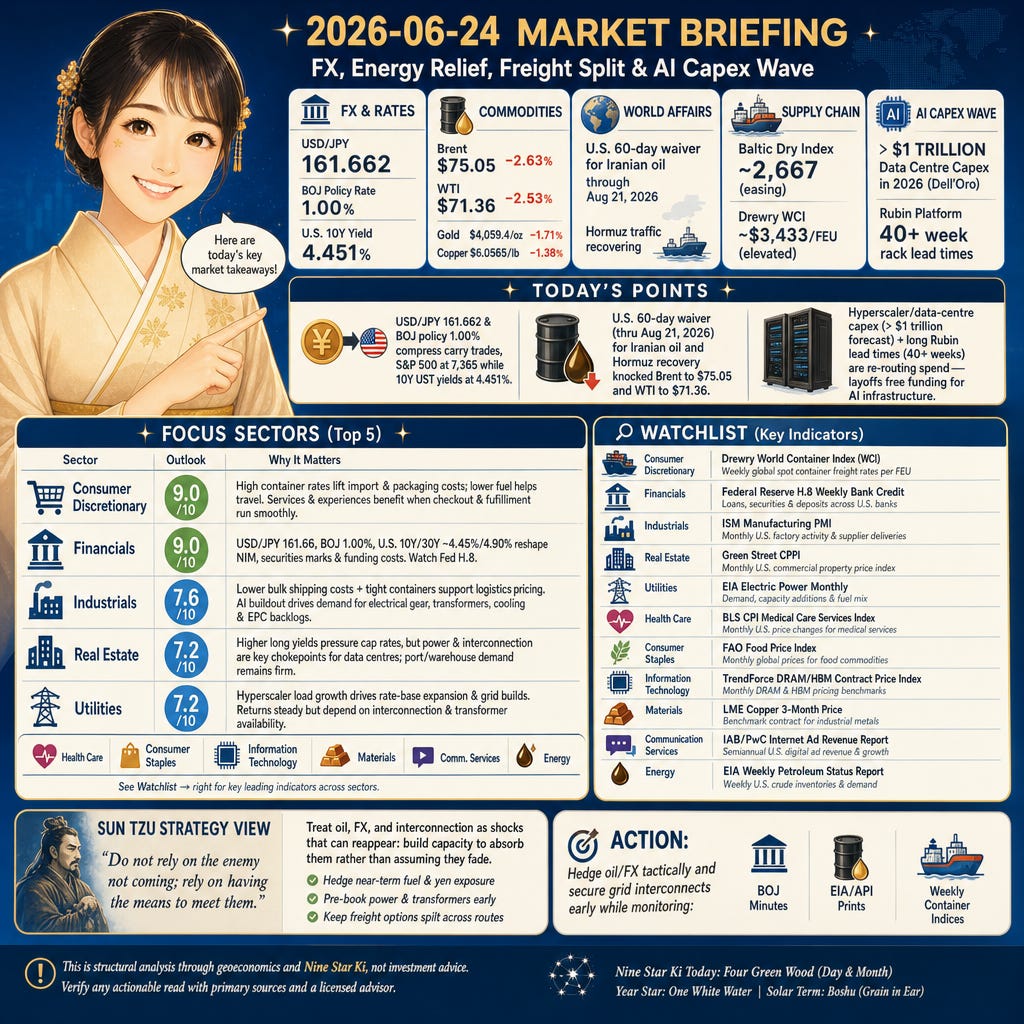
Good morning. USD/JPY at 161.662 with the BoJ policy rate at 1.00% sets today’s FX and rates tone as U.S. 10Y yields sit near 4.451%. Brent $75.05 and WTI $71.36 reflect a 60‑day Iran waiver and a partial Hormuz reopening, easing energy premia. Freight is split — Baltic Dry 2,667 vs. WCI ~$3,433/FEU — while an AI capex wave (> $1T) extends lead times across chips, power, and racks.
Paid content below this line
Stocks and FX
USD/JPY 161.662 and a 1.00% BoJ policy rate, alongside a U.S. 10Y at 4.451% and 30Y at 4.901%, framed a softer equity tape with the S&P 500 at 7,365 and Nasdaq 25,587 (Reuters). A firmer path for BoJ tightening narrows the U.S.–Japan yield carry, reshaping FX hedging and cross‑border funding costs. Higher long-end yields compress growth‑stock valuations and reprice Financials’ net interest margin and securities marks.
Commodities
WTI $71.36/bbl (-2.53% d/d) and Brent $75.05 (-2.63% d/d) extended multi‑day declines as supply‑risk premia faded (Investing.com reporting Reuters). Gold $4,059.4/oz (-1.71%), silver $59.87/oz (-3.47%), and copper $6.0565/lb (-1.38%) also slipped. Cheaper crude eases transport and packaging inputs for shippers and retailers but compresses upstream Energy cash flow; softer metals temper the inflation‑hedge bid and feed through to financing conditions for Real Estate and Financials.
World Affairs
A 60‑day U.S. Treasury waiver through Aug 21, 2026 allows Iranian oil exports, and shipping via the Strait of Hormuz is recovering (Enerdata/Reuters). With roughly 20–25% of global seaborne oil historically moving through Hormuz, the waiver directly cut the crude risk premium. That reduces Energy tail‑risk and lowers near‑term input costs for Industrials and Materials tied to feedstocks and freight.
Supply Chain
Baltic Dry at ~2,667 (capesize ~4,046) versus Drewry’s WCI around $3,433/FEU and SCFI near ~2,985 shows bulk easing while containers tighten (TradingEconomics/Drewry). U.S. BTS weekly data flag easing in some port metrics but continued truck planning‑time pressure. Lower bulk costs support ore/coal margins, but elevated container rates lift landed costs for retailers and CPG, while logistics and port‑warehouse assets retain pricing power.
AI
$1 trillion data‑centre capex in 2026 (Dell’Oro) and NVIDIA’s Vera Rubin platform with 40+ week rack lead times are pulling forward demand for GPUs, HBM, networking, cooling and power (NVIDIA/Dell’Oro/CoreWeave). Public deal flow includes a $6B CoreWeave financing commit and multi‑year partnerships totaling about $21B with Meta, underscoring sustained orders. The capex pulse benefits semis, OEMs, Utilities and data‑centre REITs, while stretching supply chains for memory and high‑power gear.
Industry News
8,000 job cuts at Meta and ~4,760 at PayPal, part of >100,000 tech layoffs this year, are freeing cash for AI infrastructure (AP/TechCrunch, company filings). Meta’s capex guidance cited in coverage sits around $125–$145B for 2026, evidencing spend reallocation. Wage‑bill relief lifts near‑term margins while higher capex raises demand for chips, data‑centre construction, and power — a timing gap operators must plan around.
Industry Forecast
Today’s Setup
June 24, 2026 sits under Four Green Wood (Shiroku Mokusei, 四緑木星) for both day and month, with One White Water (Ippaku Suisei, 一白水星) framing the year, during Boshu (Grain in Ear). That alignment prioritizes diffusion and network effects: FX and rates steer financing costs, Hormuz and freight routes set delivered‑cost dispersion, and AI‑driven power and interconnection queues determine where demand can actually land.
Focus Sectors
Consumer Discretionary (9.0/10): Drewry WCI above ~$3,400/FEU lifts import and packaging costs into peak season, while WTI near ~$71 moderates fuel and travel inputs. When checkout and fulfillment rails run smoothly, card/acquirer networks convert demand into revenue, favoring services and experiences. Watch for peak‑season surcharges and tight truck planning‑time (BTS) that can squeeze gross margin; mix and speed discipline matter until container rates ease.
Financials (9.0/10): USD/JPY at 161.66 with BoJ policy at 1.00% and U.S. 10Y/30Y near 4.45%/4.90% reshapes net interest margin and securities marks. FX‑basis and cross‑currency funding costs move through dealer balance sheets and hedges, affecting cross‑border deal flow. A sudden curve shift or vol spike would pressure duration‑heavy books; track Fed H.8 for loan/deposit trends and securities balances as the transmission channel.
Industrials (7.6/10): A Baltic Dry near ~2,667 lowers bulk‑commodity transport costs, while high container spot rates sustain pricing power for logistics operators. The data‑centre buildout (Dell’Oro >$1T 2026 capex; NVIDIA Rubin ramp) pulls demand into electrical gear, transformers, cooling, and EPC backlogs. Execution rests on transformer/switchgear lead times and interconnection timing; renewed container congestion could slip deliveries and raise working capital. Watch ISM Manufacturing PMI for order and supplier‑delivery signals.
Real Estate (7.2/10): U.S. long yields around 4.45–4.90% lift financing costs and pressure cap rates, but power‑proximate land and interconnection are the true chokepoints as data‑centre capex accelerates (Dell’Oro >$1T). Elevated container rates support port/warehouse utilization. Risks are higher‑for‑longer rates and grid‑queue or transformer delays that stall timelines; monitor Green Street CPPI for price discovery and interconnection milestones on DC projects.
Utilities (7.2/10): Hyperscaler load growth is driving multi‑year transmission/substation programs and rate‑base expansion as data‑centre buildouts scale. Regulated returns provide steadier earnings, but realized load depends on interconnection timing and large‑power transformer availability. Rate‑case pushback is a second‑order risk if bills rise alongside capex. Track EIA Electric Power Monthly for demand growth, capacity additions, and fuel‑mix shifts.
Watchlist
Consumer Discretionary: Drewry World Container Index (weekly global spot container freight rates per FEU, published by Drewry).
Financials: Federal Reserve H.8 weekly bank credit (Fed Board — loans, securities, and deposits across U.S. commercial banks).
Industrials: ISM Manufacturing PMI (Institute for Supply Management — monthly U.S. factory activity including new orders and supplier delivery times).
Real Estate: Green Street Commercial Property Price Index (monthly U.S. commercial property pricing across sectors, published by Green Street).
Utilities: EIA Electric Power Monthly (U.S. electricity generation, consumption, capacity additions, and fuel mix — published monthly by the Energy Information Administration).
Health Care: BLS CPI Medical Care Services index (monthly U.S. price changes for medical services, published by the Bureau of Labor Statistics).
Consumer Staples: FAO Food Price Index (monthly global prices across cereals, vegetable oils, dairy, meat, and sugar, published by the UN Food and Agriculture Organization).
Information Technology: TrendForce DRAM/HBM contract price index (monthly benchmarks for DRAM and HBM pricing, published by TrendForce).
Materials: LME Copper 3‑month price (London Metal Exchange benchmark contract for industrial metals demand and pricing).
Communication Services: IAB/PwC Internet Advertising Revenue Report (semiannual U.S. digital ad revenue totals and growth, published by IAB and PwC).
Energy: EIA Weekly Petroleum Status Report (weekly U.S. crude and product inventories, refinery utilization, and implied demand — published by the Energy Information Administration).
Caveats
A mid‑window solar‑term transition would change which costs and signals diffuse fastest across sectors; today’s Boshu setting can shift with seasonal demand and policy prints. The Iran waiver is explicitly time‑boxed and container indices are volatile week to week; a BoJ communication shift or a chokepoint incident at Hormuz would quickly alter the read.
Sun Tzu Strategy View
Sun Tzu wrote: —— Do not rely on the enemy not coming; rely on having the means to meet them.
Treat oil, FX, and interconnection as shocks that can reappear: build capacity to absorb them rather than assuming they fade. That means hedging near‑term fuel and yen exposure, pre‑booking power and transformers, and keeping freight options split across routes.
Action: Hedge oil/FX tactically and secure grid interconnects early while monitoring BoJ minutes, EIA/API prints, and weekly container indices.
Today’s Points
USD/JPY at 161.662 and BOJ policy at 1.00% compresses carry trades and helped push the S&P to 7,365 while 10Y UST yields sit at 4.451%.
The U.S. Treasury 60‑day waiver (through Aug 21, 2026) for Iranian oil and signs of Hormuz traffic recovery knocked Brent to $75.05 and WTI to $71.36, removing a large portion of the prior supply premium.
Hyperscaler/data‑centre capex (Dell’Oro > $1 trillion forecast) plus long Rubin lead times (40+ weeks) are re‑routing corporate spend from payroll to capex — Meta’s ~8,000 cuts and PayPal’s ~4,760 announced layoffs help free funding for large AI infrastructure programs.
This is structural analysis through geoeconomics and Nine Star Ki, not investment advice. Verify any actionable read with primary sources and a licensed advisor.
Tiger Capital Researchさん、いいねありがとうございます。読んでいただけてうれしいです。