Please subscribe and support Oracle Ayano so this work can continue.
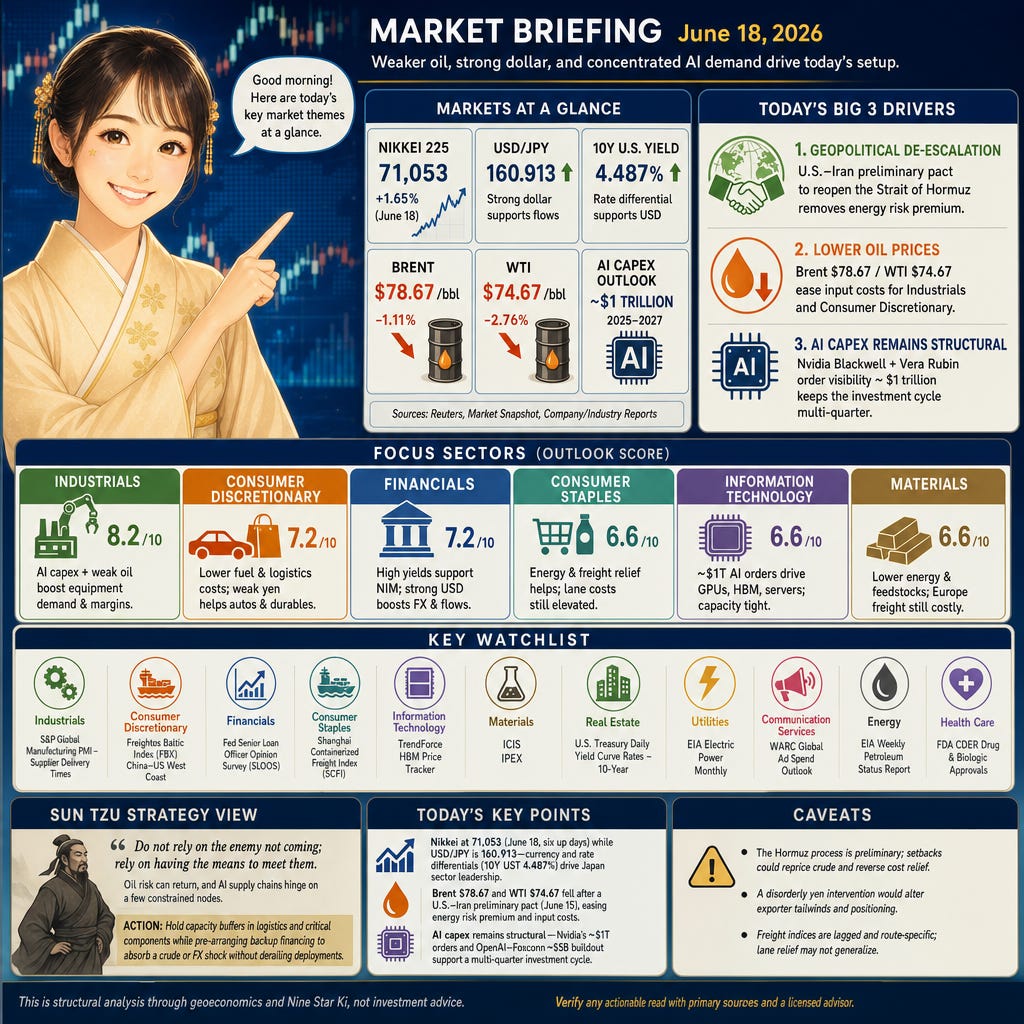
Good morning—today’s setup is defined by a weaker oil tape, a strong dollar, and concentrated AI demand. USD/JPY near 160.9 and 10Y U.S. yields around 4.49% are steering flows and valuation spreads. Brent and WTI eased after signs of a U.S.–Iran understanding on Hormuz, trimming input-cost risk. Nvidia-linked order visibility keeps AI infrastructure the multi-quarter anchor for capex, supply chains, and select equity leadership.
Stocks and FX
71,053 on the Nikkei 225 (+1.65% on June 18) and USD/JPY at 160.913 (Reuters/market reports) headline a six-day Japan rally concentrated in AI and semiconductor names. U.S. yields remain firm with the 10Y at 4.487% and 30Y at 4.975% (Market Snapshot), widening rate differentials that support the dollar. A 160.9 yen boosts exporter translation and equipment valuations but raises imported-cost pressure for domestic demand. Elevated long rates favor banks’ net interest margins while capping duration-sensitive assets.
Commodities
$78.67/bbl Brent and $74.67/bbl WTI (Reuters/market coverage) marked multi-week lows after reports of a preliminary U.S.–Iran pact and resuming Hormuz traffic; WTI fell 2.76% and Brent 1.11% on the day in the snapshot. Lower crude filters into freight, packaging, and power costs, easing headline CPI risk and improving operating leverage for Energy-intensive manufacturers. The flip side is squeezed upstream cash margins and a pivot to product cracks as the key earnings lever for refiners.
World Affairs
60 days of ceasefire extension and a potential $24–25 billion phased asset release feature in the U.S.–Iran preliminary understanding to reopen the Strait of Hormuz (Reuters). The move coincided with crude sliding to Brent $78.67 and WTI $74.67, stripping out a geopolitical premium. Easing energy volatility can soften inflation prints, influence Treasury yields, and redirect FX flows—especially the dollar/yen cross that is shaping Asia equity leadership.
Supply Chain
2,140.66 on the Shanghai Containerized Freight Index (mid-May composite) and $1,780–$2,260 per 20’ box on Freightos’ China→Germany route (mid-June quotes) show costs remain route‑specific (Shanghai Shipping Exchange/Freightos). Reopening steps in Hormuz should gradually cut tanker diversion and insurance costs, improving turnaround times. For retailers and consumer importers, elevated Europe lanes still pressure delivered margins and inventory cycles even as fuel surcharges ease.
AI
$1 trillion in Nvidia Blackwell + Vera Rubin order visibility across 2025–2027 (Reuters/company coverage) underwrites sustained demand for GPUs, HBM memory, and servers. Early OEM deliveries and H2 customer trials keep lead times tight, especially in advanced packaging (CoWoS) and HBM. The capex cycle lifts Industrials and data‑center suppliers while supporting IT hardware revenues and valuations tied to backlog quality.
Industry News
¥47.2 trillion in SoftBank market cap earlier in June and a ~$5 billion OpenAI–Foxconn buildout (Meyka/company reports) highlight AI‑centric market concentration. OEM commentary (e.g., Jabil, Dell) points to stronger rack and server order backlogs as hyperscalers accelerate deployments. This concentration amplifies index risk and vendor revenue dispersion if capex guidance or component supply wobbles.
Industry Forecast
Today’s Setup
June 18 is a Nine Purple Fire (Kyushi Kasei, 九紫火星) day within Four Green Wood (Shiroku Mokusei, 四緑木星) month during Boshu (Grain in Ear). Expect narratives, guidance, and visible order books to drive tape action: oil’s pullback eases delivered costs while AI-infrastructure signals and FX rate spreads steer flows and pricing power.
Focus Sectors
Industrials (8.2/10): Nvidia’s ~$1T multi‑year AI order visibility and OpenAI–Foxconn’s ~$5B buildout pull through machinery, rack assembly, HVAC, and power systems. USD/JPY ~160.9 boosts exporter translation and demand for equipment, while softer Brent/WTI trims freight and fuel. Watch upstream chokepoints (HBM, CoWoS) and grid interconnect delays that can defer data‑centre timelines.
Consumer Discretionary (7.2/10): FBX shows China–Europe lanes still costly, but Brent/WTI declines reduce fuel surcharges and logistics overhead. A weak yen aids Japan autos/durables via pricing and FX translation, and quicker port turns lift operating leverage. Risk: lane‑specific spikes or an oil snap‑back. Monitor FBX China–US West Coast for U.S. retail demand and cost pressure.
Financials (7.2/10): A 10Y UST near 4.49% supports NIM and rate‑sensitive fee income, while USD/JPY strength drives FX and securities flows. Softer oil may cool headline CPI ahead, but for now elevated long rates keep spreads constructive. Watch for a sharp yield drop that compresses NIM, and ongoing CRE/duration risks on balance sheets.
Consumer Staples (6.6/10): Lower Brent/WTI eases energy, packaging, and transport costs; early Hormuz reopening should trim tanker insurance and diversion premia. Yet SCFI/FBX still flag pricey Europe lanes, creating uneven delivered‑cost relief. Margin recovery hinges on lane normalization and limited pass‑through elasticity in value channels.
Information Technology (6.6/10): ~$1T of AI platform orders anchors demand for GPUs, HBM, servers, and power components. Strong USD vs yen lifts Japanese IT exporters on translation, but HBM and advanced packaging capacity keep lead times tight. Policy moves on advanced chip exports or cloud procurement remain swing risks; watch HBM pricing and delivery cadence.
Materials (6.6/10): Weaker Brent/WTI lowers petrochemical feedstocks and process energy, while OPEC demand‑growth downgrades cap upside. SCFI/FBX indicate Europe lanes remain expensive, sustaining delivered‑cost dispersion. Volumes hinge on construction/manufacturing prints as inventories normalize; monitor petrochemical benchmarks for early margin signals.
Watchlist
Industrials: S&P Global Manufacturing PMI — Supplier Delivery Times subindex (S&P Global; monthly measure of input lead times and delivery speed)
Consumer Discretionary: Freightos Baltic Index (FBX) China–US West Coast spot rate (Freightos; weekly container shipping price for a key retail lane)
Financials: Federal Reserve Senior Loan Officer Opinion Survey (SLOOS) (Federal Reserve; quarterly U.S. bank lending standards and loan demand)
Consumer Staples: Shanghai Containerized Freight Index (SCFI) composite (Shanghai Shipping Exchange; weekly benchmark of container shipping rates across major routes)
Information Technology: TrendForce HBM price tracker (TrendForce; quarterly contract pricing and supply/lead‑time updates for high‑bandwidth memory)
Materials: ICIS IPEX (Independent Commodity Intelligence Services; monthly global petrochemical price index)
Real Estate: U.S. Treasury Daily Treasury Yield Curve Rates — 10‑Year (U.S. Department of the Treasury; benchmark long-term interest rate used in cap‑rate models)
Utilities: EIA Electric Power Monthly (U.S. Energy Information Administration; utility generation mix, capacity factors, and retail sales)
Communication Services: WARC Global Ad Spend Outlook (WARC; quarterly forecasts of advertising expenditure by channel and region)
Energy: EIA Weekly Petroleum Status Report (U.S. Energy Information Administration; weekly crude/product inventories and refinery utilization)
Health Care: FDA CDER Drug and Biologic Approvals (U.S. Food and Drug Administration; monthly count of new approvals and major labeling decisions)
Caveats
The Hormuz process is preliminary; any setback could quickly reprice crude and reverse cost relief assumptions. A disorderly yen intervention would alter exporter tailwinds and cross‑border positioning. Freight indices are lagged and route‑specific, so lane relief may not generalize.
Sun Tzu Strategy View
Sun Tzu wrote: —— Do not rely on the enemy not coming; rely on having the means to meet them.
Oil risk can return, and AI supply chains hinge on a few constrained nodes. Build cushions—inventory, alternative lanes, and financing headroom—so projects and margins hold if crude snaps back or HBM/packaging delays surface.
Action: Hold capacity buffers in logistics and critical components while pre‑arranging backup financing to absorb a crude or FX shock without derailing deployments.
Today’s Points
Nikkei at 71,053 on June 18 (six consecutive up days) while USD/JPY is 160.913 — currency and rate differentials (10Y UST 4.487%) are key drivers of Japan’s sectoral leadership.
Brent $78.67 and WTI $74.67 fell after a U.S.–Iran preliminary pact to reopen the Strait of Hormuz (reported June 15), removing a key energy risk premium and easing input‑costs for Industrials and Consumer Discretionary.
AI capex remains structural — Nvidia’s Blackwell+Vera Rubin order visibility ~ $1 trillion and OpenAI–Foxconn manufacturing ties of ~$5 billion keep vendors and data‑centre suppliers (HW, Real Estate, Industrials) on a multi‑quarter investment cycle.
This is structural analysis through geoeconomics and Nine Star Ki, not investment advice. Verify any actionable read with primary sources and a licensed advisor.