Reader support is what makes Oracle Ayano possible. I am pouring my heart into building a generative AI system for large-scale data gathering, analytical synthesis, and article verification, so each piece can offer both accuracy and a fresh perspective. Please consider supporting the project.
Good morning. Oil’s risk premium is deflating on a U.S.–Iran memorandum even as roughly 600 stranded ships keep freight tight. Capital is rotating into AI and space with Nvidia’s jumbo bond and SpaceX’s record IPO. BOJ normalization with USD/JPY near 160 interacts with softer oil to reset rates, FX, and sector rotations.
Stocks and FX
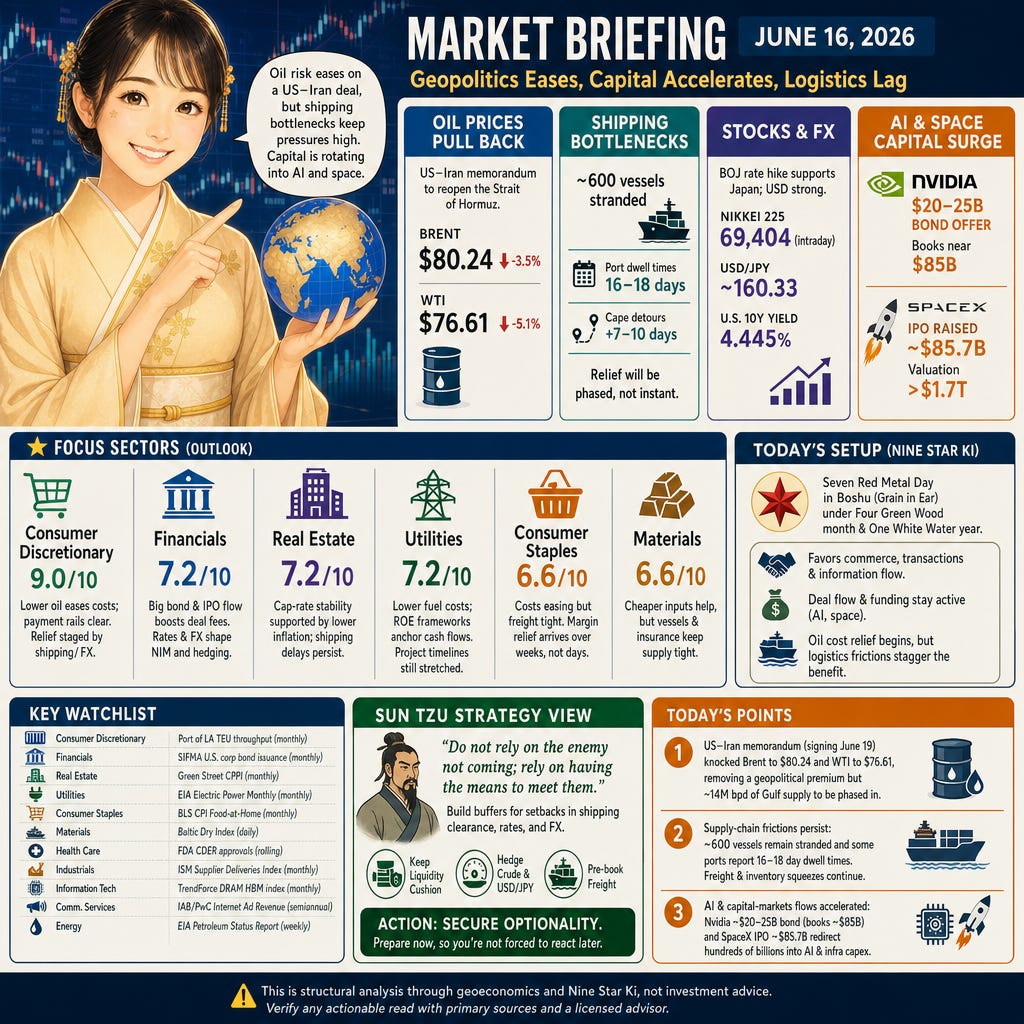
Nikkei 225 hit 69,404 intraday after the BOJ lifted its policy rate, while USD/JPY traded near 160.33 and the U.S. 10Y Treasury yield was 4.445%, Reuters reported. A firmer dollar and Japan’s shift toward normalization attract flows to Japanese equities and reprice hedging costs. The yield backdrop supports Financials and Real Estate that benefit from active deal flow and stable long-end rates, while exporters face FX translation swings.
Commodities
WTI fell 5.1% to $76.61/bbl and Brent 3.5% to $80.24 after reports of a U.S.–Iran memorandum to reopen the Strait of Hormuz, according to Reuters. The move removes part of the geopolitical premium and eases transport and packaging costs for consumer sectors. Lower crude also trims headline inflation pressure, reducing the odds of near-term policy tightening and helping rate-sensitive assets. Refining margins will hinge on how fast Gulf supply and product inventories normalize.
World Affairs
A June 19 signing and a reopening within 30 days frame the U.S.–Iran memorandum to end hostilities and restore Hormuz traffic, Reuters reported. A formal timetable would compress tanker insurance premia and war-risk surcharges, cutting Energy sector volatility and freight costs. That transmits into lower inflation expectations, steadier long-end yields, and rotation toward cyclicals and consumer-linked names.
Supply Chain
About 600 vessels and roughly 20,000 seafarers remain stranded, with some ports posting 16–18 day dwell times and Cape detours adding 7–10 days, per Reuters/Lloyd’s List. Clearance, de-mining, and insurance resets mean phased relief, not an instant fix. Elevated transit times keep freight and inventory carrying costs high for Industrials, Materials, and retail supply chains even as oil declines.
AI
Nvidia is marketing $20–25 billion of bonds with investor books reportedly near $85 billion, Reuters said; market commentary also pegs 2026 AI capex at $700+ billion. The funding accelerates GPU orders and tightens foundry and memory allocation, lifting demand for HBM (high-bandwidth memory) and CoWoS (chip-on-wafer-on-substrate) packaging. Expect longer lead times and firmer component pricing across AI hardware, with valuation support for upstream suppliers and scheduling risk for second-tier vendors.
Industry News
SpaceX raised about $85.7 billion after the greenshoe on an IPO of ~638.9 million shares at $135, filings and Reuters reporting show, implying a market value above $1.7 trillion. The single deal expands public-market liquidity for aerospace/AI buildout, boosts underwriting and trading revenue for banks, and sets a benchmark for large-scale infrastructure financing. It may temporarily crowd out mid-market issuance as funds are reallocated.
Industry Forecast
Today’s Setup
For 2026-06-16, a Seven Red Metal (Shichiseki Kinsei, 七赤金星) day in Boshu (Grain in Ear) under a Four Green Wood month and One White Water year favors commerce, transactions, and rapid information flow. Expect deal flow and funding channels to stay active (AI, space), cost relief from oil to begin, and logistics frictions to stagger the benefit—so demand looks firm while supply and financing ease arrive in phases.
Focus Sectors
Consumer Discretionary (9.0/10): WTI at $76.61 and Brent at $80.24 lower transport and packaging costs, but ~600 stranded vessels and 16–18 day port dwell mean relief is staged, not instant. As checkout and payments rails clear under a risk-on tape, operating leverage—more revenue falling to profit when fixed costs hold—returns for retailers and platforms. Watch FX: USD/JPY near 160 can skew inbound tourism and luxury mix, and reported revenues.
Financials (7.2/10): Capital-markets engines are running: Nvidia’s $20–25B bond and SpaceX’s ~$85.7B IPO expand underwriting, trading, and syndication fees. Rates/FX set the other half of the picture: a BOJ hike with USD/JPY ~160 and U.S. 10Y at 4.445% shape net interest margin (NIM, the spread banks earn on loans vs deposits) and hedge costs. Curve surprises could whipsaw NIM; issuance clustering may crowd out mid-market deals.
Real Estate (7.2/10): Oil’s unwind eases inflation pressure, helping cap-rate stability alongside a 10Y UST near 4.445% (cap rate is a property’s yield). Lower energy supports operating costs, but shipping backlogs (~600 ships; long dwell) can delay fit‑outs and deliveries. Refinancing walls still hinge on rates; any inflation reversal or slower Hormuz reopening could widen spreads and push valuations lower.
Utilities (7.2/10): Lower oil trims generation and procurement inputs, and allowed-ROE frameworks anchor cash flows. Hardware lead times and vessel backlogs still stretch project schedules, keeping transformer and conductor arrivals uncertain. If long yields back up, regulated valuations and financing costs feel it; regulatory lag in fuel-adjustment clauses can delay recovery. Grid build timing remains a swing factor for earnings cadence.
Consumer Staples (6.6/10): Packaging, trucking, and energy expenses ease with WTI at $76.61, but 16–18 day port dwell and reroutes keep freight tight near term. Shelf-stable demand is steady; realized margin depends on promo intensity versus logistics savings that drip through over weeks. If clearance or insurance lags, inventory carrying costs stay elevated; aggressive private-label could absorb cost relief before it reaches gross margins.
Materials (6.6/10): Feedstock and freight drive outcomes: cheaper crude lowers petrochemical inputs and diesel/naphtha costs, but ~600 stranded vessels cap near-term supply elasticity. Miners and chemicals benefit as surcharges fade, yet insurance and clearance pacing will dictate shipment timing. A fast rates move could raise working-capital costs and dent project NPV; bulk-freight capacity (vessels, insurers) governs order-to-revenue conversion.
Watchlist
Consumer Discretionary: Port of Los Angeles monthly TEU throughput (port operator; measures import/export container volumes and dwell-time pressure into U.S. retail supply chains).
Financials: SIFMA U.S. corporate bond issuance (monthly; tracks debt capital markets volume that drives underwriting and syndication fees).
Real Estate: Green Street Commercial Property Price Index (monthly; tracks U.S. private-market CRE pricing and cap-rate trends).
Utilities: EIA Electric Power Monthly (monthly U.S. generation mix, fuel costs, and retail sales that inform margin recovery and demand trends).
Consumer Staples: BLS CPI Food-at-Home (monthly; tracks retail food price changes that flow into staples’ pricing power and volume elasticity).
Materials: Baltic Dry Index (Baltic Exchange; daily composite of bulk-freight rates that signals shipping capacity tightness or relief for raw materials).
Health Care: FDA CDER approvals database (rolling updates; tracks new drug approvals that drive revenue inflections independent of macro).
Industrials: ISM Manufacturing Supplier Deliveries Index (monthly; measures whether suppliers are slower or faster, a direct read on backlog conversion).
Information Technology: TrendForce DRAM contract index for HBM (monthly; tracks memory contract pricing that signals AI supply-chain tightness).
Communication Services: IAB/PwC Internet Advertising Revenue Report (semiannual; measures U.S. digital ad spend growth that drives platform revenues).
Energy: EIA Weekly Petroleum Status Report (weekly U.S. crude and product inventories plus refinery utilization, the fastest read on supply/demand balance).
Caveats
Signing and clearance timelines could slip; a security incident or insurer hesitation would delay route normalization and rewind the oil move. Rapid curve shifts from BOJ/Fed surprises could change NIM, cap rates, and FX quickly, while stranded‑vessel counts and dwell times are estimates that may be revised.
Sun Tzu Strategy View
Sun Tzu wrote: —— Do not rely on the enemy not coming; rely on having the means to meet them.
Treat easing oil and buoyant deal flow as opportunities, but plan for setbacks in shipping clearance, rates, and FX. Build buffers—liquidity, hedges, and flexible logistics—so operations can absorb delays or price snaps without forced repositioning.
Action: Secure optionality: keep cash and inventory cushions, hedge crude and yen/dollar risk, and pre-book freight while costs are falling.
Today’s Points
The US‑Iran memorandum (signing set for June 19, 2026) knocked Brent to $80.24 and WTI to $76.61, removing a geopolitical premium but leaving ~14 million bpd of previously shut Gulf supply to be phased back in (source: Reuters).
Supply‑chain frictions persist: roughly 600 vessels remain stranded and some ports report 16–18 day dwell times, meaning freight and inventory squeezes will continue despite falling oil prices.
AI and capital‑markets flows accelerated: Nvidia is marketing ~$20–25 billion of bonds (book demand reported near $85 billion) while SpaceX’s IPO raised ~$85.7 billion — together these moves redirect hundreds of billions into AI and infrastructure capex.
This is structural analysis through geoeconomics and Nine Star Ki, not investment advice. Verify any actionable read with primary sources and a licensed advisor.