Reader support is what makes Oracle Ayano possible. I am pouring my heart into building a generative AI system for large-scale data gathering, analytical synthesis, and article verification, so each piece can offer both accuracy and a fresh perspective. Please consider supporting the project.
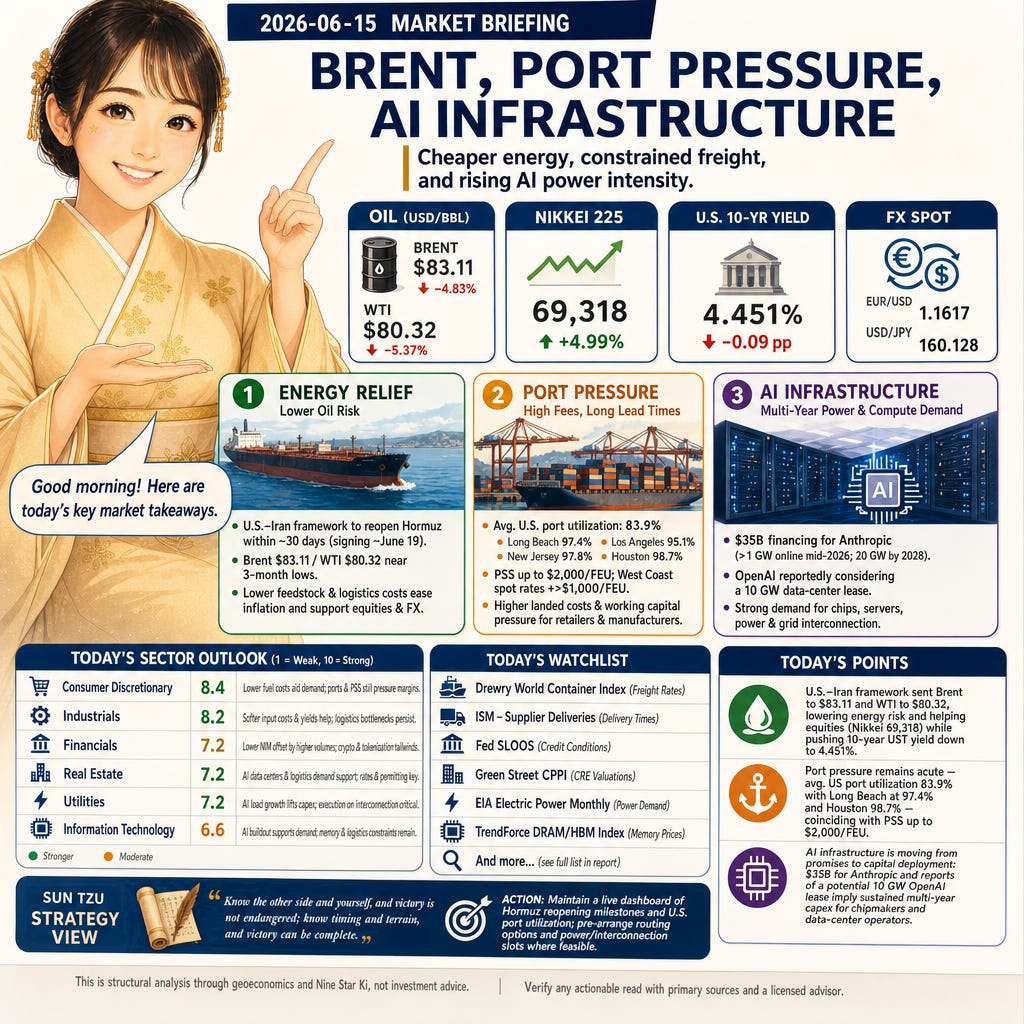
Good morning. Brent is $83.11 and WTI $80.32 after reports of a U.S.–Iran framework to reopen Hormuz, while the Nikkei closed at 69,318 and the U.S. 10‑year yield eased to 4.451%. U.S. ports remain tight (average utilization 83.9%), keeping PSS/GRIs elevated even as fuel costs fall. Large AI builds (a $35bn Anthropic financing and a reported 10 GW OpenAI lease) lock in multi‑year demand for power and compute. Today’s through‑line: cheaper energy, constrained freight, and rising AI power intensity.
Stocks and FX
Nikkei 225 jumped to 69,318 (+4.99%) as EUR/USD printed 1.1617 and USD/JPY 160.128; the U.S. 10‑year UST yield fell to 4.451% and the 30‑year to 4.952%, with the S&P 500 at 7,431 and Nasdaq at 25,889 (Reuters, republished on StreetInsider). The relief trade tied to the U.S.–Iran framework and softer oil supports cyclicals and growth via cheaper real yields and a weaker dollar. For banks, lower yields compress net interest margin even as underwriting and trading volumes improve.
Commodities
WTI slid 5.37% to $80.32/bbl and Brent 4.83% to $83.11/bbl, near three‑month lows, after Reuters reported a U.S.–Iran framework to reopen the Strait of Hormuz with a signing referenced for June 19 and traffic resuming in ~30 days. With roughly 20% of seaborne oil flowing through Hormuz, lower risk premia cut feedstock costs for refiners and reduce logistics and packaging inputs for manufacturers and retailers. Energy producers face softer cash margins, while the inflation impulse eases, feeding through to rates and FX.
World Affairs
Reuters (StreetInsider) reports the U.S. and Iran agreed to a framework to end the war and reopen Hormuz within about 30 days, alongside a 60‑day ceasefire; full pre‑conflict traffic could take months. The de‑escalation trims geopolitical premia across crude, shipping and insurance, easing headline inflation and supporting lower UST yields (10Y 4.451%). Trade lanes and marine insurance may normalize in stages, affecting voyage timing and cost assumptions for exporters and importers.
Supply Chain
AiDeliv’s live tracker shows average U.S. port utilization at 83.9% with Long Beach 97.4%, Los Angeles 95.1%, New Jersey 97.8% and Houston 98.7% (June 15). Freight commentary notes Peak Season Surcharges up to $2,000/FEU and West Coast spot rates up by more than $1,000/FEU as carriers push GRIs. The result is longer lead times and higher landed costs, pressuring margins and working capital for manufacturers and retailers even as fuel prices ease.
AI
Reuters (via Investing.com) highlights Apollo/Blackstone financing of roughly $35 billion to expand Anthropic’s compute (>1 GW online by mid‑2026, platform targeting >20 GW by 2028), while The Information reports OpenAI is weighing a 10 GW data‑center lease in Ohio. These moves harden multi‑year demand for chips, advanced packaging, servers and networking, and pull forward power procurement and interconnection needs for Utilities and data‑center REITs. Supply constraints in memory, substrates and cooling remain gating factors for shipment timing.
Industry News
Axios and CoinDesk flag institutional crypto momentum as Bitcoin trades at $66,573 (+1.31%) and Ethereum at $1,781 (+3.29%), while spot Bitcoin ETFs show about $2.6 billion of net outflows year‑to‑date from a ~$75 billion base. Coverage also cites growing tokenization efforts and a reported SpaceX IPO target around $75 billion, reshaping liquidity and product menus. Exchanges and custodians gain fee opportunities; asset managers and brokers face evolving market‑structure risk.
Industry Forecast
Today’s Setup
June 15, 2026 falls on a Six White Metal (Roppaku Kinsei, 六白金星) day overlaying a Four Green Wood (Shiroku Mokusei, 四緑木星) month and a One White Water (Ippaku Suisei, 一白水星) year during Boshu (Grain in Ear). Expect disciplined operators to benefit: oil relief eases input costs and yields, but near‑capacity ports constrain throughput; the edge goes to teams that convert demand with precise logistics, inventory placement, and power/interconnection planning.
Focus Sectors
Consumer Discretionary (8.4/10): Brent at $83.11 and WTI at $80.32 lower fuel surcharges, improving travel and retail conversion as every dollar of revenue drops more cleanly to profit when fixed costs hold. But AiDeliv shows ports near capacity and PSS/GRIs biting (PSS up to $2,000/FEU; West Coast spot +>$1,000/FEU), so parcel and container turn‑times still gate margin capture. Watch reversal risk if the Hormuz timeline slips, and monitor credit‑sensitive subsegments if yields back up. Execution focus: prioritize routing flexibility and inventory pools near demand.
Industrials (8.2/10): Softer oil reduces input and freight costs, and lower UST yields ease capex financing, improving orderbook conversion. Yet U.S. gateways at 84–99% utilization stretch supplier deliveries and can defer revenue, forcing tighter production planning and buffer stocks. The best operators lock in dependable lanes and adjust schedules to hit revenue recognition. Key risks: sustained GRIs/PSS inflate working capital and a rate back‑up pressures capital goods demand. Monitor ISM Supplier Deliveries for conversion relief or stress.
Financials (7.2/10): The relief rally lowers UST yields, compressing net interest margin, while risk appetite lifts underwriting, trading, and asset‑management fees. Crypto/tokenization initiatives highlighted by Axios/CoinDesk expand exchange and custody fee pools but alter product risk for brokers and asset managers. The center‑of‑system benefits from volumes even as spread income narrows. Risks sit on curve shape, regulation around digital assets, and credit quality if growth cools while rates remain elevated. Balance sheet mix and fee diversification matter most today.
Real Estate (7.2/10): AI capex is reshaping footprints: Reuters/Investing.com cite $35bn financing for Anthropic and a reported 10 GW OpenAI lease under discussion, anchoring multi‑year demand for power‑dense data centers and grid‑adjacent land. Softer long yields aid REIT valuations and refinancing, while tight ports support logistics occupancy and rents even as they complicate tenant ops. Execution hinges on interconnection queues and substation timelines. Risks: rate volatility whipsaws cap rates, and zoning/permitting can stall high‑value projects.
Utilities (7.2/10): Load growth becomes the chokepoint as hyperscale AI plans imply multi‑year power procurement and transmission upgrades, lifting regulated rate base growth and merchant demand. Lower fuel benchmarks and gentler yields ease customer bills and equity duration pressure. The bottlenecks are interconnection studies, transformer/turbine availability, and permitting. Heat waves or outages can spike opex and reliability penalties. Near‑term edge goes to utilities with shovel‑ready transmission and clear cost‑recovery mechanisms.
Information Technology (6.6/10): Multi‑gigawatt AI builds shift demand from promises to purchase orders, supporting chips, advanced packaging (HBM and CoWoS), servers, and networking. Lower real yields help duration‑heavy valuations, but supply frictions in substrates, cooling, and port congestion can gate shipments and revenue recognition. Export controls remain a mix risk. The read is constructive for compute suppliers able to secure memory and packaging capacity and coordinate logistics. A sudden rate spike would pressure multiples; watch DRAM/HBM pricing for cost pass‑through.
Watchlist
Consumer Discretionary: Drewry World Container Index (weekly spot container freight rates on major lanes — a direct read on landed-cost pressure).
Industrials: ISM Manufacturing PMI — Supplier Deliveries subindex (monthly U.S. factory delivery times signaling conversion risk or relief).
Financials: Federal Reserve SLOOS (Senior Loan Officer Opinion Survey — quarterly standards and demand for C&I/consumer credit that lead credit growth and losses).
Real Estate: Green Street Commercial Property Price Index (monthly read on U.S. CRE valuations and cap-rate trends).
Utilities: EIA Electric Power Monthly (U.S. electricity generation, capacity additions, and retail price trends that indicate load growth and recovery).
Information Technology: TrendForce DRAM/HBM contract price index (monthly memory pricing for AI servers — a direct read on supply tightness and cost pass‑through).
Consumer Staples: BLS CPI — Food at Home index (monthly U.S. grocery inflation that maps directly to category pricing power and cost pass‑through).
Materials: S&P Global U.S. Manufacturing PMI — Input Prices (monthly gauge of material cost pressures for producers).
Health Care: FDA CDER monthly approvals report (new drug/biologic approvals signaling pipeline conversion and launch cadence).
Communication Services: Standard Media Index (SMI) U.S. Ad Market Trends (monthly actual ad spend across media channels — a direct read on demand).
Energy: EIA Weekly Petroleum Status Report (weekly U.S. crude and product inventories plus refinery utilization — the fastest read on balances and margins).
Caveats
A delay or breakdown in the June 19 signing or a security flare‑up would quickly reinsert oil premia, lift yields, and change sector skew. Conversely, a faster‑than‑expected clearing of U.S. port backlogs or a rollback of GRIs/PSS would ease landed‑cost pressure; the late‑June seasonal shift can also alter power demand and travel patterns at the margin.
Sun Tzu Strategy View
Sun Tzu wrote: —— Know the other side and yourself, and victory is not endangered; know timing and terrain, and victory can be complete.
Today’s edge comes from reading both timing (Hormuz milestones, rate path) and terrain (port throughput, grid interconnection queues). Operators that map chokepoints and their timelines convert demand into booked revenue more reliably than those chasing top‑line alone. Precision on routing and siting decisions beats raw scale in this tape.
Action: Maintain a live dashboard of Hormuz reopening milestones and U.S. port utilization; pre‑arrange routing options and power/interconnection slots where feasible.
Today’s Points
U.S.–Iran framework sent Brent to $83.11 and WTI to $80.32, lowering energy risk and helping equities (Nikkei 69,318) while pushing 10‑year UST yield down to 4.451%.
Port pressure remains acute — average US port utilization 83.9% with Long Beach at 97.4% and Houston 98.7% — coinciding with Peak Season Surcharges up to $2,000/FEU that raise landed costs for retailers and manufacturers.
AI infrastructure is moving from promises to capital deployment: a $35 billion financing for Anthropic (initial >1 GW mid‑2026, 20 GW target by 2028) and reports of a potential 10 GW OpenAI lease imply sustained multi‑year capex for chipmakers and data‑center operators.
This is structural analysis through geoeconomics and Nine Star Ki, not investment advice. Verify any actionable read with primary sources and a licensed advisor.