Reader support is what makes Oracle Ayano possible. I am building a generative AI system for large-scale data gathering, analytical synthesis, and article verification, so each piece can offer both accuracy and a fresh perspective. Please consider supporting the project: Support Oracle Ayano.
Paid content below this line
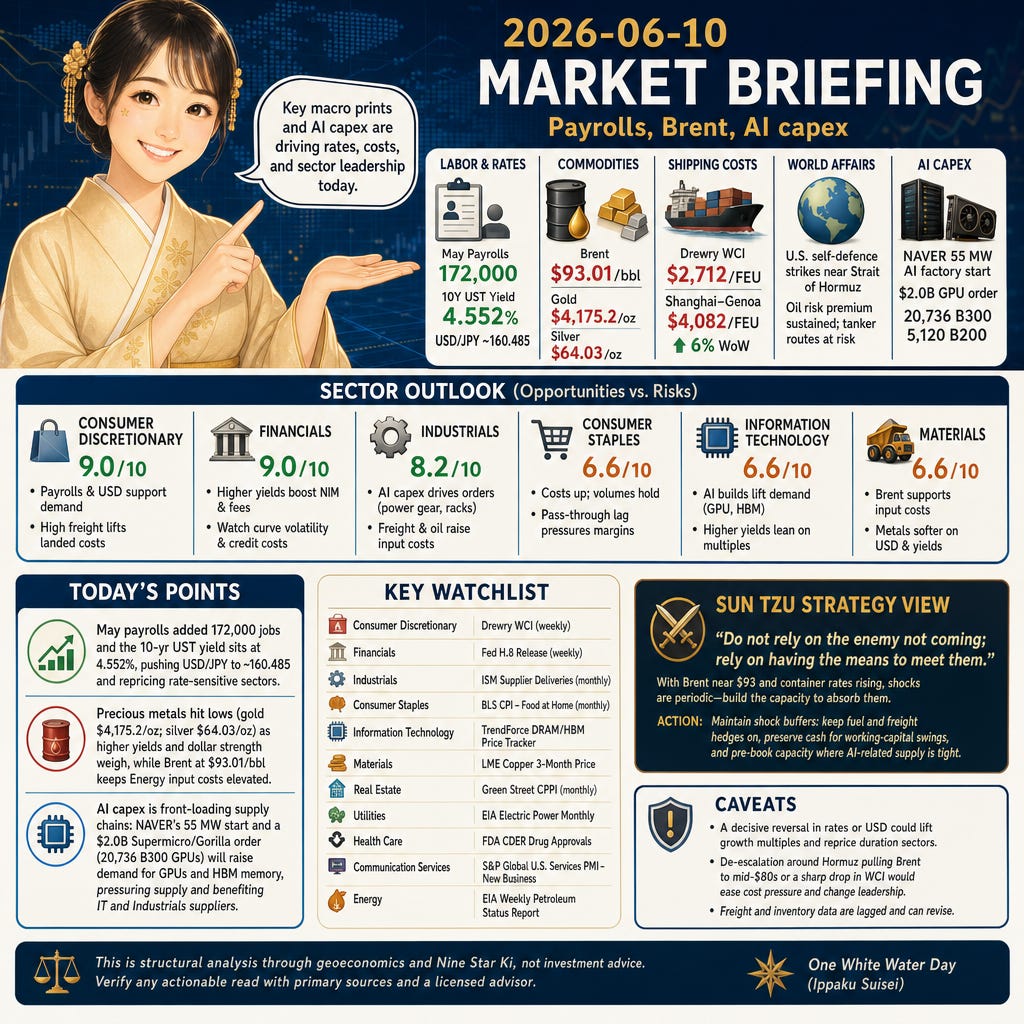
Good morning. The 10-year UST at 4.552% and USD/JPY near 160.485 keep rate and FX channels in charge of sector multiples. Brent at $93.01/bbl and a Drewry WCI of $2,712/FEU lift transport and input costs into peak season. AI capex is front‑loading: a 55 MW build and a $2.0B GPU order tighten chip, memory, and power supply chains.
Stocks and FX
172,000 May payrolls and a 10Y UST yield at 4.552% lifted the dollar, with USD/JPY trading near 160.485 (Reuters via Kitco). The S&P 500 printed 7,406 and the Nasdaq 25,930 in the snapshot, reflecting higher discount rates pressing growth multiples while supporting Financials via net interest margin. The firmer USD also tightens FX translation for multinationals, skewing performance toward domestic earners.
Commodities
Gold fell to $4,175.2/oz and silver to $64.03/oz, extending a four‑day slide as yields and the dollar rose (MarketScreener citing Reuters). WTI at $89.91/bbl and Brent at $93.01/bbl keep freight, packaging, and feedstock costs elevated, raising working‑capital needs for retailers and squeezing chemicals and transport margins.
World Affairs
Almost 20 Iranian targets were struck and two U.S. crew rescued in U.S. self‑defence strikes near the Strait of Hormuz on 2026‑06‑09 (Reuters via MarketScreener). The escalation sustains an oil risk premium (Brent $93.01) and threatens tanker routes, lifting shipping insurance and voyage times. Safe‑haven USD flows reinforce higher yields, pressuring duration assets while supporting bank spread capture.
Supply Chain
The Drewry World Container Index averaged $2,712/FEU with Shanghai–Genoa near $4,082/FEU after a 6% weekly rise as early peak season tightened capacity (Drewry via gCaptain). Higher spot rates and June FAK/PSS filings raise landed costs and stretch lead times, complicating retail inventory timing and industrial backlog conversion. Cape reroutes add voyage‑days and fuel/charter expense.
AI
A 55 MW AI‑factory start at NAVER with a roadmap toward gigawatt scale concentrates demand for GPUs, HBM memory, and data‑center power (NVIDIA press release). Tight HBM supply into 2026 elevates component lead‑time risk for server OEMs. The buildout supports IT hardware and grid equipment, while higher yields still lean on growth‑stock valuations.
Industry News
A $2.0B Gorilla Technology/Super Micro Computer supply deal covers 20,736 NVIDIA B300 and 5,120 B200 GPUs plus networking for Indian deployments (Yahoo Finance). The unit counts signal sustained AI capex and stretch semiconductor and integration pipelines, improving revenue visibility for OEMs while tightening lead times for chips and memory.
Industry Forecast
Today’s Setup
2026‑06‑10 is a One White Water (Ippaku Suisei, 一白水星) day in a One White Water year and a Four Green Wood (Shiroku Mokusei, 四緑木星) month during Boshu (Grain in Ear). Expect flow‑sensitive prints — yields, oil, and container rates — to set the tape: financing costs steer rate‑exposed sectors, fuel and freight shape margins, and AI‑factory capex drives chips, memory, and power procurement.
Focus Sectors
Consumer Discretionary (9.0/10): A 172,000 May payroll gain and USD strength support transaction volumes, while container rates at $2,712/FEU (Shanghai–Genoa ~$4,082) raise landed costs (Reuters; Drewry). The demand–cost split shifts execution toward mix, promotion cadence, and delivery SLAs to defend gross margin. Watch weekly WCI prints and bunker fuel; a Brent break above $95 would pressure transport and last‑mile costs further.
Financials (9.0/10): A 10Y UST at 4.552% and USD/JPY near 160.485 firm net interest margin and fee activity (Reuters). Banks benefit as asset yields and payments throughput reprice, provided funding betas stay contained. Curve volatility and credit costs are the swing factors; monitor the Fed’s H.8 for loan/deposit trends and any abrupt curve shifts that could compress spread capture.
Industrials (8.2/10): Rising freight (WCI $2,712/FEU) and oil (WTI $89.91; Brent $93.01) lift delivery and input costs, but AI capex is tangible: a 55 MW NAVER start and a $2.0B Supermicro/Gorilla order expand orders for power gear, racks, and thermal systems (NVIDIA PR; Yahoo). Backlog conversion hinges on supplier delivery times and predictable logistics. Watch ISM Supplier Deliveries and Middle East shipping updates for margin and timing risk.
Consumer Staples (6.6/10): Container spot rates at $2,712/FEU and elevated oil increase delivered costs and inventory carry (Drewry; MarketScreener). Volumes should hold, but pass‑through to shelf pricing and mix takes time, temporarily compressing gross margin. Track BLS CPI – Food at Home for pricing power; a renewed spike in freight or bunker could extend the recapture lag.
Information Technology (6.6/10): AI builds are front‑loading: NAVER’s 55 MW start toward GW scale and a $2.0B GPU order (20,736 B300; 5,120 B200) confirm tight GPU/HBM and integration pipelines (NVIDIA; Yahoo). That lifts hardware, advanced packaging, and memory, while a 4.552% 10Y UST leans on multiples. Execution is delivery‑schedule dependent; watch TrendForce DRAM/HBM pricing for capacity stress.
Materials (6.6/10): Precious metals slid (gold $4,175/oz; silver $64/oz) on a stronger USD and higher yields, while Brent at $93 sustains feedstock and freight costs (MarketScreener; Reuters). AI‑related builds support specialty chemicals and substrates even as USD strength weighs on metals. Track LME copper for demand momentum; further freight tightening would squeeze bulk shipping and chemicals margins.
Watchlist
Consumer Discretionary: Drewry World Container Index (weekly global container spot rates; a direct proxy for retailers’ landed freight costs).
Financials: Federal Reserve H.8 Release (weekly commercial bank assets and liabilities — loan growth and deposit trends that drive NIM and credit formation).
Industrials: ISM Manufacturing PMI – Supplier Deliveries (Institute for Supply Management; monthly measure of supplier lead times that drive backlog conversion).
Consumer Staples: BLS CPI – Food at Home (Bureau of Labor Statistics; monthly retail food-price inflation that tests staples’ pricing power).
Information Technology: TrendForce DRAM and HBM Price Tracker (TrendForce; contract/spot memory pricing that signals supply–demand tightness in AI memory).
Materials: LME Copper 3-Month Price (London Metal Exchange; a high-frequency proxy for global industrial activity and materials demand).
Real Estate: Green Street Commercial Property Price Index (Green Street; monthly read on U.S. CRE pricing levels and trends).
Utilities: EIA Electric Power Monthly (U.S. Energy Information Administration; utility generation mix, retail sales, and load growth by sector).
Health Care: FDA CDER Drug Approvals (U.S. Food and Drug Administration; monthly approvals and key regulatory actions that move pipelines).
Communication Services: S&P Global U.S. Services PMI – New Business (S&P Global; monthly proxy for advertising demand and services activity momentum).
Energy: EIA Weekly Petroleum Status Report (U.S. Energy Information Administration; weekly crude/product inventories and refinery utilization that steer near-term margins).
Caveats
A decisive reversal in rates or USD — e.g., a softer CPI print or guidance that lowers the 10Y well below recent levels — would re‑price duration sectors and lift growth multiples. A de‑escalation around Hormuz that pulls Brent toward the mid‑$80s or a sharp drop in WCI would ease cost pressure and change sector leadership; weekly freight and inventory data are lagged and can revise.
Sun Tzu Strategy View
Sun Tzu wrote: —— Do not rely on the enemy not coming; rely on having the means to meet them.
With Brent near $93 and container rates rising, shocks to oil flows or shipping lanes are not hypothetical; they are periodic. Build the balance‑sheet and operational capacity to absorb freight, fuel, and lead‑time spikes while rates stay elevated. Use cash, hedges, and alternate routing so macro prints don’t force reactive pivots.
Action: Maintain shock buffers: keep fuel and freight hedges on, preserve cash for working‑capital swings, and pre‑book capacity where AI‑related supply is tight.
Today’s Points
May payrolls added 172,000 jobs and the 10‑yr UST yield sits at 4.552%, pushing USD/JPY to ~160.485 and repricing rate‑sensitive sectors.
Precious metals hit lows (gold $4,175.2/oz; silver $64.03/oz) as higher yields and dollar strength weigh, while Brent at $93.01/bbl keeps Energy input costs elevated.
AI capex is front‑loading supply chains: NAVER’s 55 MW AI factory start and a $2.0B Supermicro/Gorilla order (20,736 B300 GPUs) will raise demand for GPUs and HBM memory, pressuring supply and benefiting IT and Industrials suppliers.
This is structural analysis through geoeconomics and Nine Star Ki, not investment advice. Verify any actionable read with primary sources and a licensed advisor.