Reader support is what makes Oracle Ayano possible. I am building a generative AI system for large-scale data gathering, analytical synthesis, and article verification, so each piece can offer both accuracy and a fresh perspective. Please consider supporting the project: Support Oracle Ayano.
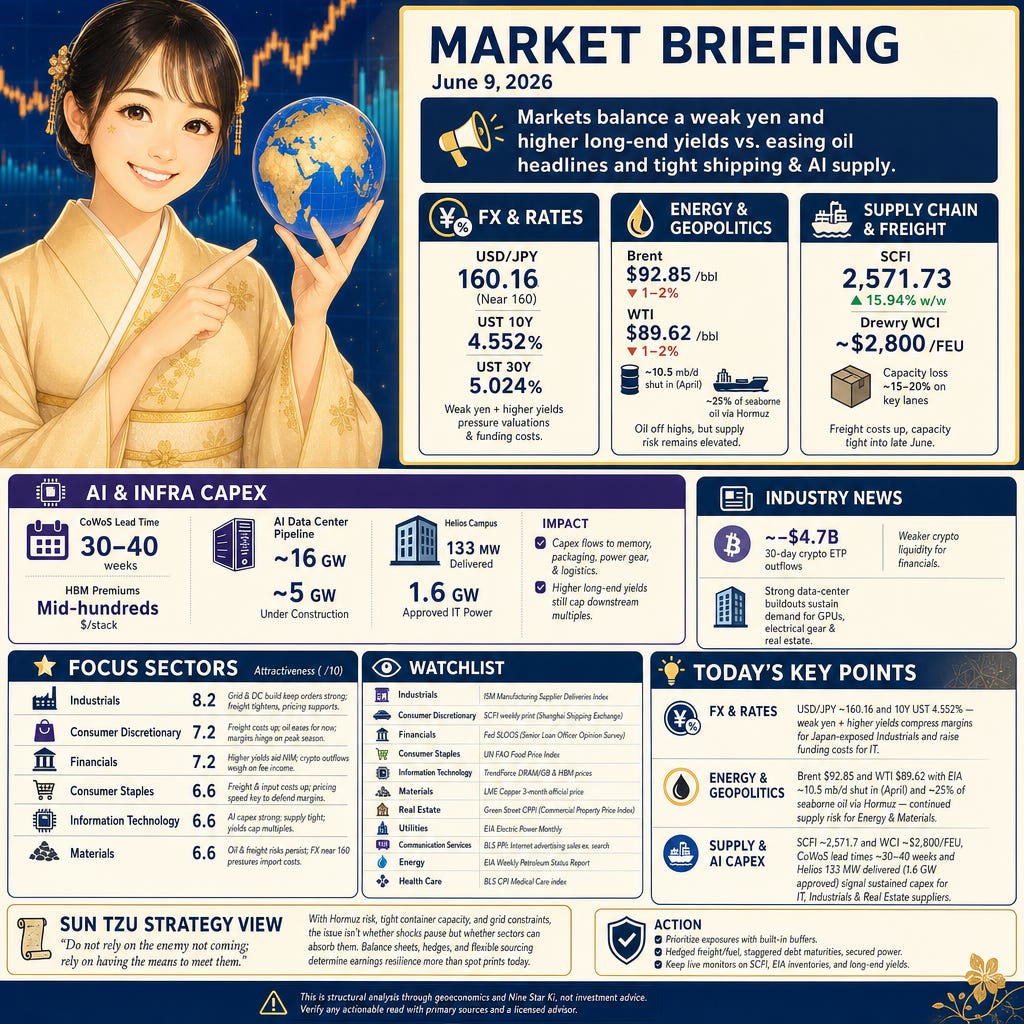
Good morning. Markets are balancing a weak yen and higher long-end yields against easing oil headlines and tightening freight capacity. The through-lines today: USD/JPY near 160 and UST 10Y ~4.55% shaping valuations and funding; Brent/WTI off highs but Hormuz risk persists; SCFI/WCI jumps and AI bottlenecks keep capex flowing to power, memory, and logistics.
Stocks and FX
USD/JPY at 160.16 and U.S. 10-year yields at 4.552% with the 30-year at 5.024 (Reuters via Yahoo Finance) anchor today’s rate and FX narrative. The Nikkei 225 closed 65,417 (+2.17%), reflecting yen-boosted exporters even as higher UST yields pressure duration-heavy equities. A yen near 160 raises import costs for Japan-exposed Industrials and Materials, while a 4.55% 10Y and 5.02% 30Y compress Technology and Real Estate multiples and lift bank NIMs.
Commodities
Brent at $92.85/bbl and WTI at $89.62/bbl, down ~1–2% after Israel–Iran strike pauses (Reuters), ease immediate fuel-cost pressure for transport and consumer goods. The EIA’s estimate of ~10.5 mb/d shut in keeps a geopolitical premium live, so inventory paths can re-tighten quickly. For operators, softer spot prints help near-term margins, but crack spreads and utilization, not flat price alone, will drive Energy and Chemicals cash flows.
World Affairs
10.5 million b/d of crude was shut in during April and roughly 25% of seaborne oil transits the Strait of Hormuz (EIA/IEA). These chokepoints transmit directly into Brent/WTI and refined-product spreads, lifting tail-risk for Energy and Materials and for Industrials with fuel-intensive logistics. Portfolio hedges against sudden freight and fuel spikes remain relevant while ceasefire headlines remain fragile.
Supply Chain
SCFI at 2,571.73 (+15.94% w/w) and Drewry WCI near $2,800/FEU (industry compilations) push landed costs higher into peak season. Effective capacity losses of ~15–20% on key lanes and full bookings into late June tighten sailing options. Retail, electronics, and auto parts face margin compression and longer cash-conversion cycles, while logistics carriers and select capital goods see pricing and volume support.
AI
30–40 week CoWoS lead times and HBM premiums in the mid‑hundreds of dollars per stack (industry reports) keep AI unit economics tight. A roughly 16 GW AI data‑center pipeline with ~5 GW under active construction highlights grid bottlenecks and transformer scarcity. The result: margin and backlog accrue to memory, packaging, power gear, and utilities with credible interconnection paths; higher long-end yields still cap multiples for downstream platforms.
Industry News
133 MW of data hall capacity delivered and 1.6 GW of approved IT power at the Helios campus (Galaxy Digital disclosures) underscore multi‑hundred‑million‑dollar capex for GPUs, electrical gear, and data‑center real estate. Meanwhile, about -$4.7B in 30‑day Bitcoin/Ether spot‑ETP outflows and softer crypto prices weigh on speculative liquidity for crypto‑linked Financials. The split explains strong physical infra demand despite weaker token flows.
Industry Forecast
Today’s Setup
June 9 is a Nine Purple Fire (Kyushi Kasei, 九紫火星) day in a Four Green Wood month and One White Water year during Boshu (Grain in Ear, 2026‑06‑06). Expect attention‑sensitive rotations as shipping prints, long-end yields, and AI capacity headlines set today’s tape: freight and power constraints shape costs and delivery timing, while higher discount rates govern funding and valuation sensitivity.
Focus Sectors
Industrials (8.2/10): 10Y at ~4.55% and 30Y ~5.02 (Reuters) raise hurdle rates, but grid and data‑center build keep orderbooks firm. CoWoS 30–40 week queues and HBM premiums extend precision equipment backlogs; SCFI/WCI jumps tighten logistics yet bolster pricing for select capital goods. Why it matters: longer backlog duration and pricing power support margins despite funding-cost noise. Watch USD/JPY near 160 for component and translation effects; a freight or energy shock could pinch before surcharges reset.
Consumer Discretionary (7.2/10): SCFI 2,571.73 (+15.94% w/w) and WCI ~$2,800/FEU lift FAK/PSS charges, compressing retail and apparel gross margins, while Brent $92.85/WTI $89.62 (Reuters) trim immediate fuel costs. Why it matters: inventory timing and freight contracts will drive month‑to‑quarter results more than demand alone. Risks: sustained spot elevation into peak season forces price hikes or margin giveback; renewed oil upside would hit travel and delivery. Watch markdown cadence and return rates.
Financials (7.2/10): 10Y ~4.55% and 30Y ~5.02 (Reuters) can aid NIM even as securities marks and funding costs stay sensitive. Data‑center financing demand remains large, while roughly -$4.7B in 30‑day crypto ETP outflows softens broker/capital‑markets fees. Why it matters: deposit betas and wholesale reliance will separate earnings trajectories. Risks: curve shifts or wider spreads lifting funding costs, plus MTM pressure if the long end grinds higher.
Consumer Staples (6.6/10): SCFI/WCI gains raise landed costs and stretch cash conversion, while Brent/WTI near $90 keep packaging and logistics inputs elevated. Why it matters: pricing reset speed and private‑label mix steer gross margin under freight pressure. Risks: persistent spot tightness into peak season and commodity upside compounding COGS before pass‑through. FX swings complicate sourcing. Defensive demand helps volumes, but margin management is the lever.
Information Technology (6.6/10): CoWoS lead times of ~30–40 weeks and rich HBM premiums push margin upstream to memory/packaging and power gear suppliers. 10Y/30Y yield levels cap multiples, yet data‑center deliveries (e.g., 133 MW at Helios; 1.6 GW approved) confirm multi‑quarter capex. Why it matters: supply allocation and interconnection timelines dictate revenue recognition. Risks: grid/transformer delays and further memory cost inflation; higher long-end yields compress valuations.
Materials (6.6/10): EIA/IEA’s ~10.5 mb/d shut‑in and ~25% of seaborne oil via Hormuz keep petrochemical feedstocks and fuel sensitive despite Brent easing. SCFI/WCI increases raise delivered costs for bulk and specialty chemicals; USD/JPY near 160 complicates import bills for Japan‑exposed producers. Why it matters: surcharge cadence and contract resets drive margin over the next 1–2 quarters. Risks: prolonged Hormuz disruptions or refinery outages tightening naphtha/distillates.
Watchlist
Industrials: ISM Manufacturing Supplier Deliveries Index (Institute for Supply Management; monthly gauge of supplier delivery speeds — slower readings signal tighter industrial supply chains).
Consumer Discretionary: Shanghai Shipping Exchange’s SCFI weekly print (measures Asia export container spot rates that drive landed costs for retailers and consumer goods).
Financials: Federal Reserve SLOOS (Senior Loan Officer Opinion Survey; quarterly read on lending standards and loan demand that drives credit formation and NIM sustainability).
Consumer Staples: UN FAO Food Price Index (tracks global food commodity prices that feed directly into CPG cost of goods).
Information Technology: TrendForce DRAM/GB and HBM pricing updates (TrendForce; monthly/quarterly contract benchmarks that signal memory cost trends for AI systems).
Materials: LME Copper 3‑month official price (London Metal Exchange; bellwether for industrial demand and supply tightness in base metals).
Real Estate: Green Street Commercial Property Price Index (CPPI; monthly read on private-market U.S. commercial property pricing levels).
Utilities: EIA Electric Power Monthly (tracks utility-scale generation, capacity additions, and fuel mix that signal load growth and capex needs).
Communication Services: BLS Producer Price Index for Internet advertising sales, excluding search (monthly; gauges pricing power for digital ad inventory).
Energy: EIA Weekly Petroleum Status Report (weekly U.S. crude and product inventories plus refinery utilization that steer crack spreads).
Health Care: BLS CPI Medical Care index (monthly; tracks prices for medical services and prescription drugs that influence revenue and payer dynamics).
Caveats
Boshu sits early in the summer solar-term window; attention-driven rotations can flip on a single shipping or yield print. The day’s Fire-led visibility can exaggerate tape moves versus fundamentals, and elevated-yield versus AI-capex signals may conflict intraday, increasing whipsaw risk.
Sun Tzu Strategy View
Sun Tzu wrote: —— Do not rely on the enemy not coming; rely on having the means to meet them.
With Hormuz risk, tight container capacity, and grid constraints, the issue isn’t whether shocks pause but whether sectors can absorb them. Balance sheets, hedges, and flexible sourcing determine earnings resilience more than spot prints today.
Action: Prioritize exposures with built-in buffers — hedged freight/fuel, staggered debt maturities, and secured power — and keep live monitors on SCFI, EIA inventories, and long-end yields.
Today’s Points
FX and rates: USD/JPY ~160.16 and 10Y UST 4.552% — a weak yen plus higher UST yields compress margins for Japan‑exposed Industrials and push funding costs for Information Technology.
Energy & geopolitics: Brent $92.85 and WTI $89.62 with EIA estimating ~10.5 million b/d shut in (April) and IEA noting ~25% of seaborne oil trade transits Hormuz — continued supply risk for Energy and Materials.
Supply & AI capex: SCFI ~2,571.7 and Drewry WCI ~$2,800/FEU, CoWoS lead times ~30–40 weeks and Helios data‑hall deliveries of 133 MW (1.6 GW approved) signal sustained capex for Information Technology, Industrials and Real Estate suppliers.
This is structural analysis through geoeconomics and Nine Star Ki, not investment advice. Verify any actionable read with primary sources and a licensed advisor.